

Why the Heat Pump Defrost Cycle Explained for Minnesota Homeowners Is Something Every Twin Cities Resident Needs to Understand
If you’ve ever looked outside on a cold January morning and seen your heat pump defrost cycle explained for Minnesota homeowners in real time — steam rising off the outdoor unit, the fan stopped, the system making a strange whooshing sound — you might have panicked and reached for the phone. You’re not alone. Every winter, Twin Cities homeowners mistake this completely normal process for a breakdown.
Here’s the short answer:
- What it is: A built-in process where your heat pump briefly reverses operation to melt frost off the outdoor coil
- Why it happens: Minnesota’s cold, humid air causes ice to build up on the outdoor coil, blocking heat absorption
- How long it lasts: Typically 5 to 15 minutes
- How often: Every 30 to 90 minutes during sustained cold weather, when frost is actually detected
- Is it normal? Yes — steam, a stopped fan, and briefly cooler indoor air are all expected
Minnesota’s Zone 6 climate is one of the harshest environments a heat pump can operate in. Temperatures regularly drop below freezing for months at a time, and the humidity levels that come with weather patterns in the 30°F to 40°F range create near-perfect conditions for frost to form on your outdoor coil. When that happens, your system needs to clear that ice to keep working efficiently — and that’s exactly what the defrost cycle does.
The good news? Modern cold-climate heat pumps are built for this. Understanding what’s happening inside your system — and knowing the difference between normal defrost behavior and a real problem — can save you unnecessary stress and potentially costly service calls.
The Necessity of Defrosting in Minnesota’s Zone 6 Climate
Living in the Twin Cities, from Edina to St. Paul, we are well-acquainted with “Zone 6” winter conditions. But why does a heat pump need to “defrost” when it’s 20 degrees outside? It seems counterintuitive, but it all comes down to basic physics and heat extraction.
In heating mode, your heat pump’s outdoor coil acts as an evaporator. It absorbs heat from the outdoor air—yes, even when it’s freezing, there is thermal energy available. However, for the coil to absorb heat, its surface temperature must be significantly colder than the surrounding air. If it’s 35°F outside, your coil might be at 20°F. When that cold metal meets the humidity in our Minnesota air, frost begins to form, much like it does on your car’s windshield.
This frost is more than just a cosmetic issue. Ice acts as an insulator. If a thick layer of frost covers the outdoor coil, it prevents the refrigerant inside from “grabbing” heat from the air. This causes your system to work harder, consume more electricity, and eventually lose its ability to heat your home. Without a defrost cycle, your heat pump would eventually become a solid block of ice.
Understanding these Heat Pump Basics And Benefits Explained helps you realize that defrosting isn’t a flaw; it’s a vital maintenance function that allows your system to survive a Minnesota winter.
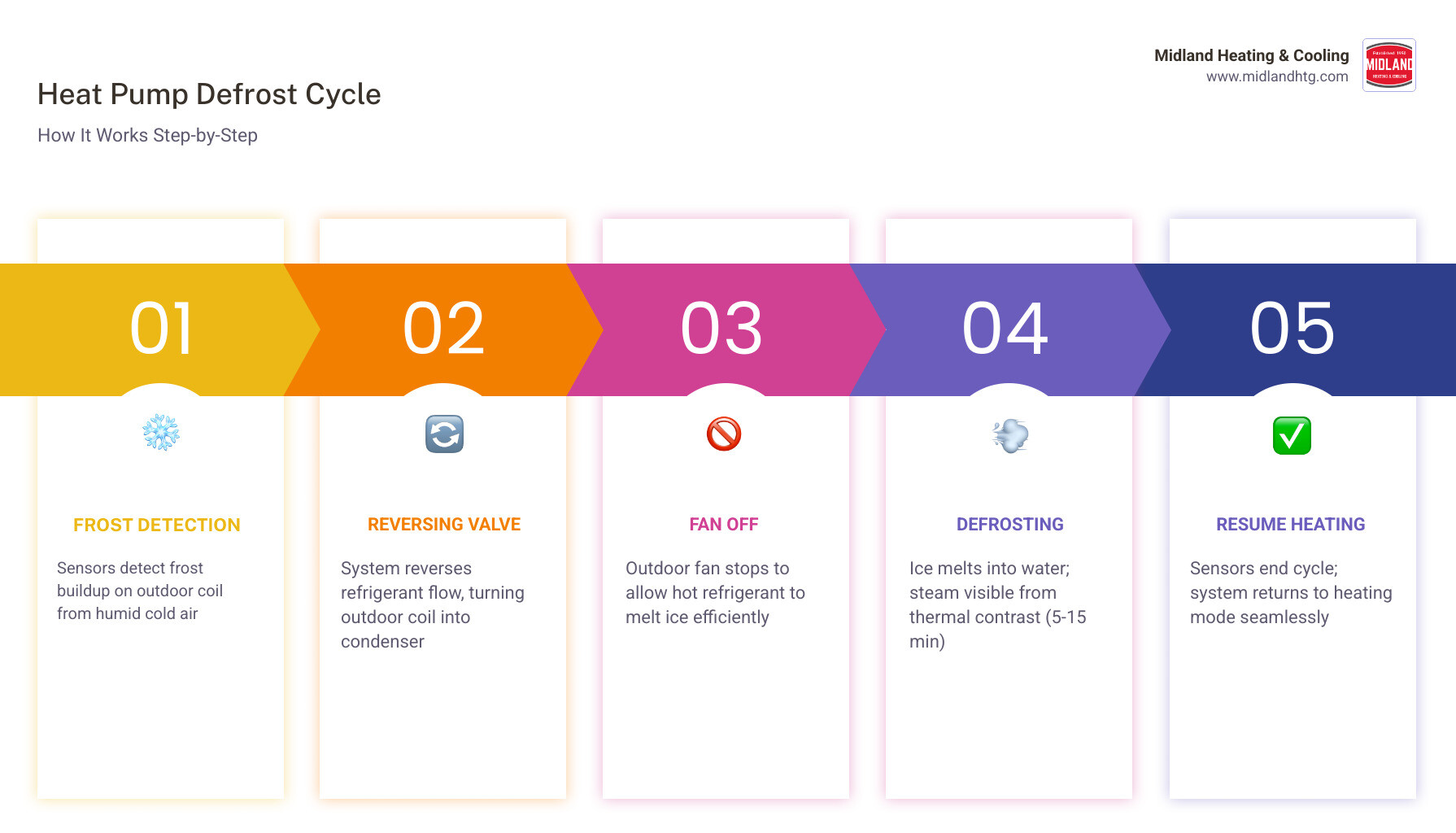
How the Heat Pump Defrost Cycle Works Step-by-Step
When your heat pump decides it’s time to “shake off the ice,” it goes through a very specific sequence of events. It’s a bit like the system is taking a quick “cooling break” to ensure it can keep heating you later.
- Detection: Most modern systems use “demand defrost.” Sensors monitor the temperature of the outdoor coil and the outdoor air. When the temperature difference indicates that ice is restricting airflow, the control board triggers the cycle.
- The Shift: The reversing valve—the heart of your heat pump—switches the flow of refrigerant. This essentially turns your system into an air conditioner for a few minutes. Instead of sending heat inside, it sends warm refrigerant to the outdoor coil.
- The “Whoosh”: You might hear a loud hissing or “whooshing” sound when this happens. This is simply the pressure equalizing as the reversing valve moves.
- Fan Shutdown: To melt the ice as quickly as possible, the outdoor fan motor stops. This allows the outdoor coil to get very hot (often reaching 100°F to 140°F) without the cold Minnesota wind blowing that heat away.
- Auxiliary Heat Activation: Since the heat pump is technically in “cooling mode” during this time, it would normally blow cold air into your living room. To prevent this, your system automatically turns on its electric heat strips (auxiliary heat) to “temper” the air so you stay comfortable.
- Termination: Once the sensors detect the coil has reached a safe temperature (usually around 57°F) or a maximum time limit is reached (usually 10-15 minutes), the system switches back to heating mode.
Knowing the Process Heat Pump Installation steps helps you appreciate how these components, like the reversing valve, are calibrated specifically for our local weather.
Normal Signs vs. Warning Signals: Heat Pump Defrost Cycle Explained for Minnesota Homeowners
Because the defrost cycle is so dramatic, it’s easy to think something is wrong. Let’s break down what you should see and hear versus what warrants a call to us at Midland Heating & Cooling.
What is Normal:
- Visible Steam: As the ice melts off the hot outdoor coil, it turns into water vapor. In cold air, this looks like a cloud of steam. Many homeowners in Minneapolis or Minnetonka have called the fire department thinking their unit is “smoking,” but if it’s white and odorless, it’s just steam!
- Strange Noises: Clicking, hissing, and the sudden silence of the outdoor fan are all part of the script.
- Duration: A typical cycle in the Twin Cities lasts between 5 and 15 minutes.
- Frequency: If it’s very humid and hovering around 32°F, your system might defrost every 30 to 90 minutes.
Warning Signals (When to Call a Pro):
- The “Ice Block” Look: If your unit is completely encased in a thick, solid block of ice that doesn’t go away after a defrost cycle, something is wrong.
- Long Cycles: If the system stays in defrost mode for more than 15 or 20 minutes consistently, the sensors or reversing valve may be failing.
- No Heat: If the system goes into defrost and never returns to heating mode.
- Loud Grinding: While hissing is normal, metal-on-metal grinding sounds are not.
If you notice these red flags, you might be dealing with Common Heat Pump Operating Problems that require a technician’s touch.
Understanding the heat pump defrost cycle explained for Minnesota homeowners during extreme cold
You might wonder if heat pumps can even handle the “Polar Vortex” days we get in St. Louis Park or Bloomington. The answer is yes, provided you have a cold-climate model.
Modern cold-climate heat pumps are engineered with inverter compressors that can ramp up their speed to maintain 70% to 80% of their heating capacity even when it’s -13°F outside. These advanced systems also use demand-defrost technology, which is a game-changer for Minnesota. Older systems used a timer (defrosting every 60 minutes regardless of ice). Demand-defrost only runs when it needs to, which can improve efficiency by up to 35% in our humid, freezing winters.
Why the heat pump defrost cycle explained for Minnesota homeowners matters for energy efficiency
The efficiency of a heat pump is measured by its Coefficient of Performance (COP). A COP of 3.0 means for every $1 of electricity you put in, you get $3 of heat out. However, ice is the enemy of the COP.
When frost builds up, the COP drops because the system has to work harder to pull heat through that layer of ice. By running a timely defrost cycle, the system restores its ability to transfer heat efficiently. While the defrost cycle itself uses a small amount of electricity (about 0.3 to 0.5 kWh per cycle), it saves much more energy in the long run by keeping the coils clean and the airflow unrestricted.
Troubleshooting Why Your System is Defrosting Too Frequently
Is your heat pump “taking a breather” every 20 minutes? While frequent defrosting is normal in a damp 35°F fog, it shouldn’t happen constantly in dry, sub-zero cold. If it does, here are the usual suspects:
- Low Refrigerant: If your system has a leak, the coil will get much colder than it’s supposed to, triggering premature frost.
- Faulty Sensors: If the temperature sensor is out of calibration, it might tell the board there is ice when there isn’t.
- Outdoor Fan Failure: If the fan isn’t moving air, the coil will freeze up almost instantly.
- Dirty Coils: If the outdoor unit is clogged with dirt or autumn leaves from your yard in Eden Prairie, it restricts airflow and encourages ice formation.
- Stuck Reversing Valve: If the valve doesn’t fully shift, the defrost cycle won’t be effective.
Often, these issues stem from Common Heat Pump Installation Mistakes or a lack of regular maintenance.
Preventative Maintenance for Cold-Climate Heat Pumps
We’ve been serving the Twin Cities for over 70 years, and if there’s one thing we’ve learned, it’s that a little winter prep goes a long way. To keep your heat pump defrost cycle explained for Minnesota homeowners working perfectly, follow these tips:
- Keep it Clear: After a heavy Bloomington snowstorm, check your outdoor unit. Ensure there is at least a 2-foot perimeter cleared of snow. High drifts can block airflow and cause the unit to “recycle” its own cold air, leading to massive ice buildup.
- Elevate the Unit: In Minnesota, heat pumps should be installed on a stand (often called “snow legs”) to keep them 12 to 24 inches above the ground. This prevents the unit from being buried and allows meltwater to drain away during the defrost cycle.
- Watch the Gutters: Make sure your roof gutters aren’t leaking directly onto the heat pump. A constant drip of water in 20-degree weather will create an ice cap that no defrost cycle can melt.
- Change Your Filters: Indoor airflow is just as important. A clogged air filter can cause the system to struggle, which sometimes messes with the pressure readings the defrost board relies on.
- Schedule a Tune-Up: We recommend two tune-ups per year—one before the cooling season and one before the heating season. We check the refrigerant charge, clean the coils, and test the defrost logic to make sure you won’t be left in the cold.
Proper Heat Pump Installation is the foundation of a system that can handle a Minnesota winter without constant issues.
Frequently Asked Questions about Heat Pump Defrosting
Is it normal for my heat pump to look like it is smoking?
Yes! As we mentioned, that “smoke” is actually steam. When the outdoor coil heats up to melt the ice, the water turns into vapor. Because it’s cold outside, that vapor becomes visible. It’s a sign that your system is doing exactly what it was designed to do. If there is no acrid smell and the “smoke” is white, don’t worry.
How long is too long for a defrost cycle to last?
In our local climate, anything over 15 minutes is a red flag. Most systems have a “timeout” feature that will force the unit back into heating mode after 10 or 15 minutes to prevent the house from getting too cold. If your unit is staying in defrost mode for 30 minutes or more, or if it’s doing it every hour when there’s no visible frost, it’s time to call us for a technical inspection.
Why does my home feel drafty when the unit is defrosting?
This usually happens if your auxiliary heat (the backup electric strips) isn’t kicking in fast enough or isn’t sized correctly. During defrost, the heat pump is technically “cooling” your home. The backup heat is supposed to turn on to “temper” that air. If you feel a distinct cold draft for 10 minutes, your auxiliary heat might need a check-up to ensure it’s engaging properly.
Conclusion
The heat pump defrost cycle explained for Minnesota homeowners doesn’t have to be a mystery. It is a vital, automated safeguard that allows your system to provide efficient, green heating even in the depths of a Twin Cities winter. By knowing what’s normal—like steam, whooshing sounds, and brief fan pauses—you can rest easy knowing your home is in good hands.
At Midland Heating & Cooling, we’ve spent seven decades helping our neighbors in Minneapolis, Edina, and across the metro area stay comfortable. Our family-owned business is built on trust, 100% customer satisfaction, and a deep understanding of how HVAC systems perform in the unique Minnesota climate.
Whether you’re looking for a new Heat Pump Installation or you need a certified technician to troubleshoot a stubborn icing issue, we are here to help. Don’t let a little winter frost get you down—give us a call today and let us ensure your heat pump is ready for whatever the Minnesota sky throws at it!