

How a Heat Pump Works for Heating and Cooling (Quick Answer)
How does a heat pump work for heating and cooling is simpler than most people expect. Instead of burning fuel to create heat, a heat pump moves existing heat from one place to another using electricity and a refrigerant cycle.
Here’s the short version:
- In summer: The heat pump pulls heat from inside your home and releases it outdoors, cooling your living space.
- In winter: It runs in reverse, extracting heat from the outdoor air (yes, even cold air contains heat energy) and transferring it inside to warm your home.
- The result: One system handles both heating and cooling, using 2 to 3 times less energy than a traditional furnace or boiler.
That last point matters a lot if you’re a Twin Cities homeowner staring down a Minnesota winter with an aging furnace. A heat pump doesn’t generate warmth through combustion — it collects and amplifies heat that already exists in the air around your home. With a coefficient of performance (COP) of around 4, a heat pump can deliver 4 units of heat energy for every 1 unit of electricity it consumes. That’s the kind of efficiency a gas furnace simply can’t match.
Think of it like a refrigerator — but one that can run in both directions. Your fridge pulls heat out of the food compartment and dumps it into your kitchen. A heat pump does the same thing, except it can flip the process entirely depending on the season.
Understanding the Basics of Heat Transfer
To understand how does a heat pump work for heating and cooling, we first have to look at the physics of thermal energy. Heat isn’t something that just disappears; it’s always present in the air, the ground, or water, even when it feels cold to us. In thermodynamics, “cold” is just the absence of heat. As long as the temperature is above absolute zero (which is roughly -459°F), there is thermal energy available to be harvested.
Most traditional heating systems are “heat generators.” A gas furnace burns fuel to create a flame, and an electric baseboard uses resistance to turn electricity into warmth. Heat pumps are different; they are “heat movers.” Instead of creating heat from scratch, they use a small amount of electricity to pump existing ambient heat from a “source” to a “sink.”
According to the second law of thermodynamics, heat naturally flows from a warmer area to a cooler one. A heat pump uses mechanical work to reverse this natural flow. By manipulating the pressure of a special fluid called refrigerant, we can make that fluid colder than the outdoor air to soak up heat, or hotter than the indoor air to release it. This process is incredibly efficient because moving heat takes much less energy than creating it. For more on the fundamentals, check out our guide on Heat Pump Basics And Benefits Explained.
How Does a Heat Pump Work for Heating and Cooling?
The “magic” component that allows one machine to do two jobs is the reversing valve. In a standard air conditioner, the refrigerant only flows in one direction. In a heat pump, the reversing valve acts like a traffic cop, redirecting the flow of refrigerant to switch the system between heating and cooling modes.
When you switch your thermostat from “Cool” to “Heat,” this valve slides into a new position. This changes which coil acts as the evaporator (absorbing heat) and which acts as the condenser (releasing heat). This dual-functionality provides year-round comfort without needing two separate, bulky systems taking up space in your St. Louis Park or Edina home.
The science of how does a heat pump work for heating and cooling efficiently
The efficiency of this system comes down to the vapor-compression cycle. By forcing the refrigerant through various stages of pressure, we trigger a “phase change”—switching the substance between a liquid and a gas.
When a liquid evaporates into a gas, it absorbs a massive amount of thermal energy. When that gas condenses back into a liquid, it releases that energy. By controlling where these phase changes happen, we can amplify the heat we find outdoors and bring it inside. While most people in Minneapolis use air-source heat pumps, there are three main types of heat sources:
- Air-source: Extracts heat from the outdoor air.
- Ground-source (Geothermal): Extracts heat from the steady temperatures underground.
- Water-source: Uses a nearby body of water as a thermal reservoir.
The Four Stages of the Refrigerant Cycle
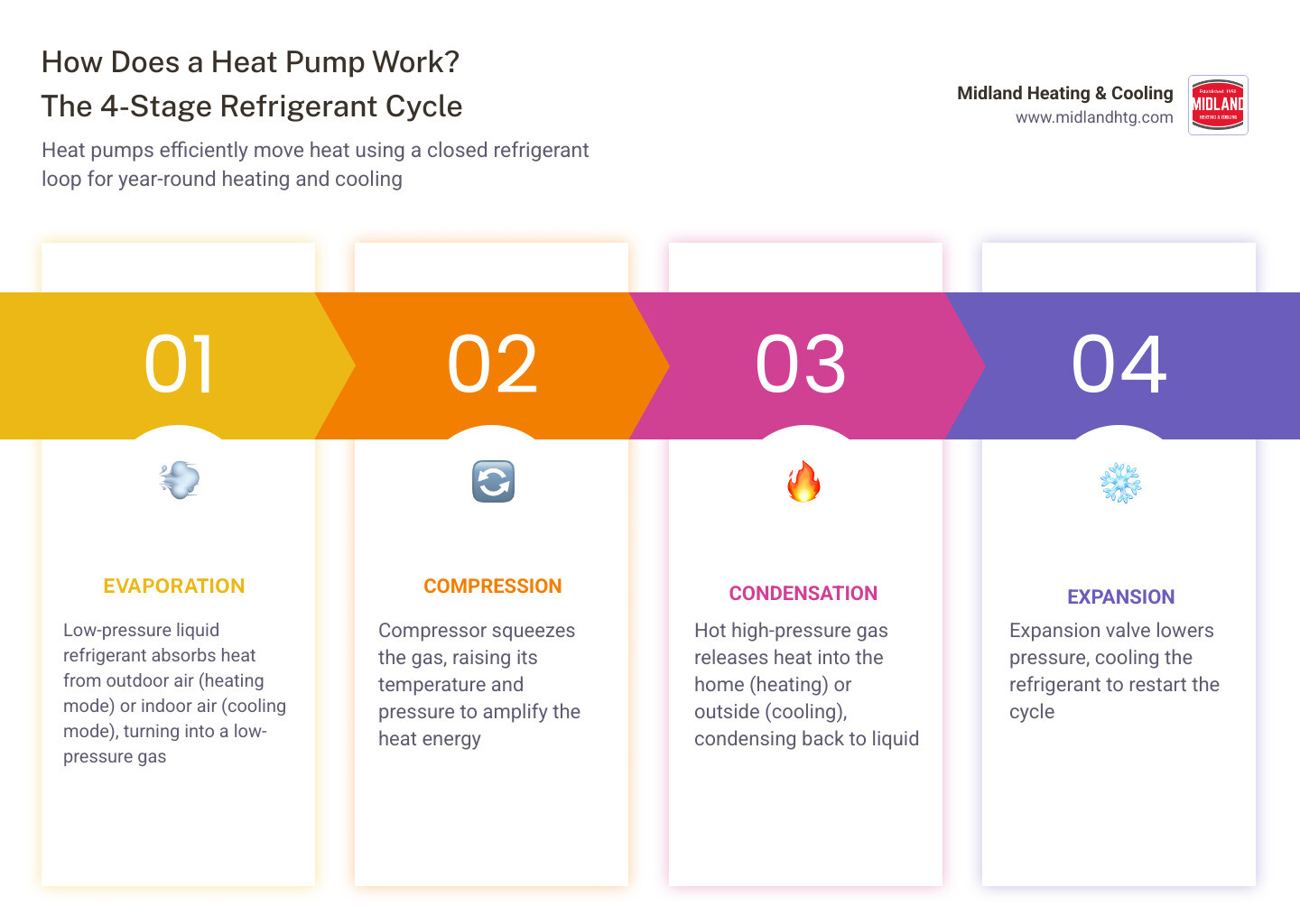
To get a clear picture of how does a heat pump work for heating and cooling, we need to follow the refrigerant through its four-stage journey. This cycle repeats indefinitely to maintain your desired temperature.
- Evaporation: The cold, liquid refrigerant enters the evaporator coil. Because it is colder than the surrounding medium (air or ground), it soaks up heat and evaporates into a low-pressure gas.
- Compression: This gas travels to the compressor. By squeezing the gas into a smaller volume, the compressor spikes the pressure and the temperature, turning it into a hot, high-pressure vapor.
- Condensation: The hot gas enters the condenser coil. As indoor air (in winter) or outdoor air (in summer) passes over the coil, the refrigerant releases its heat and condenses back into a liquid.
- Expansion: The high-pressure liquid passes through an expansion valve. This drops the pressure and temperature rapidly, prepping the refrigerant to head back to the evaporator and start over.
| Feature | Heating Mode | Cooling Mode |
|---|---|---|
| Indoor Coil Role | Condenser (Releases Heat) | Evaporator (Absorbs Heat) |
| Outdoor Coil Role | Evaporator (Absorbs Heat) | Condenser (Releases Heat) |
| Refrigerant State Indoors | Hot Liquid/Gas | Cold Gas |
| Main Goal | Warm the house | Remove heat and humidity |
Step-by-step: How does a heat pump work for heating and cooling your home
In the summer, the process is identical to your refrigerator or a standard AC. The indoor coil absorbs heat from your living room, and the compressor pumps that heat to the outdoor coil, where a fan blows it away into the Minneapolis sky. An added bonus? As the indoor coil absorbs heat, it also pulls moisture out of the air, providing excellent dehumidification for those sticky July afternoons in Bloomington.
In the winter, the reversing valve flips the script. The outdoor coil becomes the evaporator, finding heat in the freezing air, while the indoor coil becomes the condenser, radiating that warmth into your home.
Performance in Cold Climates: Can It Handle a Twin Cities Winter?
A common question we hear in Minnetonka and Hopkins is: “Can a heat pump actually work when it’s ten below zero?” In the past, the answer was “not very well.” However, it is now May 2026, and modern technology has changed the game.
Modern cold-climate heat pumps are equipped with variable-speed compressors (often called inverter technology). Unlike older models that were either “on” or “off,” variable-speed units can ramp up or down to match the heating load precisely. Many of these high-performance models can maintain 100% of their heating capacity down to 5°F and continue to extract heat efficiently even at -13°F or -22°F.
For those truly brutal Minnesota nights, we often recommend a “dual-fuel” or hybrid system. This pairs your high-efficiency heat pump with a gas furnace. The heat pump handles the heating for about 85-90% of the year, and the furnace only kicks in as “auxiliary heat” when temperatures drop into the extreme negatives. This setup ensures you are never left in the cold while maximizing your energy savings. If you’re curious about the technicalities of setup, you might want to look at Factors To Consider Heat Pump Installation or learn about Common Heat Pump Operating Problems.
How does a heat pump work for heating and cooling during a Minnesota winter?
In the Twin Cities, our heat pumps have to be tough. During the winter, the outdoor unit may develop a layer of frost on the coils. This is a normal part of operation. The system will occasionally enter a “defrost cycle,” where it briefly reverses into cooling mode to melt the ice off the outdoor coil. Because we’ve been serving this area for over 70 years, we know exactly how to calibrate these systems for our specific climate. Whether you need a Heat Pump Installation in Hopkins or Heat Pump Installation in Bloomington, we ensure the system is sized correctly to prevent common issues.
Frequently Asked Questions
When homeowners start researching how does a heat pump work for heating and cooling, they often run into a few common misconceptions. Avoiding Common Heat Pump Installation Mistakes starts with getting the right information.
Does a heat pump bring in fresh air from outside?
No. This is a very common myth. A heat pump does not “pump air” from the outside into your house. It is a sealed, closed-loop system. The only thing moving between your indoor and outdoor units is the refrigerant through copper lines. The system recirculates the air already inside your home, passing it over the indoor coils to either add or remove thermal energy.
What is the Coefficient of Performance (COP)?
The COP is a way to measure efficiency. If a heater has a COP of 1, it means for every 1 kilowatt of electricity you put in, you get 1 kilowatt of heat out. Standard electric space heaters have a COP of 1. A typical modern heat pump has a COP of around 3 to 4.
This means the system is 300% to 400% efficient! This is possible because roughly 80% of the energy delivered to your home comes from renewable sources (the air or ground), and only about 20% comes from the electricity used to drive the compressor.
How long does a typical heat pump system last?
With proper maintenance, a high-quality air-source heat pump typically lasts 10 to 15 years. Ground-source systems can last even longer, with the indoor components lasting 20+ years and the underground loops lasting up to 50 years. Regular tune-ups are the best way to protect your investment and ensure the system remains durable through our intense seasonal shifts.
Conclusion
At Midland Heating & Cooling, we’ve seen HVAC technology evolve significantly over our 70+ years in the Twin Cities. Today, understanding how does a heat pump work for heating and cooling is the first step toward a more comfortable, sustainable, and cost-effective home. By moving heat instead of burning fuel, you can drastically reduce your carbon footprint and enjoy more consistent temperatures in every room.
Whether you are in St. Paul, Wayzata, or Excelsior, our family-owned team is here to help you navigate the transition to modern comfort. From the initial Process Heat Pump Installation to long-term maintenance, we bring local expertise to every job. Ready to see if Heat Pumps are the right fit for your home? Give us a call today and let’s get your home moving better than a Monday morning.