

Is Your Heat Pump Trying to Tell You Something?
Knowing the signs your heat pump needs repair could save you from a full system breakdown — especially during a brutal Twin Cities winter. Heat pumps work hard year-round, handling both heating and cooling, and even small problems can quietly grow into expensive failures if left unchecked.
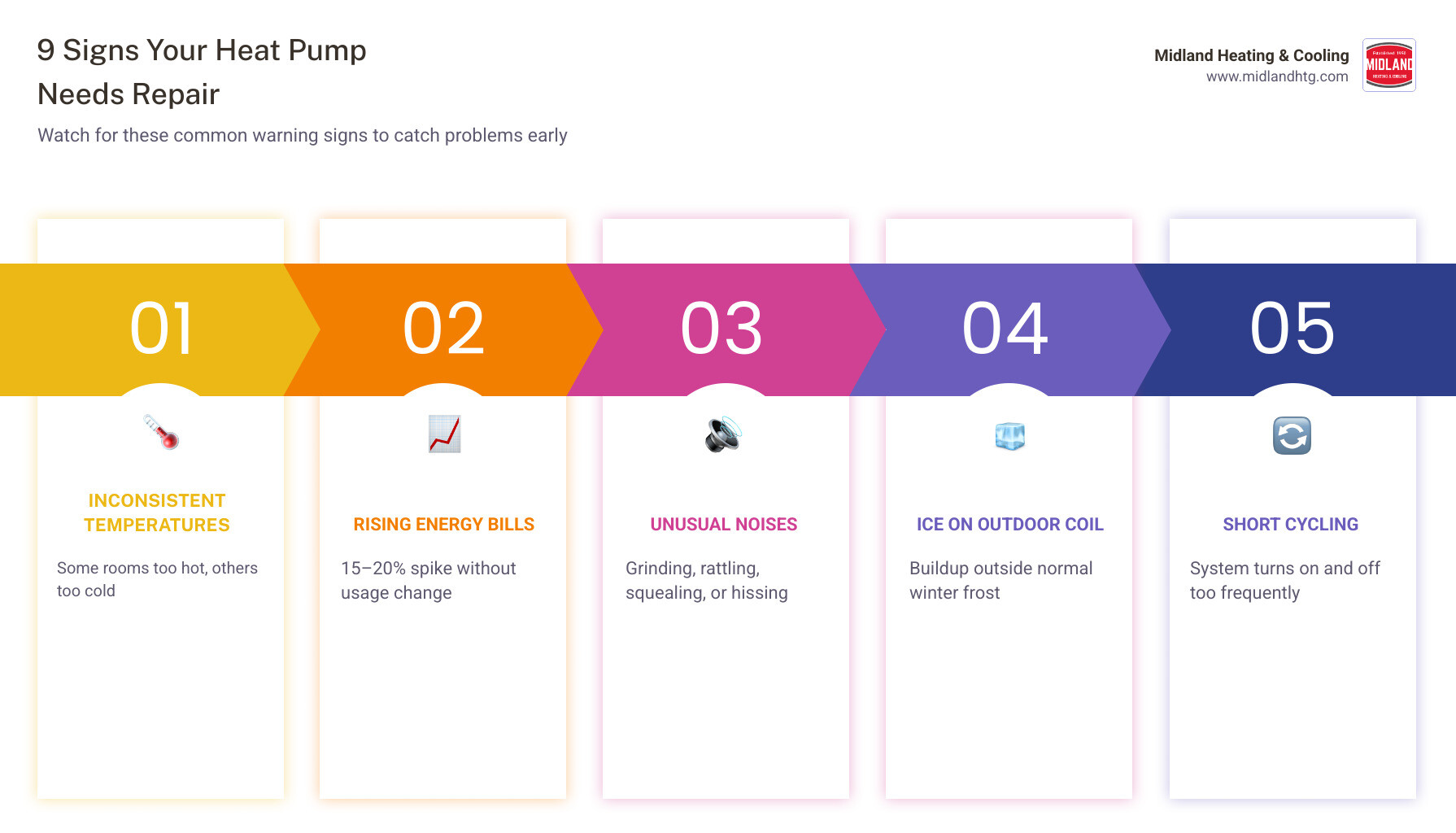
Here are the most common warning signs to watch for:
- Inconsistent temperatures — some rooms too hot, others too cold
- Rising energy bills — a 15–20% spike without a change in usage or weather
- Unusual noises — grinding, rattling, squealing, or hissing from the unit
- Ice buildup on the outdoor coil — especially outside of normal winter frost
- Short cycling — the system turns on and off too frequently
- Weak or reduced airflow — from vents throughout the home
- Strange odors — burning smells, musty odors, or chemical scents
- System won’t turn on — or struggles to reach the set temperature
- Excessive humidity — or water pooling near the indoor unit
Most of these signs point to something fixable — but only if you catch them early. The longer a struggling heat pump runs, the more strain it puts on critical components like the compressor, blower motor, and capacitor.
Introduction
In the Twin Cities, our HVAC systems don’t get much of a vacation. Whether we are facing a humid July afternoon in Minneapolis or a sub-zero January morning in St. Paul, we rely on heat pumps for total climate control. Unlike a traditional furnace that creates heat by burning fuel, a heat pump uses heat transfer efficiency to move warmth into your home during the winter and pull it out during the summer.
Because these systems are high-tech and contain many moving parts, they require a delicate balance of refrigerant levels, electrical integrity, and airflow. When that balance is disrupted, your comfort—and your wallet—take a hit. At Midland Heating & Cooling, we’ve spent over 70 years helping neighbors from Edina to Minnetonka navigate these mechanical hiccups. Understanding how your system works and recognizing early symptoms is the best way to ensure your home remains a sanctuary regardless of the Minnesota weather.
Common signs your heat pump needs repair

One of the first things you might notice is that your home just doesn’t feel “right.” Maybe you find yourself constantly nudging the thermostat up or down, or perhaps you’ve started wearing a sweater in the living room while the kitchen feels like a sauna. These Common Heat Pump Operating Problems are often the “check engine light” of your HVAC system.
Inconsistent temperatures are a major red flag. If your heat pump is struggling to maintain a steady climate, it could be a sign of a failing compressor or a refrigerant leak. Another frustrating symptom is short cycling—this is when the system starts up, runs for a few minutes, and then shuts down prematurely, only to start again moments later. This constant “on-off” dance puts massive strain on the motor and uses significantly more electricity than a steady run.
We also see many cases of reduced airflow. If you put your hand up to a vent and feel only a faint whisper of air, your blower motor might be failing, or your ductwork could be compromised. Furthermore, keep an eye on your indoor humidity. A healthy heat pump acts as a dehumidifier during the summer; if your home feels sticky or clammy, the system isn’t doing its job. Finally, consider the age of the unit. Most heat pumps have a lifespan of 10 to 15 years. If yours is pushing its tenth birthday in May 2026, these symptoms are more likely to indicate a need for professional intervention.
Why is my heat pump producing inconsistent heating or cooling?
When your home develops “hot and cold spots,” it’s usually not a ghost—it’s a mechanical failure. To understand why this happens, it helps to review Heat Pump Basics and Benefits Explained. These systems rely on a reversing valve to switch between heating and cooling modes. If this valve gets stuck or fails, the system might blow lukewarm air when you need it to be hot, or vice versa.
Thermostat calibration is another common culprit. If the “brain” of your system isn’t reading the room temperature correctly, it won’t tell the heat pump to run long enough. In larger homes in areas like Wayzata or Eden Prairie, zoned system malfunctions can also cause one floor to be freezing while another is overheating. Lastly, don’t overlook leaky ductwork. You could have the most efficient heat pump in Minnesota, but if the heated air is escaping into your attic through a gap in the ducts, it will never reach your bedroom.
Identifying signs your heat pump needs repair through rising energy bills
Your monthly utility bill is often the most honest diagnostic tool you have. In our experience, a 15-20% spike in energy costs without a corresponding change in the weather or your daily habits is a clear indicator of a system in distress.
Why does this happen? When a component like a capacitor begins to fail or the coils become clogged with dirt, the system has to work twice as hard to achieve the same results. This mechanical friction and lack of efficiency lead to longer run times. If your system is running for 45 minutes to do a job it used to finish in 20, your electric meter is spinning much faster than it should. We often find that Heat Pumps that haven’t been serviced recently are the primary cause of these “bill shocks.”
Unusual noises and odors that require immediate attention
Your heat pump should generally operate with a steady, low-level hum. If it starts sounding like a bag of marbles in a dryer, it’s time to pay attention. Unusual noises are rarely “nothing.”
- Grinding sounds: Often indicate that the bearings in the blower motor are worn out.
- Squealing: Usually points to a belt that is slipping or a motor that is under high stress.
- Rattling: Can be as simple as a loose panel or as serious as a failing compressor mounting.
- Hissing: This is a classic sign of a refrigerant leak, which is a high-severity issue.
Odors are just as telling. A burning electrical smell is a sign that wires are overheating or a motor is burning out—turn the system off immediately if you smell this! Musty, “dirty sock” smells usually indicate mold or mildew growth on the evaporator coils, which can impact your family’s respiratory health.
What do strange noises from a heat pump mean?
Strange noises are often the result of mechanical parts reaching their breaking point. For instance, clanging or banging usually means a component has actually come loose and is hitting the fan blades or the housing. This is why Factors to Consider Heat Pump Installation are so important; a system that wasn’t leveled properly during install can develop vibrations that lead to these noises over time.
Debris is another factor. In the Twin Cities, we have plenty of cottonwood seeds, leaves, and twigs that can get sucked into the outdoor unit. If a twig gets caught in the fan, it can create a persistent clicking or flapping sound. While it might seem minor, that debris can eventually burn out the fan motor if it’s not cleared by a professional.
Critical signs your heat pump needs repair: Ice on the outdoor coil
It might seem counterintuitive, but seeing ice on your heat pump in the middle of a St. Louis Park summer is a major emergency. This usually indicates restricted airflow (often from a very dirty filter) or low refrigerant levels. When the refrigerant is low, the coil temperature drops below freezing, causing moisture in the air to turn into ice.
In the winter, a light coating of frost is normal, and your system’s defrost cycle should kick in periodically to melt it away. However, if the unit is completely encased in a block of ice, your defrost control board or sensors have likely failed. This is one of those Common Heat Pump Installation Mistakes or maintenance oversights that can lead to a destroyed compressor if the ice isn’t dealt with correctly. Never try to hack the ice off with a shovel or ice pick, as you will likely puncture the delicate refrigerant lines.
When to repair vs. replace your aging system
Deciding whether to keep fixing an old unit or invest in a new one is a common dilemma for homeowners in Bloomington and Hopkins. We generally recommend the “50% Rule”: if the cost of the repair is more than half the value of a new system, and the unit is over 10 years old, replacement is usually the smarter financial move.
| Feature | Repairing Your System | Replacing with New Unit |
|---|---|---|
| Upfront Cost | Lower (Short-term) | Higher (Investment) |
| Monthly Bills | Stays the same or increases | Decreases (up to 20% savings) |
| Warranty | Usually 30-90 days on part | 10+ years manufacturer warranty |
| Reliability | Potential for future breakdowns | Peace of mind and high reliability |
| Technology | Older, less efficient | ENERGY STAR, smart features |
As of May 2026, new heat pump technology is more efficient than ever. If you find yourself calling us for Heat Pump Installation in Hopkins, MN, you’ll likely see a significant drop in your energy bills thanks to modern SEER2 ratings.
Determining the severity of heat pump malfunctions
Not all repairs are created equal. A failed capacitor is a relatively simple fix that we can handle quickly. However, a “dead” compressor is a much more serious issue. The compressor is the heart of your heat pump, and replacing it can be quite expensive—sometimes making the Process Heat Pump Installation for a whole new unit a better choice.
Other high-severity issues include “sticky” reversing valves and significant corrosion on the electrical connections. If you live in a more humid part of the Twin Cities, like near Lake Minnetonka in Excelsior, moisture can accelerate this corrosion, leading to intermittent electrical failures that are difficult (and costly) to track down without professional diagnostic tools.
How regular maintenance prevents common heat pump problems
The best way to avoid seeing the signs your heat pump needs repair is to prevent them from happening in the first place. About 75% of “no-heat” calls during a Minnesota winter could have been prevented with a simple tune-up. During a maintenance visit, we clean the condensate lines to prevent water leaks and ensure the Process of Heat Pump Installation standards are still being met by checking all electrical tightened and refrigerant levels.
Regular maintenance also keeps you in the good graces of your manufacturer. Most warranties require proof of annual professional service to remain valid. It’s much better to spend a small amount on a tune-up in the spring and fall than to face a massive repair bill because a dirty coil caused your compressor to overheat.
Frequently Asked Questions about Heat Pump Malfunctions
How can I troubleshoot basic heat pump issues at home?
Before calling the pros, there are a few things you can check. First, look at your air filter. A matted, gray filter can cause almost every symptom on our list, from ice buildup to weak airflow. Second, check your thermostat batteries and ensure it is set to the correct mode (Heat vs. Cool). Finally, check your circuit breaker. If the system is completely dead, a tripped breaker might be the simple cause. If it trips again immediately after you reset it, do not try a third time—call us, as there is a short circuit somewhere.
When should I call a professional HVAC technician?
You should call a Midland Heating & Cooling technician immediately if you smell burning, hear loud grinding/hissing, or see a total encasement of ice on the outdoor unit. Refrigerant handling is strictly regulated and requires certification, so never attempt to “top off” your own coolant. If your system is short cycling or failing to reach the temperature on the thermostat, professional diagnostics are needed to find the root cause.
What is short cycling and why is it a problem?
Short cycling is when your heat pump turns on and off every few minutes. This is a problem because the “startup” phase of a motor uses much more energy than the “running” phase. This leads to massive energy bills and wears out the compressor and capacitor prematurely. It can be caused by anything from an oversized unit to a simple faulty sensor.
Conclusion
Your heat pump is a sophisticated piece of machinery designed to keep your family comfortable through the wildest Twin Cities weather. By staying alert for the signs your heat pump needs repair, you can address minor issues before they turn into mid-winter emergencies.
At Midland Heating & Cooling, we take pride in our 70+ years of local, family-owned service. Whether you are in Minneapolis, Edina, or Minnetonka, our certified technicians are ready to provide the expert care your system deserves. Don’t wait for a total breakdown—if your system is acting up, let us help you restore the comfort and efficiency of your Heat Pumps today.