

I Need HVAC Service in Minnesota. What Questions Should I Ask Before Scheduling a Technician?
Knowing what questions to ask before hiring an HVAC technician in Minnesota is one of the most important steps you can take as a homeowner — especially when your furnace goes out in January or your AC quits during a July heat wave. Minnesota’s climate is unforgiving. A poor service experience can leave your family without heat in below-zero temperatures or create issues that affect comfort, safety, and warranty coverage.
Here are the key questions to ask before you schedule service:
- Are you licensed in Minnesota, and can I verify your license through the DLI?
- Do you carry general liability insurance, workers’ compensation, and a surety bond?
- Who will be completing the work in my home, and what is your service process?
- Will you perform a Manual J load calculation before recommending equipment?
- What HVAC systems do you install and service most often?
- What warranties are included for parts and labor — and who registers the equipment?
- Will you pull all required mechanical permits and schedule inspections?
- Can you provide recent local references?
- Do you offer a maintenance agreement, and what does it cover?
- How do you handle emergency service and after-hours calls?
- What is your process for inspecting existing ductwork?
- What does the written project scope include?
A service provider should be comfortable answering these questions clearly before any work begins. If answers are vague or rushed, pause before signing anything.
Minnesota has specific licensing requirements through the Department of Labor and Industry (DLI). A licensed mechanical contractor must have the proper state registration and bonding to pull permits for regulated mechanical work. Pair that with the importance of safe heating and cooling performance in Minnesota homes, and it becomes clear why doing a little homework upfront protects your household.
This guide walks you through all 12 questions in plain language, so you know exactly what to listen for — and what red flags to watch out for.
What Questions to Ask Before Hiring an HVAC Technician in Minnesota: Start With Credentials
When you begin talking with local contractors in the Twin Cities, your very first step is to establish their legal authority to work on your home. In Minnesota, the heating infrastructure must handle sustained winter temperatures that drop well below zero. Because the stakes are so high, the state regulates mechanical contractors strictly.
Hiring an unlicensed or unbonded contractor transfers legal and physical risk directly to you. If a technician is hurt on your property or if a poorly installed gas line causes damage, you could be held liable. Working with experienced HVAC service professionals is one of the easiest ways to protect your household.
What state and local licenses do you hold in Minnesota?
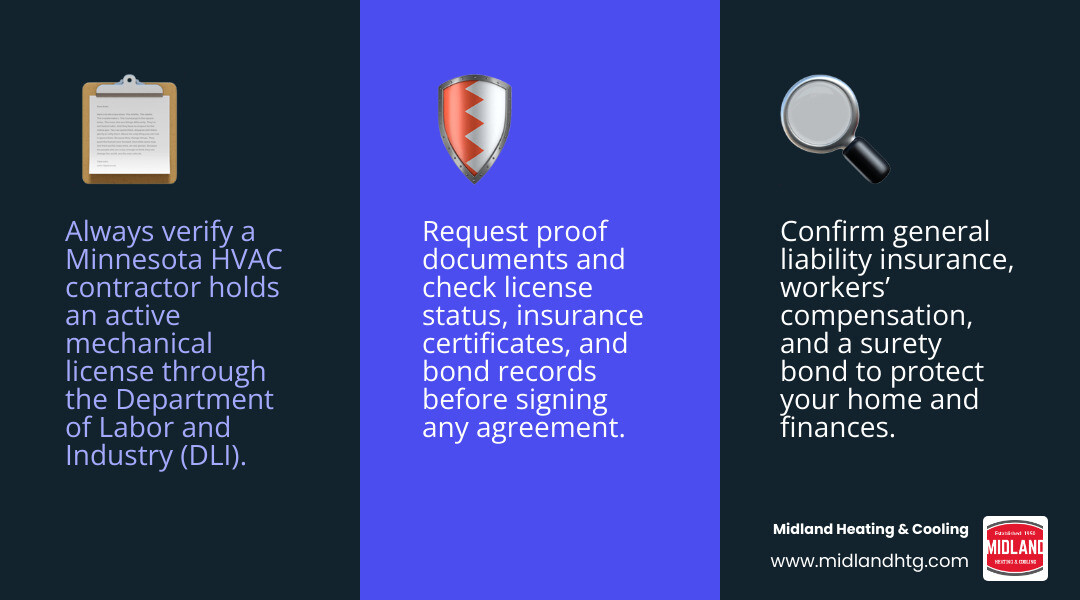
Your contractor must hold an active Minnesota Mechanical Contractor Bond and be registered with the Minnesota Department of Labor and Industry (DLI).
While some states allow local handymen to perform basic HVAC work under general contractor guidelines, Minnesota requires a dedicated mechanical filing. To legally pull mechanical permits in cities like Minneapolis, St. Paul, or Bloomington, the business must have the proper state registration on record.
When you ask this question, do not accept a vague “Yes, we are licensed.” Ask for their specific license number. A legitimate business will happily provide it.
How can I verify your license, bond, and insurance?
Once you have the contractor’s license number, do not just file it away. Take five minutes to verify it.
Go to the Minnesota Department of Labor and Industry (DLI) website and use their public license lookup tool. Enter the company name or license number to verify that:
- The status is currently active.
- The business name and address match the company you are talking to.
- There are no active disciplinary actions or histories of unresolved code violations.
If a contractor’s name does not show up in the state database, or if their license is expired, treat this as an immediate red flag and walk away.
Do you carry general liability insurance, workers’ compensation, and a surety bond?
Every reputable HVAC contractor in the Twin Cities must carry three distinct protections:
- General Liability Insurance: This covers damage to your home. If a technician accidentally punctures a water pipe while installing an air conditioner and floods your basement, this policy applies to the repair process.
- Workers’ Compensation: This covers the technicians themselves. If an installer falls down your basement stairs and breaks a leg, workers’ comp ensures they are taken care of.
- Surety Bond: Minnesota requires a mechanical contractor bond. This protects you if the contractor fails to complete the job or fails to satisfy required permit and code obligations.
Ask the contractor to have their insurance agency email you a Certificate of Insurance (COI) directly. This document should list their active policy numbers and expiration dates.
Ask About the Service Team and System Experience
Once you know the business is legally registered, it is time to understand who will be working inside your home and how the project will be handled. The person who comes to discuss your system may not be the same person who does the hands-on work. You need to know that the actual service team follows a careful, documented process. Understanding What an HVAC Technician Does can help you understand the level of detail involved in these jobs.
Who will be completing the work in my home?
Ask whether the work will be handled by the company’s in-house team, what time the crew is expected to arrive, and who your main point of contact will be during the project. This helps you know who to call if you have questions before, during, or after service.
You should also ask how the team protects your home during the appointment. A clear answer may include floor coverings, shoe covers, workspace cleanup, and a final walkthrough before the crew leaves.
What HVAC systems do you install and service most often?
Most HVAC contractors work regularly with specific types of furnaces, air conditioners, heat pumps, thermostats, and indoor air quality products. Ask which systems they service most often and why they are recommending a particular option for your home.
You want to understand that the recommended system fits your home’s layout, comfort goals, and existing HVAC setup. The answer should be specific to your home rather than a one-size-fits-all recommendation.
How do you document startup and system performance?
Modern heating and cooling systems rely on variable-speed blowers, communicating controls, safety switches, airflow settings, and precise startup procedures.
Ask whether the team completes a startup checklist, verifies airflow, tests safety controls, and reviews thermostat operation with you before leaving. Proper documentation helps ensure your system is set up correctly and gives you a clear record of the work completed.
Confirm They Size, Inspect, and Plan the Whole HVAC System
A common mistake homeowners make is assuming that replacing an HVAC system is as simple as swapping an old unit for a new one of the exact same size. However, homes change over time. You may have added insulation, replaced old windows, or completed a remodel.
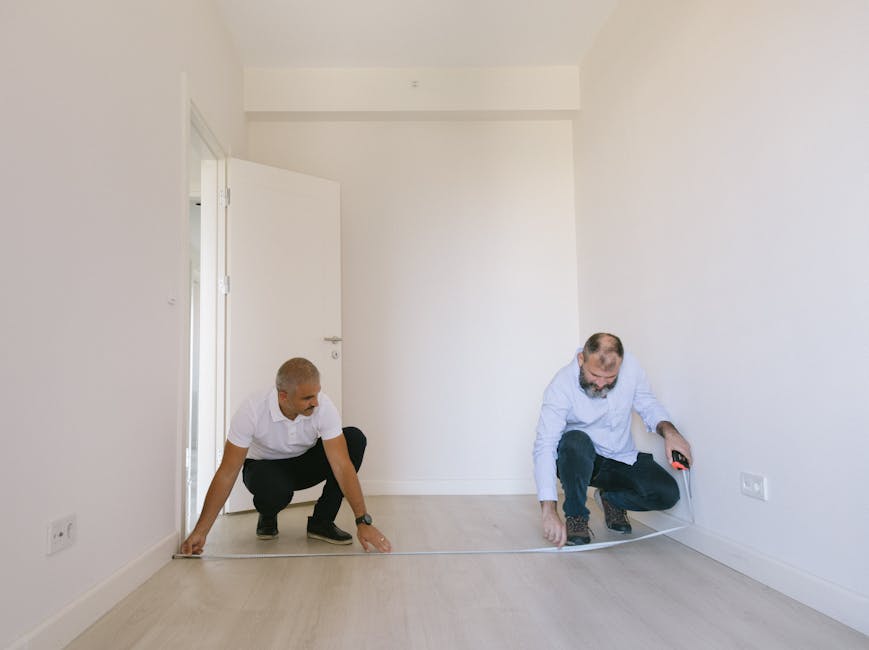
Before recommending any equipment, a professional contractor must evaluate your entire home. Understanding the value of professional central AC services means ensuring your system is designed specifically for your home’s unique layout.
Will you perform a Manual J load calculation before recommending equipment size?
Never hire a contractor who sizes your system using “rules of thumb,” such as sizing purely by square footage. Sizing a system this way often leads to oversized or undersized equipment. An oversized furnace or AC will short-cycle, which means it turns on and off rapidly, wears out components early, and creates uncomfortable temperature swings.
A professional must perform a Manual J load calculation. This is the industry-standard protocol that evaluates:
- The exact square footage and ceiling height of each room.
- The direction your home faces and the amount of solar heat gain.
- The insulation levels in your walls and attic.
- The type and age of your windows.
- Local climate data for the Twin Cities.
The Minnesota Energy Code requires a Manual J load calculation for new installations. If a contractor refuses to perform one, do not move forward with the project.
What is your process for inspecting existing ductwork?
Your ductwork is the delivery system for your home’s comfort. You can have an efficient furnace, but if your ducts are leaky, crushed, or undersized, you may still experience uneven temperatures and reduced performance. According to the Department of Energy, duct losses account for 20% to 30% of energy waste in a typical home.
A thorough contractor will inspect your existing ductwork, check for leaks, and measure static pressure to ensure the ducts can handle the airflow of your new system. If modification is needed, it should be discussed and included in the plan before any work begins.
How do you decide whether repair or replacement makes sense?
If you are dealing with a broken system, you need an honest assessment of whether a repair is practical or whether replacement should be considered. Ask the technician to explain the condition of the system, the age of the equipment, the type of failure, and whether other components show signs of wear.
You should also ask how the recommendation supports your comfort, safety, efficiency, and long-term reliability goals. A clear explanation should help you understand the options without pressure.
Knowing the Signs HVAC System Needs Professional Repair will help you make an informed decision when discussing these options with your technician.
Get the Project Details in Writing Before Work Begins
To protect yourself from miscommunications and scheduling confusion, make sure every detail of your project is documented in writing before any technician picks up a tool. If a contractor is hesitant to put their promises in writing, do not move forward. Knowing how technicians handle furnace repair and installations with structured documentation is a hallmark of professional service.
What warranties are included for parts and labor?
HVAC systems come with two distinct warranties:
- Manufacturer’s Warranty: This covers the physical parts of the system if they fail due to a manufacturing defect. Coverage length depends on the brand and product.
- Labor Warranty: This is provided by the installing contractor and covers the labor required to replace a failed covered part during the stated warranty period.
Make sure you get the exact terms of both warranties in writing. Ask what is excluded, including regular maintenance requirements, so there are no surprises later.
Who registers the equipment with the manufacturer?
This is a critical, often-overlooked detail. Most manufacturers require new equipment to be registered within a specific timeframe after installation to receive the full available warranty. If it is not registered, warranty coverage may be reduced.
Ask the contractor if they will handle this registration for you and provide you with the printed confirmation, or if you are responsible for registering it yourself.
Will you pull all required mechanical permits and schedule inspections?
In Minnesota, any significant installation or replacement of HVAC equipment requires a mechanical permit under state law.
A contractor who asks you to pull the permit or suggests skipping the permit process is a massive red flag. Skipping permits is illegal, may affect manufacturer warranty coverage, and can create issues when you try to sell your home in the future.
A professional contractor will handle the permit process and schedule the final city inspection once the installation is complete. The inspection acts as an added quality check for you, ensuring the system is safe and meets all local building codes.
What should the written project scope include?
Your written proposal should be highly detailed. It should clearly explain the work being performed and the equipment being installed. A professional project scope must include:
- The exact model numbers of all equipment being installed, such as the furnace, AC, coil, and thermostat.
- The efficiency ratings, such as AFUE for furnaces and SEER2 for air conditioners.
- A clear scope of work detailing what is included, such as duct modifications, electrical work, and gas line piping.
- Disposal of your old equipment.
- Permit responsibilities.
- Estimated start and completion dates.
Check Local Reputation, Service Support, and Maintenance Options
The relationship with your HVAC contractor should not end the moment your new system is turned on. You want ongoing support that helps you maintain your system for the next 15 to 20 years. Understanding why professional heater repair is essential to your long-term comfort means vetting the contractor’s ongoing support and local track record.
What questions to ask before hiring an HVAC technician in Minnesota about references and permit history?
Ask the contractor if they have a history of pulling permits in your specific city, whether you live in Minneapolis, St. Paul, Edina, or Minnetonka. A company that regularly works in your community will be familiar with your local building inspectors and specific municipal codes, which makes the entire project run more smoothly.
Can you provide recent local references?
Ask the contractor to provide three references from local homeowners who have had similar installations completed within the last year.
When you call these references, ask:
- Did the crew show up on time?
- Did they respect your home by wearing shoe covers and cleaning up their workspace?
- Was the written scope followed?
- If any issues came up, how quickly did the company resolve them?
Do you offer a maintenance agreement, and what does it include?
Regular maintenance is the single best way to protect your system, support efficiency, and help your equipment comply with manufacturer warranty terms. Ask if the contractor offers a maintenance agreement.
A maintenance plan should include:
- Twice-yearly visits, with a heating tune-up in the fall and a cooling tune-up in the spring.
- Safety testing, including checks for carbon monoxide and gas leaks.
- Cleaning of critical components, including coils, blowers, and burners.
- Priority scheduling for member service calls.
How do you handle emergency service and after-hours calls?
When a furnace fails in the middle of a Minnesota winter, it is a safety emergency. You need to know exactly who to call and how fast they will respond.
Ask if they have a dedicated after-hours team, how they handle emergency dispatches, and what their average response time is during peak weather seasons. Choose a provider that clearly explains the callback process and what to expect during an urgent service request.
Frequently Asked Questions About Hiring an HVAC Technician in Minnesota
Should I ask for proof of permits before HVAC work starts?
Yes. You should confirm that the mechanical permit has been pulled and is posted on-site or available digitally before the installation crew begins their work. This ensures the job is registered with your local city hall and will be inspected for safety.
How often should HVAC maintenance be scheduled in Minnesota?
You should schedule professional maintenance twice a year — once in the fall for your heating system and once in the spring for your air conditioning.
Additionally, you should inspect your air filters regularly. Most standard air filters need to be replaced at least once every 90 days. However, if you live in a household with multiple pets or family members who suffer from allergies, you may need to change them as often as every 30 days to keep your system running cleanly and efficiently. For more answers to common questions, check out our HVAC FAQs.
What are warning signs I should not ignore before calling a technician?
Do not wait for your system to break down completely before calling for help. Schedule a service call immediately if you notice:
- Uneven temperatures or weak airflow throughout your home.
- Strange, loud noises, such as clanking, squealing, or banging, coming from your furnace or AC.
- Short-cycling, which means the system turns on and off constantly.
- A sudden change in system performance or comfort.
- Any signs of gas odors or carbon monoxide detector alerts.
Conclusion
Hiring an HVAC contractor is a major decision that impacts your home’s safety, comfort, and energy efficiency for decades. By asking these critical questions, you can move forward with a clearer understanding of the service process, warranty details, permits, maintenance options, and emergency support.
At Midland Heating & Cooling, we have spent more than 70 years serving homeowners across the Twin Cities, including St. Louis Park, Minneapolis, Edina, Eden Prairie, Minnetonka, Hopkins, Bloomington, Wayzata, Excelsior, and St. Paul. As a local, family-owned business, we are committed to 100% customer satisfaction. Our experienced HVAC service professionals are ready to help you with everything from emergency repairs to complete system replacements.
If you are ready to experience the peace of mind that comes with working with a trusted, fully licensed, and bonded local team, reach out to us today. Learn more about our values and our commitment to your comfort by visiting our Midland Heating & Cooling page, and let us keep your home safe and comfortable through every Minnesota season.