

The Perfect Storm: When Summer Heat Meets the Cottonwood Shed
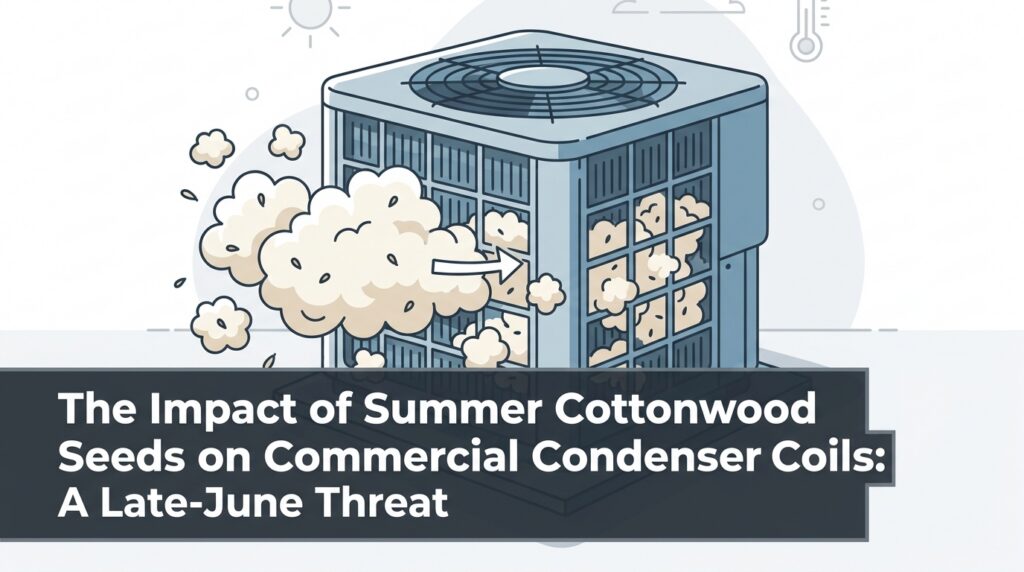
Late June brings a predictable shift in the weather, and if you manage a facility, understanding the impact of summer cottonwood seeds on commercial condenser coils is critical before the heavy heat arrives. Right as the outdoor temperatures begin to climb, the Eastern Cottonwood tree releases millions of fibrous, fluffy seeds into the air. While it looks like a harmless summer snowstorm, this localized environmental event presents a severe and immediate threat to commercial rooftop units (RTUs).
The concrete problem for Minnesota commercial properties is that these seeds act like a magnet for HVAC equipment. Rooftop units pull in massive volumes of outside air to cool the hot refrigerant circulating through your building. When the air is thick with cottonwood fluff, those seeds are sucked directly into the narrow aluminum fins of your condenser coils. Within a matter of days, they weave together to form a dense, felt-like blanket that rapidly restricts airflow just as your building demands maximum cooling.
This creates a critical decision point for facility managers and building owners. You can either schedule immediate proactive cleaning the moment the late-June shed peaks, or you can risk sudden energy bill spikes and catastrophic system failure during the peak July heat. Ignoring the cottonwood shed is not an option if you want to maintain a comfortable environment for your tenants and protect your expensive commercial cooling equipment from premature breakdowns.
How Seed Blanketing Chokes Commercial HVAC Airflow
To understand why a seemingly light, fluffy seed can cause such extensive mechanical damage, you have to look at the physics of how a commercial rooftop unit operates. Your RTU is essentially a heat transfer machine. It absorbs heat from the inside of your building and pumps it outside, releasing it through the condenser coils. When that process is interrupted, a destructive mechanical chain reaction begins.
The Insulating Effect on Condenser Coils
The condenser coils on your rooftop unit are designed with thousands of paper-thin aluminum fins. These fins maximize the surface area available for heat transfer. For the system to work, the large condenser fan must pull a continuous, unhindered volume of ambient air across these fins to cool the hot refrigerant inside the copper tubes.
Cottonwood seeds are uniquely problematic because of their sticky, fibrous nature. They do not simply bounce off the metal. Instead, they adhere tightly to the aluminum fins. As more seeds accumulate, they weave together with dust, pollen, and urban exhaust to create a highly effective insulating blanket. The immediate result: The necessary heat transfer process is physically blocked. The refrigerant cannot release its heat into the outside air, meaning it returns to the building still warm, completely defeating the purpose of the cooling cycle.
Spiking Head Pressure and Compressor Strain
When heat cannot escape the condenser coil, the temperature and pressure of the refrigerant inside the system begin to skyrocket. In the commercial HVAC industry, this is known as high head pressure. The compressor—the most expensive and critical component of your entire rooftop unit—is forced to work exponentially harder to push the high-pressure refrigerant through the restricted system.
This severe airflow restriction forces the compressor to run hotter and longer than it was ever designed to do. Over time, this intense strain degrades the lubricating oils inside the compressor, leading to internal mechanical wear and a drastically reduced lifespan. Furthermore, the disrupted refrigerant cycle can cause the evaporator coils inside the unit to drop below freezing. If you have ever dealt with a commercial rooftop unit freezing in summer heat, a heavily blanketed condenser coil is often the root cause. The system is suffocating, and the compressor is bearing the brunt of the damage.

The Hidden Financial Consequences of Spiked Energy Consumption
The physical damage to your equipment is only half of the equation. The financial impact of spiked head pressure on commercial energy consumption is severe, immediate, and often hidden until the utility bill arrives. When condenser coils are choked by cottonwood fluff, the efficiency of your entire HVAC infrastructure plummets.
According to data from the U.S. Department of Energy, dirty condenser coils can increase HVAC energy consumption by up to 30%. Because the reduced heat transfer efficiency prevents the system from reaching the setpoint on the thermostat, the rooftop units are forced to run continuously. In a large commercial facility with multiple RTUs, this non-stop operation requires a massive amount of electricity.
The commercial demand charge factor: Most Minnesota commercial properties are billed not just for total electricity used, but for their peak demand (the maximum amount of power drawn at any one time). When multiple rooftop units are struggling against high head pressure, they draw significantly more amperage than they would under normal conditions. This simultaneous heavy draw can set a new, much higher peak demand threshold for your billing cycle, resulting in a sudden, unexpected spike in your utility costs that persists even after the heatwave breaks.
| Operational Metric | Clean Condenser Coils | Cottonwood-Blanketed Coils |
|---|---|---|
| Airflow Volume | 100% (Unrestricted) | Reduced by up to 50% |
| Compressor Run Time | Normal cycling based on demand | Continuous, non-stop operation |
| Energy Consumption | Baseline efficiency | Up to 30% increase in power draw |
| Wear and Tear | Standard seasonal degradation | Accelerated compressor failure risk |
By neglecting to clear the seeds, you are essentially paying a heavy premium on your utility bills for a system that is actively destroying itself. Proactive maintenance is not just an operational expense; it is a direct strategy for controlling your facility’s overhead costs.
Strategically Timing Maintenance After the Shed Peaks
Managing the cottonwood threat requires precision timing. Because the rapid transition from the seed shed into peak July heat creates a narrow, high-stakes window for facility managers, you cannot simply schedule a cleaning whenever it is convenient. You must coordinate your maintenance with the local flora cycle.
Our deep local expertise in Minnesota’s unique environmental challenges shows that a proactive approach tailored specifically to this flora cycle is the only way to protect your equipment. Here is the exact seasonal step-by-step strategy for timing your intervention:
- Monitor the Early Shed (Late May to Early June): Keep an eye on the trees surrounding your facility. You will start to see the first flurries of seeds in the air. Do not schedule cleaning yet, as the bulk of the shed is still to come.
- Wait Out the Peak Volume (Mid to Late-June): This is when the air is thick with fluff. If you clean the coils now, they will simply re-clog within 48 hours, wasting your maintenance budget. Monitor your RTUs visually, but hold off on professional washing unless the system is actively failing.
- Execute the Immediate Post-Shed Cleaning (Early July): The moment the late-June peak concludes and the air clears, you must act. This is the critical window. You must have the coils professionally cleaned before the heaviest 90-degree heatwaves arrive.
- Verify Optimal Operation (Mid-July): Once the coils are clear, monitor the building’s cooling performance and energy draw to ensure the systems have returned to baseline efficiency before the peak summer heat sets in completely.
Cleaning too early results in immediate re-clogging. Cleaning too late risks catastrophic system downtime when your tenants need cooling the most. Timing is everything.
Moving Beyond Standard Spring Maintenance
A common misconception among facility managers is that a standard spring tune-up is sufficient to carry their rooftop units through the summer. While early spring maintenance is necessary, it does not protect you from the cottonwood shed.
A standard April or May AC tune-up occurs long before the seeds actually fall. During a spring visit, technicians check refrigerant levels, inspect belts, test electrical connections, and perform a baseline coil cleaning to remove winter grime. However, by the time late-June arrives, those perfectly clean coils can become completely choked by cottonwood fluff in a matter of days.
For buildings surrounded by these trees, a secondary, targeted coil cleaning is a required operational expense. This is not a duplicate service; it is a specific, strategic intervention designed solely to remove the biological debris from the summer shed. Professional technicians use specialized techniques to handle this fibrous material. Because the seeds weave tightly into the metal, standard water pressure is often ineffective and high-pressure washing will instantly crush the delicate aluminum fins, ruining the coil entirely. Professionals use calibrated, low-pressure chemical treatments that dissolve the biological binders in the seeds, allowing the debris to be safely rinsed away without damaging the equipment.
Proactive Protection Strategies for Facility Managers
While the actual cleaning requires professional intervention, there are several proactive steps facility managers can take to manage the risk of seed infiltration on Minnesota commercial properties. Staying ahead of the problem prevents emergency service calls.
- Conduct weekly visual inspections: During the heavy late-June shedding weeks, send maintenance personnel to the roof to visually inspect the RTU intake panels. Catching a heavily blanketed coil early can prevent a compressor burnout.
- Investigate commercial cottonwood screens: Consider installing specialized mesh filters designed specifically for commercial RTUs. These external screens catch the bulk of the fluff before it reaches the delicate internal coils.
- Brush screens regularly: If you do have external cottonwood screens installed, they must be brushed off with a soft broom every few days during the peak shed. A clogged external screen restricts airflow just as badly as a clogged internal coil.
- Avoid dangerous DIY pressure washing: Never allow untrained staff to attempt cleaning the actual condenser coils with a pressure washer or stiff brush. The aluminum fins are incredibly fragile, and flattening them will permanently destroy the coil’s ability to transfer heat.
- Pre-schedule your post-shed service: Because every building in the region faces the exact same flora cycle, HVAC service schedules fill up rapidly in early July. Book your targeted coil cleaning weeks in advance to secure your spot in the narrow post-shed window.
Frequently Asked Questions About Cottonwood and Commercial HVAC
How do cottonwood seeds affect commercial HVAC units?
They blanket the condenser coils, restricting airflow and causing the system to overwork and overheat. When the seeds are pulled into the rooftop unit, they form a dense, insulating mat over the aluminum fins. This prevents the hot refrigerant from releasing its heat into the outside air, which drives up internal pressure, drastically increases electricity consumption, and puts severe mechanical strain on the compressor.
When is the best time to clean commercial AC coils in Minnesota?
Immediately after the peak shedding season concludes, ensuring the coils are clear for the hottest summer months. The late-June shed creates a very specific timeline. If you clean the coils too early, the remaining falling seeds will just clog them again; if you wait too long, the incoming July heatwaves will push your restricted equipment to the point of failure.
Can cottonwood seeds permanently damage an air conditioner?
Yes, prolonged operation with clogged coils can lead to premature compressor failure. The severe restriction of airflow forces the compressor to operate at temperatures and pressures far beyond its design limits. Over time, this breaks down the internal lubricants and causes catastrophic, irreversible mechanical damage that requires a highly expensive compressor replacement.
Why is my commercial rooftop unit freezing in summer heat?
Severe airflow restriction from debris can disrupt the refrigerant cycle, causing condensation to freeze on the coils. When the condenser coils are choked by cottonwood fluff, the system cannot properly reject heat, which throws off the pressure balance throughout the entire unit. This imbalance often causes the indoor evaporator coils to drop below freezing, turning the condensation in the air into a solid block of ice.
Are specialized cottonwood screens worth the investment for RTUs?
They can significantly reduce the volume of seeds reaching the interior coils, though regular professional cleaning is still required. These external mesh screens act as a first line of defense, catching the bulk of the fluff where it can be easily brushed away by maintenance staff. While they do not eliminate the need for chemical coil washing, they drastically reduce the risk of a mid-shed system failure.
Secure Your Commercial Cooling Before the July Heatwave Hits
The late-June cottonwood shed is a highly predictable, localized financial threat to your facility’s energy efficiency and equipment lifespan. By understanding exactly how these seeds choke your commercial rooftop units, you can stop treating them as a simple landscaping nuisance and start treating them as a critical maintenance priority. Timing your intervention perfectly—right after the fluff stops flying but before the heavy heat arrives—is the key to protecting your building.
You need a clear understanding of the mechanical impact on your specific equipment and a definitive timeline for preventative maintenance. Don’t wait for a sudden spike in your utility bills or a completely frozen system to take action. Reach out to a local commercial HVAC expert today to schedule a targeted, professional coil cleaning and secure your building’s comfort before the peak summer heatwaves hit.