

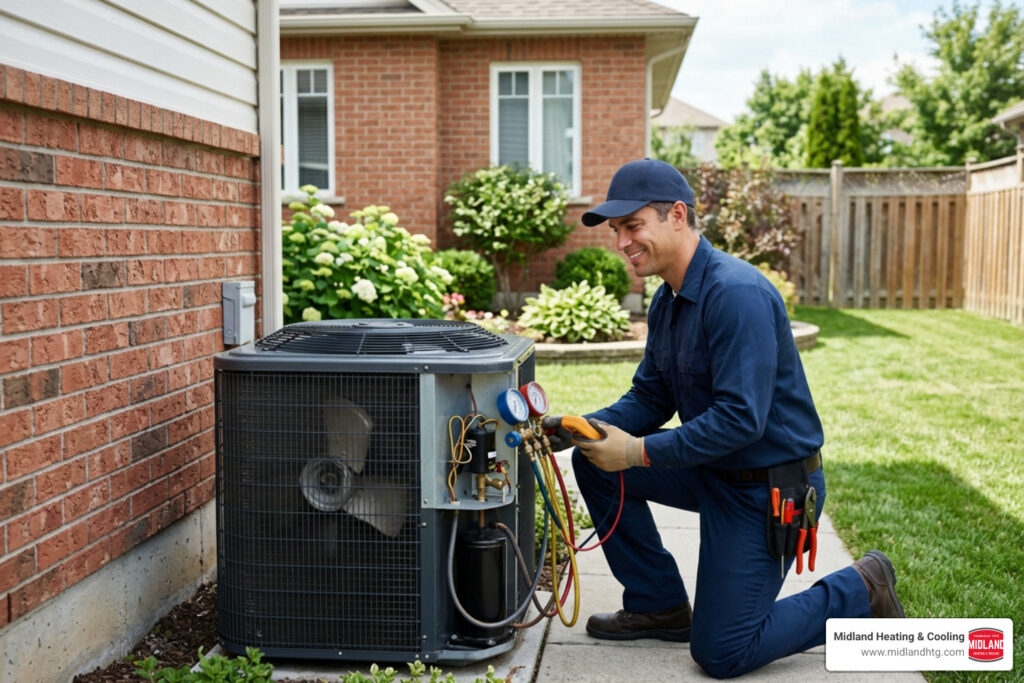
When to Call a Technician for an AC That Won’t Shut Off
Knowing when to call a technician for an AC that won’t shut off could save your system from serious damage — and save you from a sky-high energy bill. A healthy air conditioner runs in cycles of about 20 to 30 minutes, completing two to three cycles per hour. When it runs nonstop, something is wrong.
Here is a quick answer to help you decide right now:
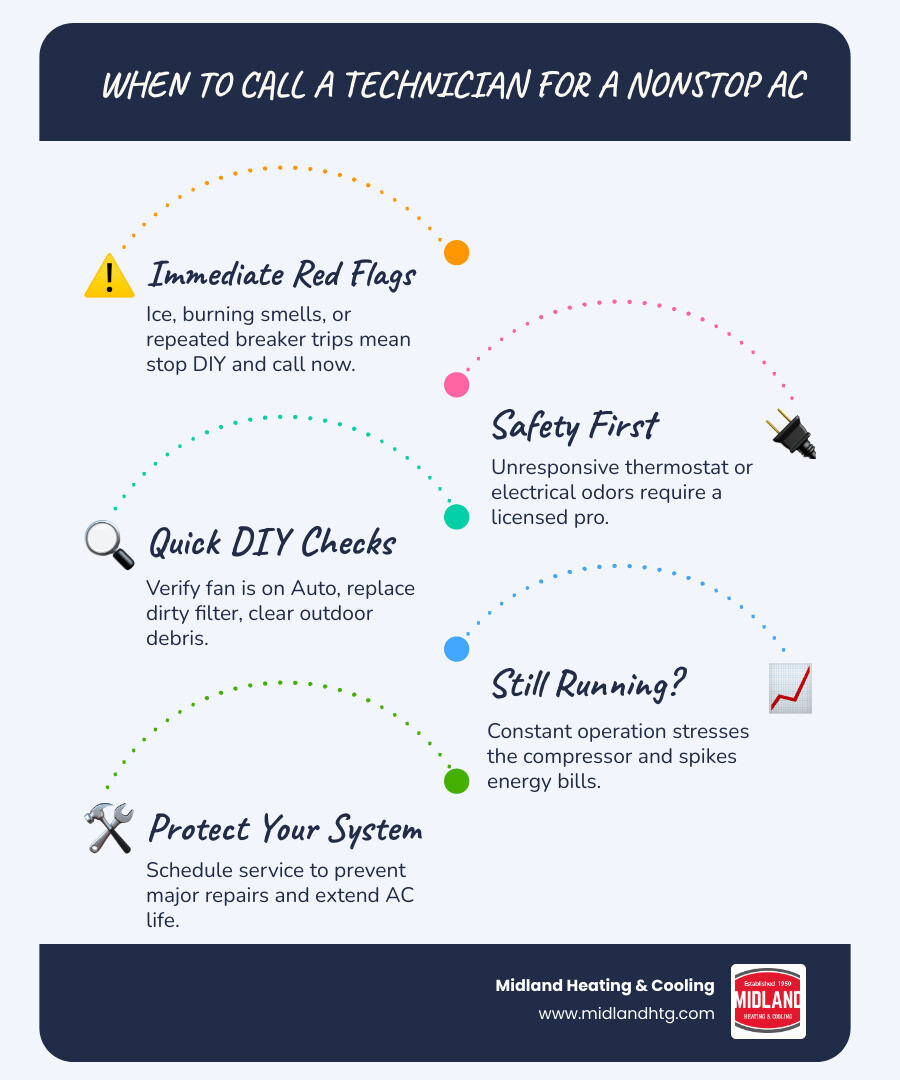
Call a technician immediately if you notice any of these:
- Ice or frost on the refrigerant lines or indoor coil
- A burning smell or electrical odor coming from the unit
- Water leaking around the indoor air handler
- The circuit breaker trips repeatedly
- The thermostat is unresponsive and the system won’t shut off
- The system runs constantly but produces little or no cool air
- Unusual humming, buzzing, or screeching sounds from the unit
You may be able to troubleshoot yourself first if:
- The fan is set to “On” instead of “Auto” on the thermostat
- The air filter looks gray and clogged
- The outdoor unit is visibly blocked by debris
- The thermostat temperature is set lower than the room temperature
If the basic checks above don’t solve it, stop there and call a professional. An AC that keeps running without shutting off puts constant stress on the compressor — one of the most expensive parts in the system. The longer it runs without a fix, the more wear it takes on.
In the Twin Cities, where summers can push your system hard, a nonstop-running AC is not something to wait out. This guide walks you through what causes it, what you can safely check at home, and exactly when it is time to call in a certified HVAC technician.
Simple guide to when to call a technician for an ac that won’t shut off:
- ac running constantly during a heat wave
- how high humidity makes your ac work harder in the upper midwest
- undersized ac unit signs and problems in a four-season climate
Why Your Air Conditioner Is Running Constantly
An air conditioner that refuses to shut down is more than just a noisy annoyance. It is a system in distress. To understand why your cooling system is running nonstop, we first have to look at how a typical cooling cycle operates.
Under normal conditions, your air conditioner should run for roughly 15 to 20 minutes (or up to 30 minutes on exceptionally humid Twin Cities afternoons) to lower your home’s temperature to the thermostat’s set point. Once that temperature is reached, the system shuts down. This cycle repeats two to three times every hour. If your system runs for hours on end without a break, it is experiencing a malfunction.
For a deeper dive into whether your system’s behavior is normal for the season, check out our guide on The Nonstop Hum: Is It Normal for AC to Run All Day?.
There are several common culprits behind an air conditioner that won’t turn off. These range from simple, easily corrected settings to serious mechanical and electrical failures that require professional attention.
| Common Cause | Primary Symptom | DIY or Professional Fix? |
|---|---|---|
| Thermostat Fan set to “ON” | Blower fan runs constantly, but outdoor unit may cycle off | DIY (Switch to “AUTO”) |
| Clogged Air Filter | Weak airflow, warm air, or ice forming on indoor unit | DIY (Replace filter) |
| Welded Contactor Relay | Outdoor unit runs even when thermostat is turned OFF | Professional Repair Required |
| Frozen Evaporator Coils | Ice on refrigerant lines, system runs but blows lukewarm air | Professional Repair Required |
| Undersized AC Unit | System runs nonstop on hot days but cannot reach target temperature | Professional Replacement |
| Low Refrigerant / Leak | System runs constantly, blowing lukewarm air; hissing sounds | Professional Repair Required (EPA Certified) |
Thermostat and Electrical Component Failures
Sometimes, the issue is not with the cooling components themselves, but with the control system that tells them when to start and stop.
Your thermostat acts as the brain of your HVAC system. If it is uncalibrated, it may misread the actual temperature in your home, constantly signaling the AC to keep cooling. Thermostat placement also matters. If your thermostat is installed in a direct line of hot afternoon sunlight, near a drafty window, or close to heat-generating appliances in your kitchen, it will read the local area as much hotter than the rest of your home, forcing the system to run continuously.
On the electrical side, the most common cause of a nonstop AC is a welded contactor. The contactor is a small electrical switch in your outdoor condenser unit that opens and closes to control the flow of electricity to the compressor and outdoor fan motor. Over time, the electrical arcing that occurs when the switch closes can physically weld the metal contacts together. When this happens, the switch is stuck in the “closed” position, sending a continuous stream of high-voltage power to your outdoor unit—even if you turn your thermostat completely off.
Control board failures can also cause the system to ignore shut-off signals. If your system is turning on and off rapidly or ignoring commands, read about Why Your AC Is Acting Like a Light Switch and How to Fix It to understand how electrical shorts can disrupt your system.
Airflow Restrictions and Frozen Coils
For an air conditioner to cool your home efficiently, it relies on a delicate balance of airflow and heat transfer. If anything restricts the airflow across your indoor evaporator coil, the system cannot absorb heat from your indoor air.
A heavily clogged air filter is the number-one cause of restricted airflow. When the filter is packed with dust, pet dander, and debris, the blower fan has to work twice as hard to pull air through. Because the warm indoor air cannot reach the cold evaporator coil, the moisture on the coil freezes. Once a layer of ice forms on the coil, it acts as an insulator, preventing any further heat transfer. Your AC will run constantly because it simply cannot cool the air.
Similarly, if the outdoor condenser unit is caked in dirt, lawn clippings, or cottonwood seeds—a very common issue in Minneapolis and St. Paul—it cannot release the heat it absorbed from indoors. If you find your system is blowing warm air and running without a break, read our troubleshooting guide on AC Running Constantly Without Cooling Properly to learn more about how airflow blocks and refrigerant leaks stall the cooling process.
How to Safely Troubleshoot a Nonstop AC at Home
Before you pick up the phone to schedule a service call, there are a few safe, basic troubleshooting steps you can perform at home. Many homeowners are surprised to learn that up to 30% of cooling issues can be resolved without a professional technician simply by checking the basics.
If you want a comprehensive checklist of what to evaluate before calling us, review our Home AC Troubleshooting Guide: What to Check Before Calling HVAC.
Step-by-Step DIY Checks Before Calling for Service
Follow these steps in order to rule out simple issues:
- Check the Thermostat Settings: Walk over to your thermostat and look closely at the display. First, ensure it is set to “COOL” and that the target temperature is set to a reasonable level (higher than the current room temperature to see if it shuts off). Next, look at the fan setting. If the fan is set to “ON,” the indoor blower fan will run 100% of the time, even when the AC is not actively cooling. Switch the fan setting to “AUTO.” This ensures the fan only runs when the system is actively cooling.
- Inspect and Replace the Air Filter: Turn your system off at the thermostat. Locate your air filter (usually in the return air duct or next to your furnace/air handler) and slide it out. Hold it up to a light source. If you cannot see light passing through the filter, it is clogged and needs to be replaced immediately. We recommend replacing standard filters every 30 to 90 days, especially if you have pets.
- Inspect the Outdoor Unit: Walk outside and look at your condenser unit. Ensure there is at least two feet of clear space around the unit on all sides. Trim back any overgrown bushes, weeds, or plants. If the metal fins of the unit are covered in dirt, leaves, or cottonwood fuzz, gently rinse them down with a garden hose using light pressure (never use a pressure washer, as this will bend the delicate aluminum fins).
- Clear Indoor Vents and Returns: Walk through your home and make sure all supply vents and return grilles are open and completely unobstructed by furniture, heavy drapes, or rugs. Closing vents to “save energy” actually increases pressure in your ductwork, restricts airflow, and can cause your system to run longer or freeze up.
- Check the Circuit Breaker: If your system is completely unresponsive, check your home’s main electrical panel. If the breaker labeled “AC” or “Air Conditioner” has tripped to the middle position, switch it fully to “OFF” and then back to “ON” once. If it immediately trips again, do not reset it a second time. This indicates a severe electrical short or a failing compressor drawing too much power.
Knowing When to Call a Technician for an AC That Won’t Shut Off During DIY Checks
While changing a filter or switching your thermostat to “AUTO” is perfectly safe, you must know where to draw the line. DIY troubleshooting should stop immediately if you encounter any of the following:
- An Unresponsive Thermostat: If you set the thermostat to “OFF” or remove it from the wall entirely, and the outdoor unit continues to hum and run, you have a welded contactor or a short circuit in your control wiring.
- The Smell of Burning Plastic or Electrical Odors: This indicates overheating wires, a failing fan motor, or a damaged control board. Turn off the power at your breaker panel immediately.
- Visible Ice Buildup: If you see frost or solid ice on the copper refrigerant lines running to your outdoor unit or on the indoor evaporator coil, turn the system to “OFF” at the thermostat, switch the fan setting to “ON” to help melt the ice, and call a technician. Running an AC with frozen coils can permanently damage the compressor.
If your system is displaying any of these warning signs, refer to our guide on Signs HVAC System Needs Professional Repair to understand why professional intervention is required to protect your home.
When to Call a Technician for an AC That Won’t Shut Off
When basic DIY troubleshooting fails to resolve the issue, it is time to call in a professional. Modern air conditioners are highly complex machines that run on high-voltage electricity and contain pressurized chemical refrigerants. Attempting to repair these components yourself is not only dangerous, but it can also void your manufacturer’s warranty.
Furthermore, handling chemical refrigerants requires specialized training and licensing. Under EPA Section 608 regulations, it is legally required that anyone opening or servicing refrigerant lines be a certified technician.
Red Flags: When to Call a Technician for an AC That Won’t Shut Off Immediately
Certain situations go beyond a standard service call and require immediate, urgent attention. You should contact us for emergency service if:
- You smell electrical burning or melting plastic: This points to a severe electrical hazard that could lead to an HVAC fire.
- The circuit breaker keeps tripping: Repeatedly resetting a tripped breaker can cause catastrophic damage to your compressor or lead to an electrical fire.
- Water is actively leaking into your finished home: A clogged condensate drain line or a melting frozen coil can overflow the drain pan, causing extensive water damage to your ceilings, walls, and floors.
- The system is running but the indoor air is hot: If your system is running constantly during a Twin Cities heat wave but only blowing warm air, your home will quickly reach dangerous temperatures, putting vulnerable occupants (such as infants, the elderly, or pets) at risk of heat exhaustion.
How a Professional Diagnoses and Fixes the Issue
When a Midland Heating & Cooling technician arrives at your home in Minneapolis, Edina, or St. Paul, they will perform a systematic diagnostic process to pinpoint the exact cause of the continuous operation:
- Electrical Testing: Using a multimeter, the technician will test the voltage and continuity of your thermostat wiring, the control board, the run capacitor, and the contactor relay. If the contactor is welded shut, they will safely replace it.
- Refrigerant Subcooling and Superheat Testing: We will connect digital gauges to your refrigerant lines to measure the pressures and temperatures. This tells us if your system is low on refrigerant due to a leak. If a leak is present, we will locate it, repair it, evacuating the system, and recharge it to factory specifications.
- Airflow and Coil Inspection: We will inspect the evaporator coil and condenser coil for dirt buildup. If the coils are dirty, we use specialized, non-corrosive chemical cleaners and professional tools to clean them without damaging the delicate aluminum fins.
- Thermostat Calibration: We will verify that your thermostat is reading the room temperature accurately and communicating correctly with your heating and cooling equipment.
To learn more about how regular maintenance prevents these complex issues from developing in the first place, read Why Regular AC Service Is Crucial.
The Risks of Letting Your AC Run Continuously
It can be tempting to ignore a nonstop running air conditioner as long as your home is staying cool. However, letting your system run continuously without repair carries serious risks:
- Catastrophic Compressor Failure: The compressor is the heart of your air conditioning system. It is designed to run in cycles, allowing it to cool down between runs. Continuous operation causes extreme heat buildup in the compressor, leading to mechanical wear, oil breakdown, and eventual electrical burnout. Replacing a compressor is incredibly expensive and often means you need a completely new unit.
- Sky-High Energy Bills: Your air conditioner is the single largest consumer of electricity in your home. When it runs 24 hours a day instead of its usual 8 to 10 accumulated hours, your power consumption skyrockets, leading to shocking utility bills.
- Severe Ice Accumulation and Water Damage: If the continuous running is caused by a frozen coil, the ice will continue to grow until it completely blocks all airflow. When the system is eventually turned off, that massive block of ice will melt rapidly, easily overwhelming your condensate drain pan and flooding your utility room or basement.
To understand how constant running compares to other cycle issues, such as short cycling (where the system turns on and off every few minutes), read our guide on Troubleshooting AC Short Cycling.
Repair vs. Replacement: Making the Right Choice
When your air conditioner won’t turn off and a technician diagnoses a major component failure, you will face a decision: should you repair the system or replace it entirely?
Here are the key factors we help our customers evaluate:
- System Age: If your air conditioner is between 10 and 15 years old, it is approaching the end of its natural lifespan. Investing in major repairs on an aging system often only delays the inevitable.
- Frequency of Repairs: Are you calling us for repairs every summer? If you are constantly replacing parts, those repair bills will quickly add up to the cost of a modern, high-efficiency replacement.
- Energy Efficiency: Older systems use older, less efficient technology and may run on R-22 refrigerant, which is phased out and highly expensive to source. Upgrading to a modern system will drastically lower your monthly energy bills.
- The “5,000 Rule”: A helpful industry rule of thumb is to multiply the age of your system by the cost of the repair. If the result is greater than $5,000, replacement is generally the smarter long-term financial decision. For example, a $600 repair on an 11-year-old system equals $6,600—making replacement the better choice.
If you are noticing that your overall HVAC system is struggling to keep up with the seasons, it might also be time to evaluate your heating system. Read our guide on Signs You Need Furnace Repair to keep your entire home comfortable year-round.
Frequently Asked Questions About Constant AC Running
Should I turn off my AC if it won’t stop running?
Yes, if you have tried basic troubleshooting (checking the thermostat settings and the air filter) and the system still refuses to shut off, you should turn it off manually. You can do this by setting the thermostat to “OFF,” switching off the dedicated AC breaker in your electrical panel, or pulling the outdoor disconnect plug located in the metal box near your outdoor unit. Shutting the system down protects the expensive compressor from overheating and prevents further damage while you wait for a technician to arrive.
Can a dirty air filter cause my AC to run nonstop?
Absolutely. A dirty air filter restricts the volume of air flowing over your indoor evaporator coil. Without enough warm air passing over the coil, the refrigerant inside cannot absorb heat effectively. This causes the coil’s temperature to drop below freezing, turning condensation into ice. The ice blocks airflow completely, and your system will run continuously in a futile attempt to cool your home. Changing your filter every 30 to 90 days is the easiest way to prevent this.
Why is my AC running but not cooling my home?
If your system is running constantly but your home is warm, the issue is typically a lack of heat transfer. This is commonly caused by a severe refrigerant leak, heavily soiled indoor or outdoor coils, a failing compressor, or a completely frozen evaporator coil. In rare cases, your system may simply be undersized for your home, meaning it lacks the cooling capacity (measured in BTUs) to keep up with hot summer days.
Conclusion
An air conditioner that won’t shut off is a clear cry for help from your HVAC system. While simple settings or a dirty filter can occasionally cause the issue, continuous running is often a sign of electrical component failures, frozen coils, or low refrigerant levels that require professional diagnostic tools and training.
At Midland Heating & Cooling, we have been serving homeowners across the Twin Cities, MN—including Minneapolis, St. Paul, Edina, Bloomington, and Minnetonka—for over 70 years. As a local, family-owned business, we are committed to 100% customer satisfaction and employ certified, highly trained technicians who can quickly get to the root of your cooling problems.
Don’t let a nonstop AC drive up your energy bills and wear out your compressor. Contact us today to schedule your professional service call at Midland Heating & Cooling Air Conditioning Services.