
When Your AC Can’t Keep Up: Signs and Problems of an Undersized Unit in a Four-Season Climate
If you’ve noticed undersized ac unit signs and problems in a four-season climate like the Twin Cities, you’re not alone — and your discomfort is not just bad luck.
Here’s a quick look at the most common signs your AC is too small for your home:
- Runs constantly but never reaches your thermostat setting
- High humidity indoors — that sticky, clammy feeling even with the AC on
- Uneven cooling — some rooms are comfortable, others feel like a sauna
- Energy bills climbing despite no change in how you use the system
- Hot spots on upper floors or rooms farthest from the air handler
- Frequent breakdowns from a system pushed well beyond its limits
- New system still struggling — a sign the unit was never sized correctly to begin with
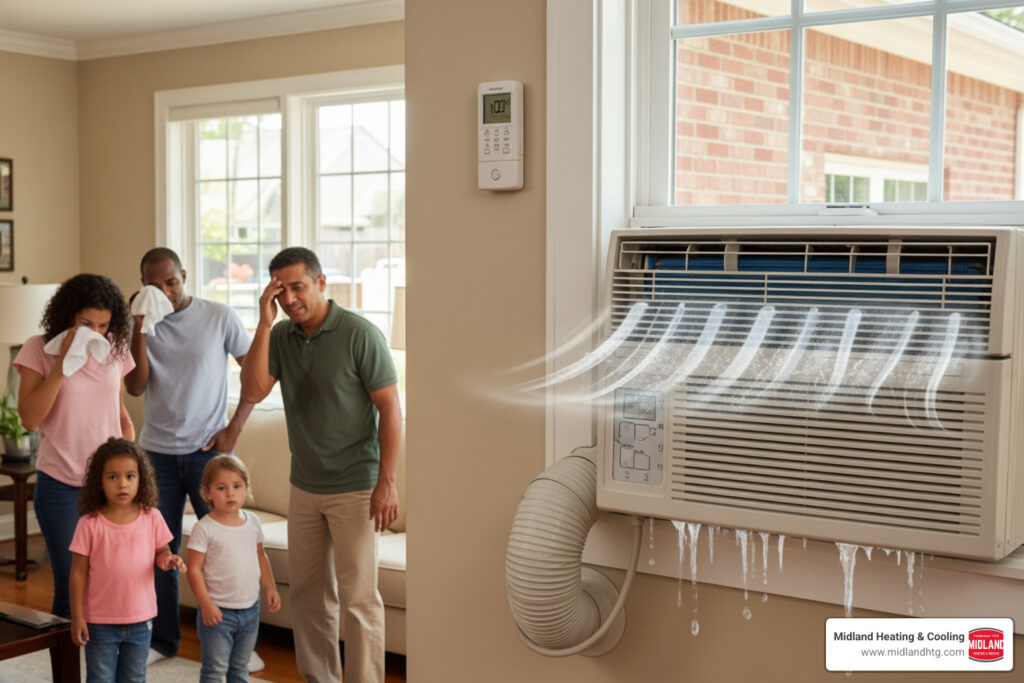
It’s the middle of July. Your thermostat is set to 72°F. The living room reads 78°F — and the AC hasn’t stopped running since noon. Sound familiar?
In a four-season climate like the Twin Cities, your cooling system doesn’t just deal with hot days. It battles high summer humidity, wide temperature swings between seasons, and the added wear of starting up hard after months of sitting idle through a Minnesota winter. When an AC unit is too small for the home it’s supposed to cool, all of those challenges hit harder — and the consequences go beyond simple discomfort.
An undersized AC runs almost nonstop during peak heat, straining its components and driving up energy bills by as much as 25–40%, all while failing to actually keep your home comfortable. Over time, that constant strain shortens the system’s lifespan by several years compared to a properly sized unit.
Understanding the signs of an undersized AC — and why sizing matters more in a four-season climate — is the first step toward fixing the problem for good.
7 Common Undersized AC Unit Signs and Problems in a Four-Season Climate
In regions like St. Louis Park and Minneapolis, we experience the full spectrum of weather. When summer arrives, it brings a heavy heat that requires a robust response. If your air conditioner was selected based on a “rule of thumb” rather than a precise calculation, you may be living with an underpowered machine.
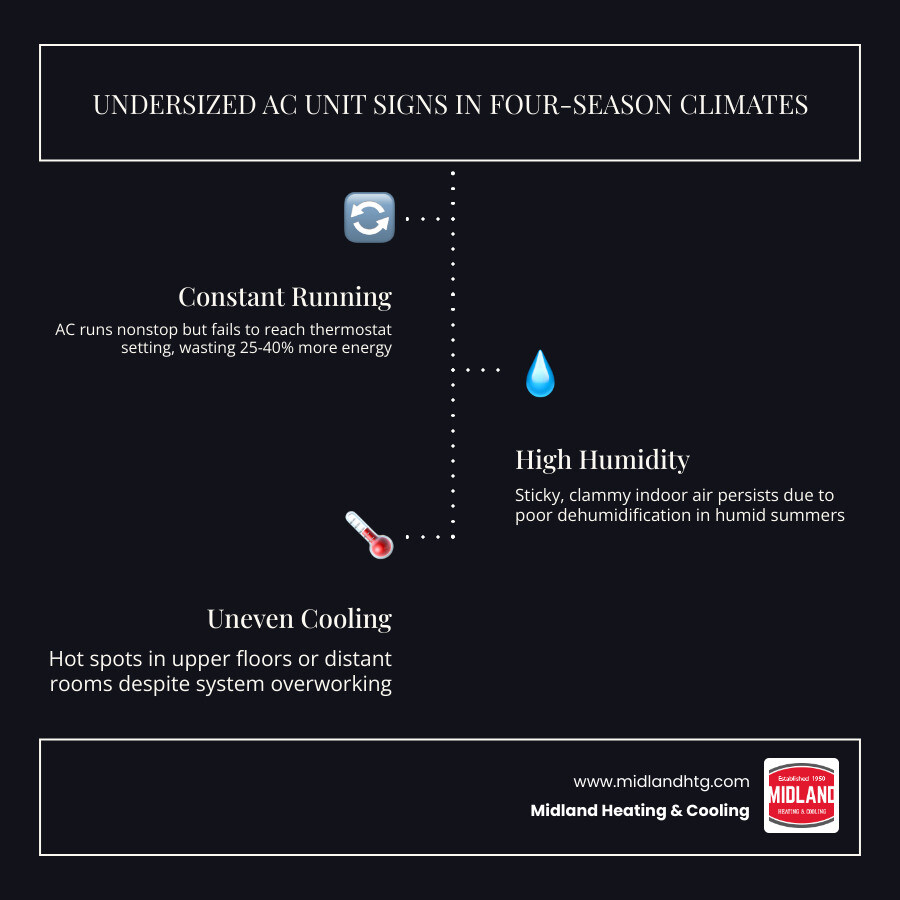
One of the most glaring undersized ac unit signs and problems in a four-season climate is a unit that simply won’t turn off. Ideally, an AC should run in cycles of 15 to 20 minutes. If yours is AC Running Constantly Without Cooling Properly, it is a marathon runner trying to sprint a hundred miles. It never crosses the finish line (the thermostat setpoint), so it never stops running.
This leads directly to the second problem: energy bill spikes. You might see your utility costs jump by 25% to 40% during the peak of summer. Because the compressor is always engaged, it is consuming the maximum amount of electricity possible, even though it isn’t effectively lowering the temperature.
Furthermore, you will notice “hot spots” throughout your home. In a four-season climate, upper floors and rooms with southern exposure bear the brunt of the sun’s heat. An undersized unit lacks the “push” to distribute cool air evenly, leaving your bedrooms feeling like saunas while the area directly next to the air handler is barely tolerable. This mechanical fatigue eventually leads to premature wear, often causing the system to fail 3 to 5 years earlier than its expected lifespan.
Why an Undersized AC Unit Struggles with Humidity in a Four-Season Climate
In the Twin Cities, it’s not just the heat; it’s the humidity. A primary job of your air conditioner is to act as a dehumidifier. As warm air passes over the cold evaporator coils, moisture condenses and is drained away.
However, when a unit is undersized, it often fails to manage the “latent load” (the moisture in the air). You might find yourself asking Why is AC Not Cooling Properly? when the air coming out of the vents feels cool, but the house feels “clammy” or “sticky.” If the indoor relative humidity stays above 55%, you aren’t just uncomfortable—you’re at risk for mold growth and poor indoor air quality. A properly sized unit balances temperature reduction with moisture removal to keep your home crisp and dry.
The Impact of Continuous Strain on System Longevity
As of May 2026, modern high-efficiency standards emphasize system longevity, but an undersized unit works against these goals. When a machine is forced to run 24/7 during a heatwave, the internal components never get a chance to cool down.
This leads to AC Compressor Failures in Summer because the compressor—the heart of the system—overheats under the constant load. In a climate where we go from -20°F in the winter to 95°F in the summer, our systems already face enough environmental stress. Adding the burden of undersizing is like asking a compact car to tow a semi-truck; eventually, the engine is going to give out.
Distinguishing Sizing Issues from Mechanical Failures
It can be tricky to tell if your comfort issues are due to the unit being too small or if something is simply broken. Here is a quick guide to help you distinguish between the two:
| Symptom | Undersized Unit | Oversized Unit | Maintenance Issue (Dirty/Broken) |
|---|---|---|---|
| Runtime | Runs constantly without stopping | Turns on and off every few minutes | May run constantly or not at all |
| Humidity | Air is cool but feels clammy/damp | High humidity; “short cycles” | Varies; often high if airflow is blocked |
| Temperature | Never reaches the thermostat setting | Hits target quickly but feels uneven | Struggling to reach temp due to failure |
| Airflow | Steady but insufficient volume | Strong blasts of cold air | Weak airflow or no air at all |
| Noise | Constant hum; potential overheating | Loud thumps at startup/shutdown | Grinding, squealing, or clicking |
If your system is Troubleshooting AC Short Cycling, it’s likely oversized. If the AC Fan Not Working, you have a mechanical failure. But if everything seems to be “working” and the house is still hot, you are likely looking at a sizing problem.
How to Spot an Undersized AC Unit Signs and Problems in a Four-Season Climate vs. Maintenance Issues
Before assuming your unit is too small, check for common maintenance hurdles. A system that used to cool your home perfectly but now struggles might just need a professional tune-up.
For instance, you may need to Address Low Refrigerant Issues in AC System. Low refrigerant mimics undersizing because it reduces the cooling capacity of the coils. Similarly, frozen evaporator coils or a thick layer of dust on the outdoor condenser can make a perfectly sized unit act like an underpowered one. If the performance gap only happens during the hottest week of the year, it’s likely a sizing issue. If it struggles even on a mild 75-degree day, it’s likely a maintenance or repair need.
Why Proper AC Sizing is Critical in the Twin Cities
In cities like Edina, Bloomington, and Minnetonka, we have a mix of charming older homes and sleek new constructions. Each house has a unique “heat load.” Sizing an AC isn’t as simple as looking at square footage. If a contractor tells you that you need a “3-ton unit” just by glancing at your house, they are using a “rule of thumb” that often leads to disaster.
At Midland Heating & Cooling, we use the Manual J load calculation. This is the industry gold standard. It accounts for:
- The direction your windows face (sun exposure)
- The quality and age of your insulation
- Ceiling heights (vaulted ceilings hold more heat)
- The number of people living in the home
- Local climate data for the Twin Cities
There are many Ways to Maximize HVAC Systems Efficiency, but none are as effective as starting with a unit that is the right size. A unit that is too small will never be efficient, no matter how high its SEER2 rating is.
Factors That Make Your AC Undersized Over Time
Believe it or not, an AC that was the right size ten years ago might be undersized today. How does that happen?
- Home Additions: If you finished your basement in Eden Prairie or added a sunroom in Wayzata and tied it into your existing ductwork, you’ve increased the “load.”
- Insulation Degradation: Over decades, attic insulation can settle or be disturbed, allowing more heat to seep in.
- Occupancy Changes: More people (or more heat-generating electronics) in the house increases the indoor temperature.
- Vaulted Ceilings: These are beautiful but create a massive volume of air that needs to be cooled.
If you find that your Ductless AC Struggle in Large Rooms, it’s often because they were asked to do too much without considering the open floor plan or high ceilings of a modern Twin Cities home.
Solutions for an Underpowered Cooling System
If you’ve confirmed that you’re dealing with an undersized unit, you have a few paths forward. The most common solution is a full system replacement. With the R-22 refrigerant phase-out now complete, many older, struggling units use outdated chemicals that are incredibly expensive to service. Upgrading to a modern, properly sized system using R-410A or newer refrigerants ensures you meet May 2026 efficiency standards.
However, replacement isn’t the only answer. If your main unit is in good shape but one specific room (like a new addition or a master suite) is always hot, a ductless mini-split can act as a “booster.” These systems provide targeted cooling without putting more strain on your central AC.
If you see Signs HVAC System Needs Professional Repair, it’s time to call in the experts. We can perform a full energy audit to see if improving your insulation or sealing your ducts could “shrink” the load of your house to match your current unit.
Frequently Asked Questions about AC Sizing
What is the rough BTU guideline for homes in four-season climates?
While a professional calculation is required for accuracy, the general guideline for our climate zone is roughly 20 BTUs per square foot of living space. This means a 2,000-square-foot home in Minneapolis might need around 40,000 BTUs (or a 3.5-ton unit). However, if you have huge south-facing windows or poor insulation, that number can climb significantly. Always insist on a Manual J calculation before buying.
Can an undersized AC cause health issues?
Yes. The primary health risk comes from poor humidity control. High indoor humidity encourages the growth of mold, mildew, and dust mites, which can trigger asthma and respiratory issues. Furthermore, during extreme heatwaves, an undersized unit might fail to keep the indoor temperature below 80°F, putting elderly residents or those with health conditions at risk for heat exhaustion.
When is it time to replace an undersized AC unit?
If your unit is over 10–12 years old, uses R-22 refrigerant, and is consistently failing to keep your home cool, replacement is usually the most cost-effective choice. As of May 2026, the energy savings from a properly sized, high-efficiency SEER2 unit can often pay for the upgrade over several seasons through reduced utility bills and fewer repair calls.
Conclusion
Living with an underpowered air conditioner in the Twin Cities is a recipe for a long, sticky summer. From the high energy bills to the constant, worrying hum of a compressor that won’t quit, undersized ac unit signs and problems in a four-season climate are hard to ignore once you know what to look for.
At Midland Heating & Cooling, we’ve spent over 70 years helping our neighbors in Minneapolis, St. Paul, Bloomington, and beyond stay comfortable year-round. As a local, family-owned business, we don’t believe in “one size fits all.” Our certified technicians take the time to perform the necessary calculations to ensure your home gets exactly the cooling power it needs—no more, no less.
Don’t spend another summer sweating in your own living room. Schedule your expert air conditioning assessment today and let us help you find the perfect fit for your home.