

How to Check If AC Refrigerant Is Low: 3 Methods
Is Your AC Struggling to Cool Your Twin Cities Home This Summer?
Knowing how to check if ac refrigerant is low could save you from a sweltering summer and a damaged compressor. If your air conditioner is running but your home just won’t cool down, low refrigerant is one of the first things worth looking at.
Here are the key signs your AC refrigerant may be low:
- Warm or lukewarm air blowing from vents even on max cooling
- Ice or frost forming on the copper lines or evaporator coil
- Hissing or bubbling sounds near the indoor or outdoor unit
- Longer cooling cycles that never seem to reach your set temperature
- Higher energy bills without any change in how you use the system
One important thing to understand right away: refrigerant operates in a sealed system. Under normal conditions, it should never need topping off. If levels are low, that almost always means there is a leak somewhere in the system — not just a routine refill situation.
This guide walks you through three safe ways homeowners can spot the warning signs, explains what happens next, and makes clear where the line is between DIY observation and work that requires a licensed professional.
Glossary for how to check if ac refrigerant is low:
- ac keeps turning on and off repeatedly what is wrong
- ac not cooling but running what to check first
- ac troubleshooting before calling a pro
Common Symptoms of Low Refrigerant in Your Air Conditioner

Before diving into the specific tests, it is essential to understand how refrigerant works inside your system. Refrigerant is a specialized chemical blend that continuously cycles between liquid and gas states to absorb heat from inside your home and release it outdoors. When your system is low on this vital thermal transport medium, the entire heat absorption cycle breaks down.
If you suspect your system is losing its cooling power, recognizing the Signs AC Refrigerant Needs Inspection early can prevent minor issues from turning into major mechanical failures. Let’s look at the most common symptoms that point to a low refrigerant charge.
Warm Air and Constant Running
An obvious sign of low refrigerant is when your air conditioner runs continuously without ever reaching the temperature set on your thermostat. Because there is not enough refrigerant to absorb the indoor heat efficiently, your system has to work twice as hard.
This results in your outdoor compressor and indoor blower running nonstop. You might notice that the air coming out of your register vents feels lukewarm or slightly cool, but never truly cold. If you are trying to figure out How to Fix AC Blowing Warm Air, checking for a low refrigerant charge is a critical troubleshooting step.
When your system is AC Running Constantly Without Cooling Properly, it places immense stress on internal components, driving up your monthly utility bills in the process.
Frozen Evaporator Coils and Condensation Leaks
Another classic symptom of low refrigerant is the physical buildup of ice on your AC components. It sounds counterintuitive—how can a system that is failing to cool your home actually freeze up?
When the refrigerant level drops, the pressure inside the indoor evaporator coil drops along with it. This pressure drop causes the temperature of the coil to plunge below freezing (32°F). As the warm, humid air from your home passes over this super-chilled coil, the moisture in the air instantly freezes onto the copper tubing.
Over time, this ice layer grows, completely blocking airflow and insulating the coils so they can no longer absorb heat. Once you turn the system off, all that built-up ice melts, which often overwhelms the condensate drain pan. This leads to water pooling around your indoor furnace or air handler. If you notice your AC Freezing Up During Hot Summer Days, you are likely dealing with either a severe airflow restriction or a refrigerant leak.
How to Check If AC Refrigerant Is Low: 3 Safe Methods for Homeowners
While homeowners should never attempt to connect gauges or handle chemical refrigerants themselves, there are several safe, non-invasive diagnostic tests you can perform. If you want to run through a quick check before calling in the professionals, consult our Home AC Troubleshooting Guide What to Check Before Calling HVAC first to rule out simple issues like dirty air filters or tripped breakers.
If those basics are in order, use the following three safe methods to check your refrigerant status.
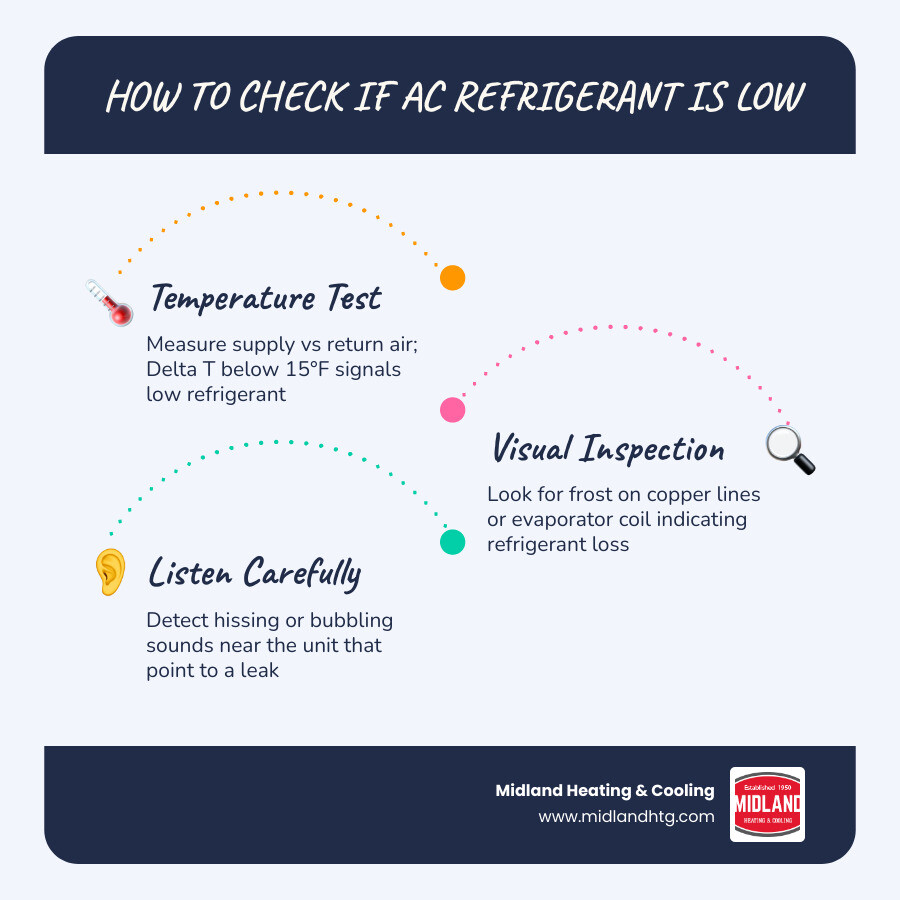
Method 1: How to check if AC refrigerant is low using the temperature difference test
The temperature difference test—often referred to by HVAC professionals as measuring the “Delta T” (temperature split)—is one of the most reliable ways to evaluate your system’s performance without specialized tools. This test measures the temperature difference between the air entering your system (return air) and the cold air blowing out of your vents (supply air).
To perform this test:
- Ensure your air filter is clean and all supply registers are fully open.
- Let your air conditioner run continuously for at least 15 minutes to allow the system pressures to stabilize.
- Take a digital thermometer and measure the temperature of the air at the return grille (where air enters the system to be cooled).
- Measure the temperature of the air coming directly out of one of your supply vents closest to the indoor unit.
- Subtract the supply air temperature from the return air temperature.
How to Interpret the Results:
- Normal Range (15°F to 20°F / 8°C to 11°C): Your system is operating efficiently and likely has a proper refrigerant charge.
- Low Temperature Split (Below 15°F / 7°C): Your system is not absorbing enough heat. If you have already ruled out airflow restrictions, this is a strong indicator of low refrigerant. Read more on Why Is AC Not Cooling Properly to understand how these temperature splits relate to system health.
- High Temperature Split (Above 21°F / 12°C): This usually indicates a severe airflow issue, such as a clogged filter or blocked ductwork, rather than low refrigerant.
Method 2: How to check if AC refrigerant is low by inspecting physical components
You can gather valuable clues about your refrigerant level by inspecting the copper lines connecting your indoor evaporator coil to your outdoor condenser unit.
Locate the two copper lines running into the outdoor unit. One line is thin and uninsulated (the liquid line), and the other is thicker and wrapped in black foam insulation (the suction or vapor line).
Carefully feel the copper connections where they enter the outdoor cabinet:
- The Suction Line (Thick, Insulated Copper Pipe): Under normal operating conditions, this pipe should feel cold to the touch and be covered in light condensation (often described as “sweating like a cold soda can on a hot July day”). If this pipe is warm, dry, or covered in a layer of white frost, your system is likely low on refrigerant.
- The Liquid Line (Thin, Uninsulated Copper Pipe): This line carries warm liquid refrigerant back to the indoor coil. It should feel warm to the touch (slightly above outdoor ambient temperature). If it feels cold or has frost forming on it, there is a pressure anomaly, which often points to a low charge or a restriction.
Method 3: Listening for Hissing or Bubbling Sounds
Because residential air conditioners are closed, pressurized systems, a refrigerant leak will often make distinct physical noises.
Walk outside to your condenser unit while it is running, and also check near your indoor air handler. Listen closely for:
- A Hissing Sound: This typically points to a high-pressure gas leak, often occurring near joint connections, service valves, or the copper coils.
- A Bubbling or Gurgling Sound: This sound occurs when the refrigerant level is low enough that bubbles of gas are mixing with the liquid refrigerant as it moves through the expansion valve or liquid line.
If you hear either of these sounds, turn off your system immediately to prevent physical damage to the compressor and contact a certified professional to locate the leak.
Why You Should Never DIY a Refrigerant Recharge
It can be tempting to search for a quick DIY solution online, but recharging a residential air conditioning system is not like adding oil to your car. It requires specialized tools, precise calculations, and strict adherence to federal and local environmental laws.
| Metric / Feature | DIY Observation (Homeowner) | Professional Manifold Gauge Testing (Licensed Tech) |
|---|---|---|
| Primary Tools Used | Thermometer, visual check, touch, and hearing | Manifold gauge sets, digital scales, temperature clamps |
| Measurement Accuracy | Qualitative (estimates based on symptoms) | Quantitative (exact pressures, superheat, and subcooling) |
| Safety Risks Involved | Extremely low (safe visual inspection only) | High (handling high-pressure gases, electrical hazards) |
| Environmental Compliance | No risk (no handling of chemical refrigerants) | Strictly regulated (EPA certification required) |
| Leak Detection Capability | Limited to large, audible leaks | Electronic detectors, nitrogen pressure tests, UV dye |
Legal and Safety Boundaries of Handling Refrigerant
In the United States, the handling of chemical refrigerants is strictly regulated under Section 608 of the Clean Air Act (codified in 40 CFR Part 82). It is legally required that anyone purchasing, handling, or adding refrigerant to an HVAC system hold an EPA Section 608 certification.
Attempting to bypass these regulations can result in substantial civil penalties. Furthermore, handling pressurized refrigerant without proper training carries severe physical safety risks, including:
- Severe Chemical Burns: Liquid refrigerant boils at extremely low temperatures. If it contacts your skin or eyes, it can cause instant frostbite and permanent tissue damage.
- Compressor Slugging: Adding too much refrigerant (overcharging) can cause liquid refrigerant to enter the compressor. Because liquids cannot be compressed, this will instantly destroy the compressor’s internal valves.
- Environmental Harm: Older refrigerants like R-22 and even common transition refrigerants like R-410A have high global warming potentials (GWP). Releasing them into the atmosphere contributes directly to environmental degradation.
How Professionals Safely Address Low Refrigerant Issues in AC System
When our certified technicians arrive at your Twin Cities home, we don’t just “top off” your system. We perform a comprehensive system diagnostic to Address Low Refrigerant Issues in AC System safely and permanently.
Our professional process includes:
- Connecting Manifold Gauges: We measure the exact suction (low-side) and liquid (high-side) pressures inside your system.
- Calculating Superheat and Subcooling: We use temperature clamps on the copper lines to calculate the exact superheat (for piston/TXV systems) and subcooling. This is the only way to know if a system is truly charged to the manufacturer’s precise specifications.
- Electronic Leak Detection: Because refrigerant does not deplete naturally, we use electronic leak sniffers, bubble solutions, or ultraviolet dyes to locate the physical leak.
- Repairing the Leak: We evacuate the remaining refrigerant, repair the leak (often by brazing copper joints or replacing damaged coils), and run a deep vacuum to remove moisture and non-condensable gases from the lines.
- Weighing in the Charge: Using a highly accurate digital scale, we weigh in the exact amount of refrigerant specified on your unit’s manufacturer rating plate.
Frequently Asked Questions About Low AC Refrigerant
Can low refrigerant damage my AC compressor?
Yes, running an air conditioner with low refrigerant is one of the quickest ways to destroy the compressor. The compressor is the “heart” of your AC system, and it relies on the cool return gas of the refrigerant to keep its motor cool during operation.
When refrigerant is low, the compressor overheats. Over time, this heat breaks down the lubricating oil inside the compressor, leading to mechanical friction, electrical shorts, and ultimate compressor failure. Replacing a compressor is a major repair, so turning off your system when you suspect low refrigerant is critical.
How often should my AC refrigerant levels be checked?
Under normal operating conditions, your AC refrigerant levels should never need to be checked or adjusted. Because your air conditioner is a factory-sealed system, the refrigerant is designed to last for the entire lifespan of the equipment.
However, having your system inspected during your annual maintenance visit is highly recommended. During this visit, a technician can monitor system performance and catch minor pressure changes before they lead to a system breakdown. For more tips on keeping your system running smoothly, check out our Essential AC Maintenance Tips.
What is the difference between checking home AC and car AC refrigerant?
While both systems operate on the same basic refrigeration cycle, there are major differences in how they are constructed and maintained:
- Automotive AC Systems: Car AC systems are subjected to constant vibration, road debris, and extreme temperature swings. Because of this, they use flexible rubber hoses and threaded fittings with O-rings that naturally weep small amounts of refrigerant over several years. They typically use R-134a or newer R-1234yf refrigerants.
- Residential HVAC Systems: Home air conditioners use rigid, solid-copper lines that are brazed (welded) together. Because there are no flexible rubber hoses, a residential system should remain 100% sealed. Any drop in refrigerant in a home AC system indicates a physical hole or structural crack that must be repaired.
Conclusion
If your air conditioner is struggling to keep your home comfortable during the humid Twin Cities summer, don’t let a hidden refrigerant leak compromise your comfort or damage your equipment. While the temperature split and physical pipe inspections are excellent ways to confirm your suspicions, resolving the underlying leak requires professional expertise.
At Midland Heating & Cooling, we have spent over 70 years delivering reliable, family-owned HVAC service to homeowners across Minneapolis, St. Paul, Edina, Bloomington, and the surrounding Twin Cities suburbs. Our certified technicians are fully equipped to diagnose, repair, and properly charge your air conditioning system to keep your home cool all summer long.
If you suspect your system is low on refrigerant, don’t wait for your compressor to fail. Schedule professional AC service with Midland Heating & Cooling today to restore your home’s comfort and efficiency.