

Is Your Old AC Unit Costing You More Than a New One Would?
Understanding how energy savings from a new AC unit offset replacement cost comes down to one straightforward comparison: what you’re spending now versus what you’d spend with a modern, efficient system.
Here’s a quick answer:
- Upgrading from a 10 SEER unit to a new high-efficiency system can cut your cooling costs by 20–40% annually
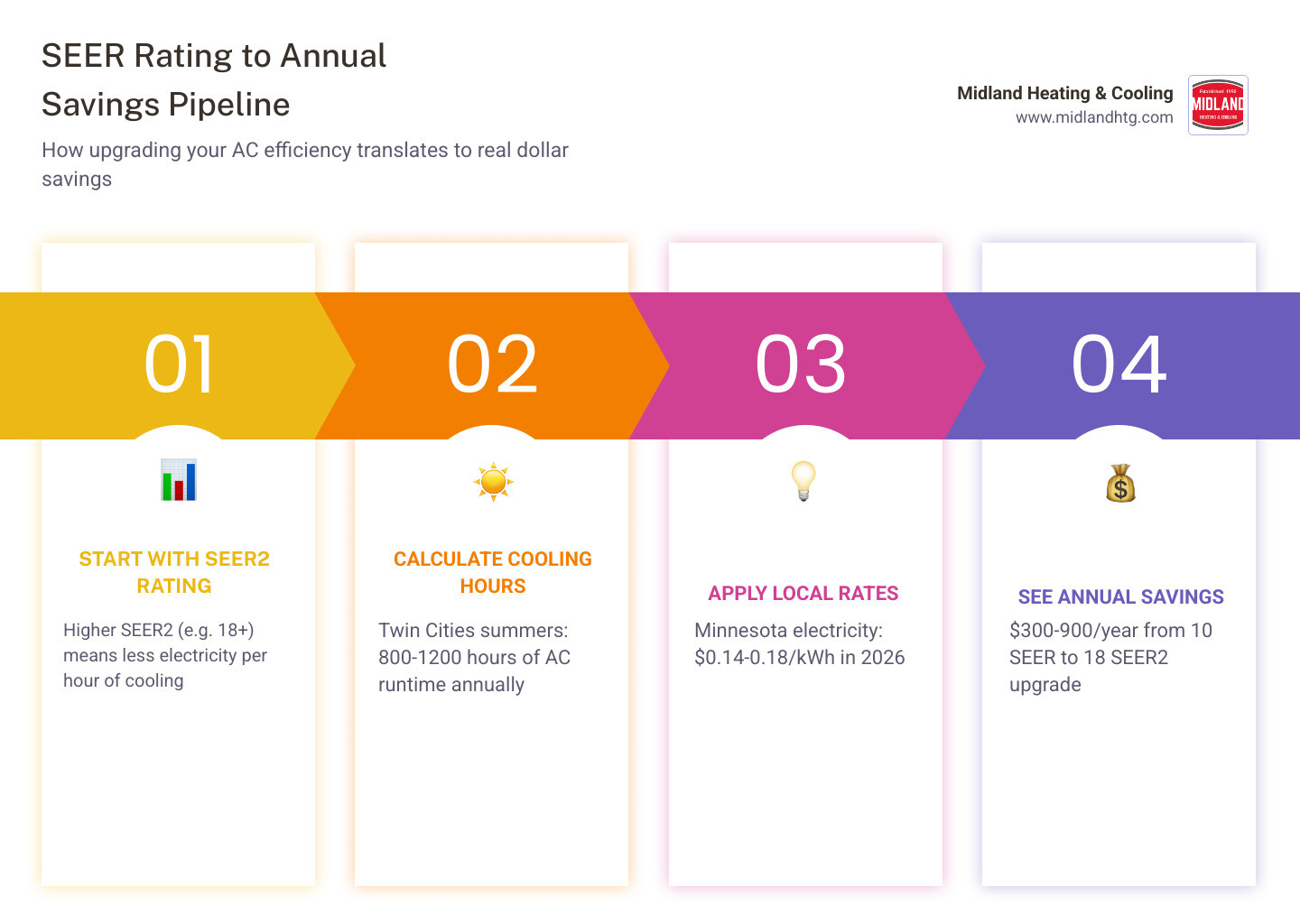
- Most U.S. homeowners save between $300 and $900 per year after a significant AC upgrade
- The typical payback period for a new high-efficiency AC unit is 7–12 years through energy savings alone
- Federal tax credits of up to $2,000 plus state and utility rebates can shorten that payback window considerably
- The older and less efficient your current unit, the faster a new system pays for itself
If your AC is more than 10 years old, chances are it’s running at a fraction of its original efficiency — and your power bill is reflecting that every single month. In the Twin Cities, where summer humidity pushes cooling systems hard, an aging unit doesn’t just struggle — it hemorrhages energy. And with electricity rates continuing to climb through 2026, that waste compounds fast.
The good news: a properly sized, correctly installed high-efficiency system doesn’t just cool your home better. It starts paying you back from day one.
Understanding the ROI: How Energy Savings from a New AC Unit Offset Replacement Cost
When we talk about Return on Investment (ROI) for a home appliance, we’re looking at how quickly the machine “pays for itself” through lower operating costs. In May 2026, with energy trends showing a steady rise in utility rates across Minnesota, this calculation is more relevant than ever.
The primary metric we use is the SEER2 rating (Seasonal Energy Efficiency Ratio 2). Think of SEER2 like the MPG for your car; the higher the number, the less fuel (electricity) it needs to go the distance. Most older units in neighborhoods like St. Louis Park or Hopkins are rated at 10 SEER or even lower. By today’s standards, those units are “energy hogs.”
| System Rating | Estimated Annual Cooling Savings | 5-Year Savings | 10-Year Savings |
|---|---|---|---|
| Old 10 SEER Unit | Baseline (No Savings) | $0 | $0 |
| New 13.4 SEER2 Unit | 23% Savings | $375+ | $750+ |
| New 16 SEER2 Unit | 33-40% Savings | $600+ | $1,200+ |
| New 18+ SEER2 Unit | 45-50% Savings | $900+ | $1,800+ |
As you can see, the jump from an old 10 SEER unit to a high-efficiency model isn’t just a minor improvement; it’s a massive reduction in waste. This transition is why Ac Replacement is often more of a financial strategy than a simple home repair.
Beyond the monthly bill, a new system offers a longer operational lifespan. While an old unit might be on its last legs, a new Hvac System Upgrade provides 15 to 20 years of reliable service, effectively spreading the initial investment over two decades of comfort.
Key Factors That Determine Your Long-Term Savings
Not every home will see the exact same savings. To truly understand how energy savings from a new AC unit offset replacement cost for your specific situation, we have to look at the “ecosystem” of your home.
- Home Square Footage: A 3,000-square-foot home in Eden Prairie requires more cooling power than a 1,200-square-foot bungalow in Minneapolis. The larger the home, the more electricity the AC consumes, and consequently, the more money you stand to save by switching to a high-efficiency model.
- Insulation Quality: Even the best AC unit can’t save you money if the cold air is escaping through a poorly insulated attic.
- Ductwork Integrity: Leaky ducts can waste up to 20-30% of your conditioned air before it even reaches your living room. When we perform an installation, we often find that sealing these gaps is one of the best Ways To Maximize Hvac Systems Efficiency.
How energy savings from a new AC unit offset replacement cost through SEER2 ratings
In 2023, the Department of Energy updated efficiency standards to SEER2. For those of us in the North (including all our Twin Cities service areas), the new minimum is 13.4 SEER2. However, “minimum” doesn’t mean “optimal.”
If you choose an Energy Star-certified unit with a rating of 17 or 18 SEER2, you are entering the territory of 40% energy reductions. This is where the math starts to get exciting. If your summer cooling bills currently average $250 a month, a 40% reduction puts $100 back in your pocket every month of the cooling season. Over the 15-year life of the unit, that’s $1,500 to $2,000 in savings—and that’s assuming electricity rates don’t go up (which they likely will). These are the Tips For Choosing Right Hvac System that help our clients make smart long-term moves.
Impact of local climate on how energy savings from a new AC unit offset replacement cost
Minnesota’s climate is unique. We deal with “The Big Humid.” In areas like Bloomington and Wayzata, the AC unit isn’t just fighting the heat; it’s fighting the moisture in the air.
Modern high-efficiency units, especially those with variable-speed compressors, are masters of dehumidification. Unlike old units that are either “100% on” or “off,” variable-speed units can run at lower, steadier levels. This removes more humidity while using significantly less power. Because our summers are shorter but more intense than the South, having a unit that can precisely manage these “runtime hours” is the key to maximizing your ROI.
The “50% Rule”: When to Stop Repairing and Start Replacing
Every homeowner faces the same dilemma: “Do I fix it one more time, or is it time to let go?” To take the emotion out of the decision, we recommend the 50% Rule.
If a single repair costs 50% or more of what a new system would cost, you should replace it. But there’s a more nuanced version for older units: The $5,000 Rule. Multiply the age of your unit by the repair estimate. If the total is more than $5,000, replacement is the smarter financial move.
For example:
- Scenario A: Your 12-year-old unit needs a $600 repair. (12 x 600 = 7,200). Replace it.
- Scenario B: Your 5-year-old unit needs a $400 repair. (5 x 400 = 2,000). Repair it.
Another factor forcing the hand of many homeowners in St. Paul and Excelsior is the R-410A refrigerant phase-out. Much like the R-22 (Freon) phase-out before it, the chemicals used in older units are becoming scarce and incredibly expensive. If your older unit has a leak, you might find that the cost of the refrigerant alone makes the repair unjustifiable. If you’re seeing Signs Ac Needs Replacement This Winter, it’s better to plan ahead than to wait for a total breakdown in July. For many, Ac Replacement in the “off-season” is the best way to secure the best equipment availability.
Maximizing Your Efficiency Gains Post-Installation
Once your new unit is installed, the work of saving money doesn’t stop. To ensure you continue to see how energy savings from a new AC unit offset replacement cost, you need a plan for the future.
- Smart Thermostats: Upgrading to a smart thermostat can shave an additional 10-15% off your cooling bills by learning your schedule and reducing usage when you’re away.
- Filter Cycles: A dirty filter can increase energy use by 5-15%. We recommend checking them monthly during the peak summer months.
- Annual Tune-ups: Just like a car, your AC needs a “check-up” to stay at peak performance. We cannot stress enough that Regular Hvac Maintenance Is Important. A unit that is slightly low on refrigerant or has a dirty condenser coil will work harder and die younger.
By following Important Hvac Maintenance Tips, you protect your investment. Many of our customers in the Twin Cities find that an Hvac Maintenance Plan Minneapolis Mn is the easiest way to ensure these tasks never get forgotten.
Frequently Asked Questions about AC Efficiency
What is the typical payback period for a high-efficiency AC unit?
For most homeowners in the Midwest, the payback period is typically 7 to 12 years. However, if you are replacing a particularly old unit (15+ years) or if you utilize federal tax credits and local utility rebates, that window can shrink to as little as 5 years. Given that a new unit should last 15-20 years, you’ll likely enjoy 5 to 10 years of “pure profit” in the form of lower bills after the unit has paid for itself.
Do federal tax credits and local rebates apply to new AC installations in 2026?
Yes! Under the Inflation Reduction Act, federal tax credits (25C) are available for high-efficiency central AC units and heat pumps. You can often claim up to $2,000 for qualifying heat pumps or $600 for high-efficiency central AC. Additionally, local Minnesota utility providers like Xcel Energy and CenterPoint often offer rebates ranging from $150 to over $1,000 for installing Energy Star-certified equipment.
Should I replace my furnace at the same time as my AC for better savings?
In many cases, yes. Your furnace’s blower motor is what moves the air for your AC. If you put a high-efficiency AC on an old, inefficient furnace blower, you won’t realize the full SEER2 potential of the new unit. Replacing them together ensures the systems are perfectly matched, often qualifies you for larger “bundled” rebates, and saves you money on labor costs since the technicians are already on-site.
Conclusion
At Midland Heating & Cooling, we’ve spent over 70 years helping our neighbors in Minneapolis, St. Paul, and the surrounding suburbs stay comfortable without breaking the bank. We know that a new air conditioner is a significant investment, but when you look at the math, it’s clear: keeping an old, failing unit is often the more expensive choice.
By understanding how energy savings from a new AC unit offset replacement cost, you can move from “bleeding cash” to building long-term home value. Whether you’re in St. Louis Park, Eden Prairie, or Minnetonka, our certified technicians are ready to help you find the system that fits your home and your budget perfectly.
Don’t wait for the next heatwave to decide. Schedule your professional AC assessment today and let us show you exactly how much you could be saving.