

Facing a Major HVAC Breakdown in the Twin Cities?
Your furnace just stopped running on the coldest night of the year, and while searching for home maintenance tips and troubleshooting is usually the first instinct, you are now staring down a massive repair quote. Experiencing a sudden heating or cooling failure is highly stressful, especially when extreme Minnesota weather makes indoor climate control a matter of safety rather than just comfort. You are suddenly forced to make a major financial decision under intense pressure.
The primary dilemma you face is evaluating whether a costly repair on an aging system is financially sound, or if it is simply throwing good money after bad. When a core component fails, it is easy to default to the cheapest immediate fix just to get the air flowing again. However, patching a dying system often leads to a cycle of repeated breakdowns and escalating costs.
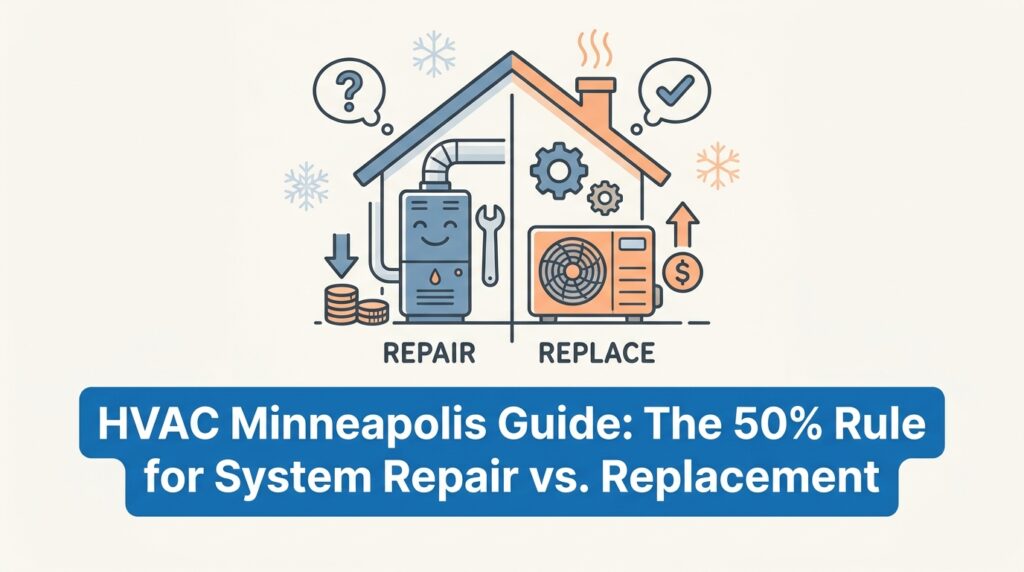
To make the smartest long-term investment, you need an objective evaluation framework rather than a high-pressure sales pitch. Understanding the true cost-benefit ratio of repairing versus replacing requires looking at hard data. By applying established guidelines—like the 50% rule for repair cost versus replacement value—you can remove the emotion from the situation and determine exactly which path makes the most financial sense for your home.
Safe HVAC Troubleshooting: What Homeowners Can Check First
Before you start calculating replacement costs or paying for an emergency diagnostic fee, there are several safe, basic checks you should perform. Often, what appears to be a total system failure is actually a minor operational hiccup. A typical pattern we see locally highlights this perfectly: one Minneapolis homeowner recently faced a furnace that stopped working just as a bitter winter freeze was approaching. Before a technician arrived quickly to restart the system and set up a proactive maintenance plan, the initial step was ruling out basic airflow and power issues.
Here are the safe troubleshooting steps you can take to clarify whether a major repair is actually needed:
- Check the thermostat batteries and settings: A blank screen or a thermostat set to the wrong mode (e.g., “cool” instead of “heat”) is one of the most common causes of a system failing to start. Replace the batteries and ensure the unit is set to “auto” rather than “on.”
- Inspect and replace dirty air filters: A severely clogged air filter restricts airflow so much that the system may overheat and shut down as a safety precaution. Pull the filter out and hold it up to a light; if you cannot see light through it, replace it immediately.
- Ensure all vents and registers are unblocked: Walk through your home and check that furniture, rugs, or heavy curtains are not blocking the supply and return vents. Closed vents increase static pressure inside the ductwork, forcing the blower motor to overwork.
- Verify the circuit breakers: Check your main electrical panel to see if the breaker for the furnace or air conditioner has tripped. Reset it once. If it trips again immediately, stop—this indicates a serious electrical short.
The limits of safe DIY: It is critical to explicitly warn against opening the equipment cabinet or attempting internal electrical and mechanical repairs. HVAC systems contain high-voltage capacitors, combustible gas lines, and complex circuitry. Any internal troubleshooting requires a licensed professional. If the basic steps above fail to restore operation, rapid professional diagnostics are the required next step.
How Extreme Minnesota Weather Accelerates HVAC Wear and Tear
When evaluating the lifespan of your heating and cooling equipment, national averages only tell part of the story. According to standard equipment life expectancy charts from organizations like ASHRAE (The American Society of Heating, Refrigerating and Air-Conditioning Engineers), a typical furnace or air conditioner should last between 15 and 20 years. However, those averages include mild climates where systems sit idle for months at a time.
The local climate in the Twin Cities paints a very different picture. With severe swings from sub-zero freezing winters to hot, humid summers regularly exceeding 90 degrees, your HVAC system is forced to run at peak capacity nearly year-round. There is very little “shoulder season” resting time for the mechanical components.
This continuous, heavy strain accelerates mechanical degradation and shortens the effective lifespan of core components. Heat exchangers expand and contract violently during extreme cold snaps, increasing the risk of stress cracks. Compressors work overtime fighting high summer humidity, leading to premature motor wear. Age must be weighted much more heavily in this climate when calculating replacement viability.
Another typical situation involved a local customer whose furnace would not start with freezing weather forecasted. A technician arrived the same day to resolve the problem quickly and restore heat, but the underlying cause was heavy mechanical wear from years of relentless winter operation. When a system reaches the 10-to-12-year mark in this region, it has often endured the equivalent wear and tear of a 15-year-old system in a milder climate.
The 50% Rule: A Mathematical Framework for Repair vs. Replacement
When you are handed a steep repair estimate, the decision-making process can feel overwhelming. To cut through the uncertainty, industry experts rely on a core objective formula known as the 50% rule. This mathematical framework helps you evaluate your current repair quote objectively, based on the repair cost versus the replacement value.
Defining the 50% Rule: The concept is straightforward. If the quoted repair cost exceeds half the value of a comparable new system, replacement is generally the better financial choice. Pumping massive amounts of capital into a failing unit yields diminishing returns, as the remaining components are still old and likely to fail soon.
The Age Multiplier Variation: For a more granular assessment, many professionals use the “Age multiplied by Repair Cost” variation. You take the age of the equipment in years and multiply it by the estimated repair cost. If that number exceeds a specific threshold (often calculated against the baseline cost of a new unit), you should lean heavily toward replacement.
Here is a conceptual example of how this objective math removes emotion from the decision:
- The Scenario: You have a 12-year-old air conditioner that needs a new compressor.
- The Math: When you multiply the high cost of a compressor replacement by 12 years of age, the resulting figure is exceptionally high.
- The Reality: Even after installing the new compressor, you still have a 12-year-old condenser coil, an aging fan motor, and outdated electrical contactors. The expensive repair does not reset the clock on the rest of the system.
Using this mathematical framework protects you from the sunk-cost fallacy. It ensures that every dollar you spend is an investment in future reliability rather than a temporary bandage on a terminal problem.

Factoring in Efficiency Degradation and Operating Costs
The repair quote is only one part of the financial equation. To make a truly informed decision, you must expand your evaluation to include the hidden costs of running an older, less efficient system. Heating and cooling equipment does not maintain its factory efficiency rating forever.
According to Energy.gov guidelines on heating and cooling efficiency, systems experience gradual performance loss over time. This means that older systems cost more in monthly energy consumption, even when they are functioning “normally” without any broken parts. Dust accumulation, microscopic wear on blower bearings, and degraded heat transfer surfaces all force the system to consume more electricity or natural gas to produce the same amount of comfort.
Consider the degraded efficiency of a 12-plus-year-old unit. A furnace that was originally rated at 80% AFUE (Annual Fuel Utilization Efficiency) might only be operating at 65% AFUE after a decade of heavy Minnesota winters. That means 35 cents of every dollar you spend on heating fuel is being exhausted out the flue pipe as waste.
Contrast this with the advanced AFUE and SEER (Seasonal Energy Efficiency Ratio) ratings of modern replacements. Today’s high-efficiency furnaces routinely operate at 95% to 98% AFUE. The energy savings generated by upgrading to a modern system actively offset the initial installation investment over time. When you apply the 50% rule, you must factor in these guaranteed monthly utility savings, as retaining an older unit essentially locks you into a high, ongoing “inefficiency tax.”
Evaluating the Long-Term Reliability of Your Heating and Cooling System
Beyond the immediate broken component and the monthly energy bills, you must assess the overall health and future viability of the system. Patching a dying system often leads to another emergency breakdown in the near future, which is exactly what the 50% rule is designed to prevent.
First, consider the frequency of past breakdowns. If you have had to call a technician out two or three times over the last few years for various minor issues, that is a clear indicator of systemic decline. A single failed capacitor is a normal maintenance event; a failed capacitor followed by a bad inducer motor and a struggling blower is a system waving a white flag.
Next, you must look at the availability and cost of replacement parts for older models. Environmental regulations heavily impact older equipment. For example, the EPA mandated the phase-out of R-22 refrigerant. If your older air conditioner uses R-22 and develops a leak, recharging it is astronomically expensive—if you can even find the refrigerant. Similarly, older furnace control boards often become obsolete, meaning a simple electrical failure could force a total system replacement regardless of your preferences.
Finally, weigh the intangible value of peace of mind and warranty protections. During an extreme cold snap, worrying about whether your patched-together furnace will survive the night carries a heavy mental toll. A new system provides robust manufacturer warranties, ensuring that if something does go wrong, you are financially protected. If you are noticing signs of systemic decline, reaching out for professional furnace repair services in Minneapolis can help you determine exactly what parts are obsolete and what life remains in the unit.
Frequently Asked Questions About HVAC Lifespans and Repairs
What is the 50 percent rule for HVAC replacement?
The 50 percent rule is a financial threshold used to determine when a system is no longer worth saving. If the quoted repair costs exceed half the value of a comparable new system, replacement is generally the better financial choice. This objective rule helps homeowners avoid pouring large sums of money into aging equipment that will likely fail again soon. It provides a clear, math-based boundary to guide your investment.
How long does an HVAC system last in Minnesota?
While national averages suggest an HVAC system should last 15 to 20 years, local extreme temperature swings often reduce this timeframe. In Minnesota, systems run at maximum capacity through sub-zero winters and high-humidity summers, accelerating mechanical wear. Because of this heavy year-round strain, many local units begin showing signs of systemic decline around the 12-to-15-year mark. Regular maintenance is the only way to push a system closer to the 20-year national average in this climate.
What HVAC troubleshooting can I do myself safely?
Safe, homeowner-level troubleshooting is limited to checking external factors that restrict airflow or power. You should always check your thermostat settings and batteries, replace dirty air filters, and ensure all room vents are open and unblocked. You can also verify that the main circuit breaker has not tripped. However, you must explicitly avoid opening the equipment cabinet or attempting internal mechanical repairs, as these systems contain high voltage and combustible gas.
Is it worth repairing a 15-year-old furnace?
Applying the objective framework, it is rarely worth sinking major funds into a 15-year-old furnace. You must factor in the current repair cost, the significant efficiency loss the unit has suffered over a decade and a half, and the high likelihood of future component breakdowns. Unless the repair is a very minor, inexpensive fix (like a basic sensor replacement), investing that money into a high-efficiency modern system yields a much better long-term return.
How does efficiency degradation affect my energy bills?
As HVAC components age, they experience microscopic wear, dust buildup, and reduced heat transfer capabilities. This means aging components draw more power and burn more fuel to achieve the exact same temperature in your home. Consequently, your monthly utility costs steadily increase over the years, even if the system appears to be running normally. Upgrading to a new unit eliminates this wasted energy and immediately lowers operating costs.
Make an Informed HVAC Decision with Local Twin Cities Experts
Using a logical, math-based framework provides immediate clarity when assessing your system’s remaining lifespan. By applying the 50% rule, factoring in efficiency degradation, and acknowledging the heavy toll of our local climate, you can confidently decide whether to repair or replace your unit. Understanding the true cost-benefit of repairing versus replacing protects your long-term investment and keeps your home safe during extreme weather.
To get the exact data needed for your specific unit, it is best to seek an objective, professional evaluation. With proven local expertise in managing Minnesota’s extreme climate variations with prompt, professional heating and cooling solutions, you can receive a clear, pressure-free assessment. Having the right information ensures you make a choice that delivers lasting comfort, lower energy bills, and total peace of mind for years to come.