

Why High Humidity Makes Your AC Work Harder in the Upper Midwest
How high humidity makes your AC work harder in the Upper Midwest is something most Twin Cities homeowners feel every summer — even if they can’t explain exactly why. When the air gets thick and sticky in July and August, your air conditioner isn’t just fighting the heat. It’s fighting moisture, too.
Here’s the short answer:
- Your AC has two jobs: lower the temperature and remove moisture from the air
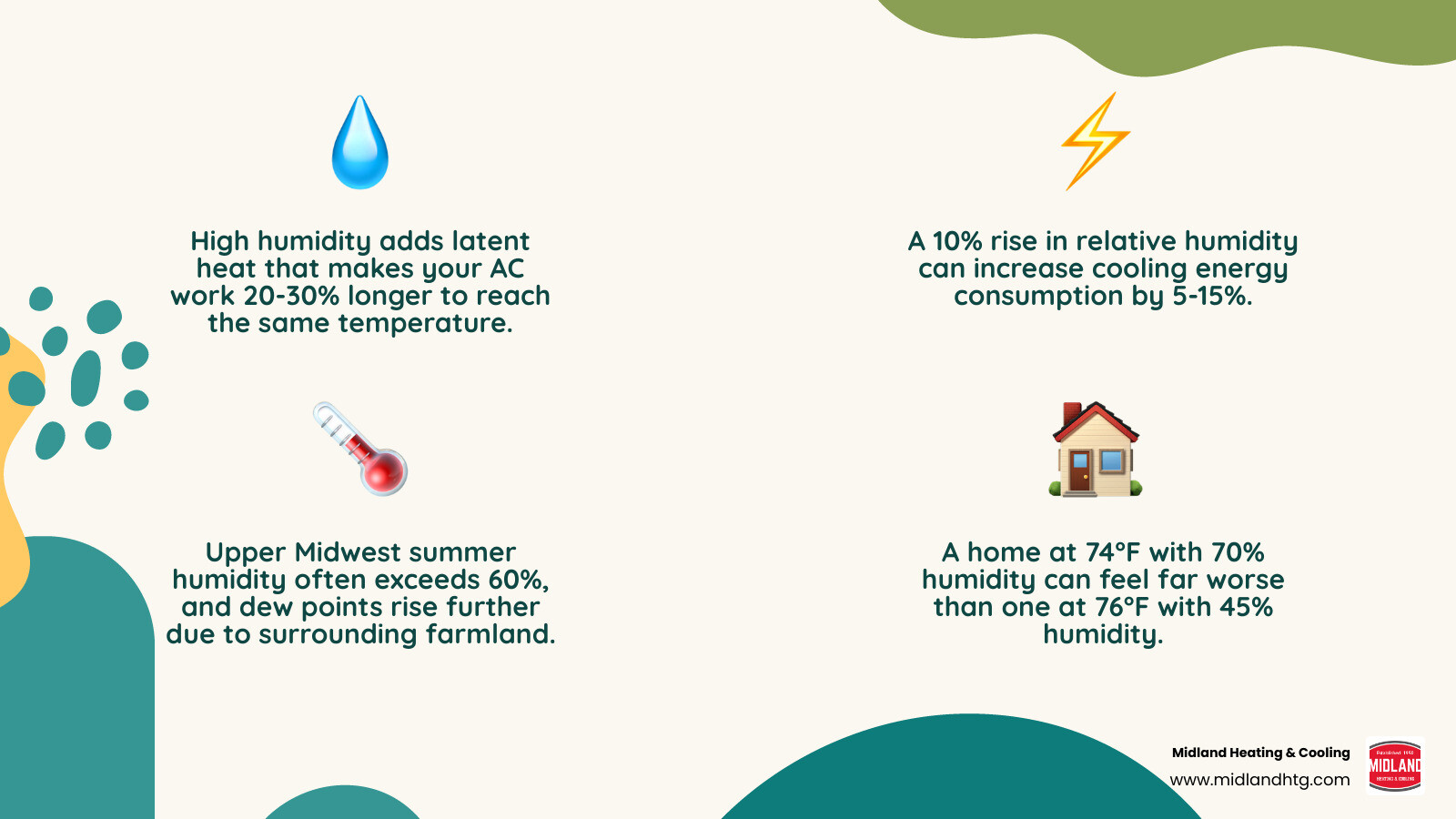
- High humidity adds a second, invisible workload called latent heat — the energy needed to pull water vapor out of the air
- More moisture = longer run times: In humid conditions, AC systems may need to run 20–30% longer to hit the same temperature setpoint
- Energy use climbs: A 10% rise in relative humidity can increase cooling energy consumption by 5–15%
- Upper Midwest summers are especially tough: Summer humidity in Minnesota and surrounding states regularly exceeds 60% relative humidity — and agricultural “corn sweat” from surrounding farmland can push dew points even higher in July and August
- The result: Your system works harder, wears faster, and your energy bills go up — even if your thermostat hasn’t changed
The discomfort isn’t just in your head. High humidity slows down your body’s natural cooling process (sweat evaporation), so a home at 74°F with 70% humidity can feel far worse than one at 76°F with 45% humidity.
The Science of How High Humidity Makes Your AC Work Harder in the Upper Midwest
To understand why a humid day makes your air conditioner run endlessly, we have to look at the physics of cooling. Many homeowners think an air conditioner simply “creates” cold air and blows it into the room. In reality, your air conditioner is a heat conveyor. It works by absorbing heat from inside your home and dumping it outdoors.
When relative humidity spikes above 60% in places like Minneapolis, St. Paul, and Bloomington, the physical nature of the air changes. Humid air holds a massive amount of thermal energy compared to dry air. This is where we must distinguish between two types of heat: sensible heat and latent heat.

- Sensible Heat: This is the heat energy you can actually measure with a standard thermometer. When your thermostat reads 78°F and you want it to be 72°F, that 6-degree difference represents sensible heat.
- Latent Heat: This is the hidden energy stored in water vapor. It does not register on a thermometer, but it represents the energy required to change water from a gas (vapor) to a liquid (condensation).
During the refrigeration cycle, your indoor blower fan pushes warm, humid air across a very cold evaporator coil. As the air contacts the cold metal of the coil, two things happen simultaneously: the air temperature drops (sensible cooling), and water vapor condenses out of the air onto the coil (latent cooling).
If the air entering your system is incredibly wet, the evaporator coil has to spend a massive amount of its cooling capacity condensing that water vapor before it can effectively lower the air temperature. In fact, latent heat removal can account for up to 25% of your system’s total energy use during a sticky Minnesota July.
When the system is overwhelmed by this moisture, the water coating the evaporator coil can actually act as an insulating barrier, reducing heat transfer efficiency. In severe cases, if airflow is restricted or the refrigerant charge is slightly off, this excess condensation can freeze, leading to an AC Freezing Up During Hot Summer Days.
Understanding How High Humidity Makes Your AC Work Harder in the Upper Midwest
When we talk about the latent heat load, we are talking about a major mechanical challenge. Because water has a very high heat capacity, wet air requires significantly more energy to cool than dry air.
As your air conditioner runs, the cold evaporator coil acts as a magnet for moisture. The water vapor in your household air hits the freezing-cold coil, reaches its dew point, converts to liquid water, and drips down into a condensate drain pan.
This process is highly effective, but it comes at a cost:
- Reduced Sensible Cooling Capacity: Because the cooling coil is busy condensing gallons of water out of the air, it has less capacity left over to actually lower the air temperature. Your 3-ton air conditioner might perform like a 2-ton system because so much of its energy is dedicated to dehumidification.
- Insulation Effect: As water heavily coats the metal fins of your evaporator coil, it creates a surface barrier. This barrier makes it harder for the refrigerant flowing through the copper lines to absorb sensible heat from the passing air.
- Sensor and Control Issues: Extended run times and high indoor humidity can lead to localized moisture buildup around electronic controls, leading to frustrating AC Thermostat Problems in Humid Weather.
Why How High Humidity Makes Your AC Work Harder in the Upper Midwest Affects Your Energy Bills
In the Upper Midwest, our summer weather is heavily influenced by moisture traveling north from the Gulf of Mexico, compounded by local lakes and agricultural transpiration (often called “corn sweat”). A single acre of mature corn can release up to 4,000 gallons of water into the atmosphere every single day. When this moisture-laden air settles over Edina, Eden Prairie, or Minnetonka, your air conditioner is forced to run much longer cycles.
Because the system is prioritizing latent heat removal over sensible cooling, it may take 20% to 30% longer to lower your home’s temperature to your thermostat’s setpoint.
Longer run times translate directly to higher electric bills. A 10% increase in relative humidity can raise your summer cooling costs by 5% to 15%. Furthermore, running your compressor and blower motor for hours on end accelerates mechanical wear and tear, shortening the lifespan of your system and increasing the likelihood of mid-summer breakdowns. This is why keeping up with Air Conditioning Preventative Maintenance Minneapolis MN is absolutely critical for keeping utility bills manageable and protecting your equipment.
Signs Your AC is Struggling with Upper Midwest Humidity
Your air conditioner won’t always shut down completely when it’s overwhelmed by humidity, but it will drop hints that it is working overtime.
If you live in St. Louis Park, Hopkins, or St. Paul, keep an eye out for these telltale signs of humidity-induced system strain:
- The “Cool but Clammy” Feeling: If your thermostat says 71°F but you still feel sticky, warm, and uncomfortable, your AC is failing to remove enough moisture. This often happens if your system is oversized; it cools the air so fast (short-cycling) that it shuts off before completing the longer cycles needed to condense moisture out of the air.
- Window Condensation: Foggy windows or beads of water forming on the inside of your glass panes mean your indoor relative humidity is dangerously high (often well above 60%).
- Musty Odors from the Vents: When an AC runs constantly in high humidity, the dark, damp interior of your ductwork and evaporator coil housing becomes a breeding ground for mold and mildew. This can severely impact your family’s health and comfort. If you notice these smells, you should look into professional Ways to Improve Indoor Air Quality.
- Ice on the Outdoor Lines or Indoor Coil: If your AC is running continuously to fight humidity, the constant condensation can freeze if there is even a slight restriction in airflow (like a dirty filter) or a minor refrigerant leak.
- Frequent On/Off Cycling (Short-Cycling): If your air conditioner turns on, runs for five minutes, and shuts off, it isn’t running long enough to lower the dew point. The air will feel cold but incredibly damp.
How to Protect Your HVAC System and Improve Efficiency
Fortunately, you don’t have to just suffer through the muggy Twin Cities summers. There are highly effective ways to manage indoor humidity, ease the load on your air conditioner, and keep your energy bills in check.
One of the most effective solutions is upgrading your HVAC system’s technology or pairing it with dedicated dehumidification. Below is a comparison of how different system setups handle high humidity:
| Feature / Performance Metric | Standard Single-Stage AC System | Variable-Speed AC System | Variable-Speed AC + Whole-Home Dehumidifier |
|---|---|---|---|
| Compressor Operation | Runs at 100% capacity or is completely off. | Adjusts speed incrementally (from 25% to 100%) based on cooling demand. | Adjusts speed dynamically while a dedicated unit manages moisture independently. |
| Dehumidification Ability | Moderate. Only removes moisture while actively cooling. | High. Runs longer, lower-capacity cycles to extract maximum moisture. | Excellent. Can run dehumidification even when no active cooling is needed. |
| Cycle Length | Shorter, frequent cycles (can lead to “cool but clammy” rooms). | Longer, continuous, low-energy cycles. | Perfectly optimized. Eliminates short-cycling moisture issues. |
| Energy Efficiency | Standard. High energy spikes during start-up. | Very High. Avoids frequent start-up spikes. | Maximum Comfort & Efficiency. AC doesn’t have to over-cool to remove humidity. |
| Lifespan & Wear | Higher wear due to constant on/off cycling. | Lower wear due to smooth, continuous operation. | Lowest wear. Both systems share the environmental load. |
Whole-Home Dehumidifiers vs. Variable-Speed Systems
If you want to take the strain off your air conditioner, installing a whole-home dehumidifier is one of the best investments you can make. Integrated directly into your existing ductwork, it pulls moisture out of the air before it ever reaches your AC’s evaporator coil. This means your air conditioner only has to focus on sensible cooling (lowering the temperature), allowing it to run shorter, highly efficient cycles.
Alternatively, upgrading to a variable-speed AC system allows the equipment to run at lower capacities for longer periods. These long, slow cycles are incredibly effective at pulling moisture out of the air without over-cooling your home.
To keep your current system running as efficiently as possible during the peak of summer, follow these Essential AC Maintenance Tips:
- Change Your Air Filter Regularly: A clogged filter restricts airflow, which reduces your system’s ability to remove moisture and can cause the coil to freeze.
- Keep Condensate Drains Clear: Ensure the drain line is free of algae and debris so the condensed water can exit your home safely.
- Use Exhaust Fans: Run bathroom and kitchen exhaust fans during and for 20 minutes after showering or cooking to eject moisture directly outside.
- Schedule Professional Tune-Ups: Always Schedule Pre-Summer AC Maintenance to verify your system’s refrigerant charge and coil cleanliness before the heavy humidity sets in.
Frequently Asked Questions About Midwest Humidity and Cooling
What is the ideal indoor humidity level for homes in the Upper Midwest?
For optimal comfort, energy efficiency, and health, you should aim to keep your indoor relative humidity between 30% and 50%. During our humid summers, keeping it under 50% prevents mold growth, deters dust mites, and allows your body to cool itself naturally through sweat evaporation. If your indoor humidity regularly climbs above 60%, your home becomes highly susceptible to mold, musty odors, and structural damage like warped wood flooring.
Does an oversized air conditioner help control indoor humidity?
No, it actually makes the problem much worse. An oversized air conditioner will cool your home down incredibly fast. Because it reaches your thermostat’s target temperature in just a few minutes, it shuts off prematurely (a process called short-cycling).
Since moisture removal occurs gradually as air passes over the cold evaporator coil, a system needs to run continuous cycles of at least 15 to 20 minutes to effectively lower the humidity. An oversized system will leave your home feeling cold, damp, and clammy. This is why proper system sizing and professional guidance are so important; to learn more about keeping your system running smoothly, read about Why Regular AC Service is Crucial.
Can high humidity cause my air conditioner to freeze up?
Yes, absolutely. When humidity is high, your evaporator coil is constantly dripping with water. If your system suffers from restricted airflow (due to a dirty air filter, blocked return vents, or a failing blower motor), the temperature of the coil can drop below freezing. This causes the heavy layer of condensation to instantly turn to ice.
Once ice forms, it acts as an insulator, blocking heat transfer entirely and causing the system to stop cooling. If you notice ice forming on your indoor or outdoor refrigerant lines, turn the system off immediately and call a professional. You can take proactive steps to avoid this by learning how to Prevent AC Problems Before Summer Arrives.
Conclusion
High summer humidity in the Upper Midwest is an unavoidable challenge, but an overworked, inefficient air conditioner doesn’t have to be. By understanding how moisture forces your system to work harder, you can take proactive steps to protect your equipment, lower your energy bills, and keep your home perfectly comfortable all summer long.
At Midland Heating & Cooling, we have spent over 70 years helping homeowners across the Twin Cities navigate our unique seasonal climate. As a local, family-owned business, we are committed to providing 100% customer satisfaction. Our certified technicians serve St. Louis Park, Minneapolis, Edina, Eden Prairie, Minnetonka, Hopkins, Bloomington, Wayzata, Excelsior, and St. Paul with expert repairs, precision maintenance, and high-efficiency system installations.
Whether you need a seasonal tune-up, a variable-speed upgrade, or a whole-home dehumidifier installation to conquer the summer mugginess, we are here to help.
Ready to restore cool, dry comfort to your Twin Cities home? Explore our professional Air Conditioning Services or sign up for our comprehensive HVAC Maintenance Plan Minneapolis MN today!