

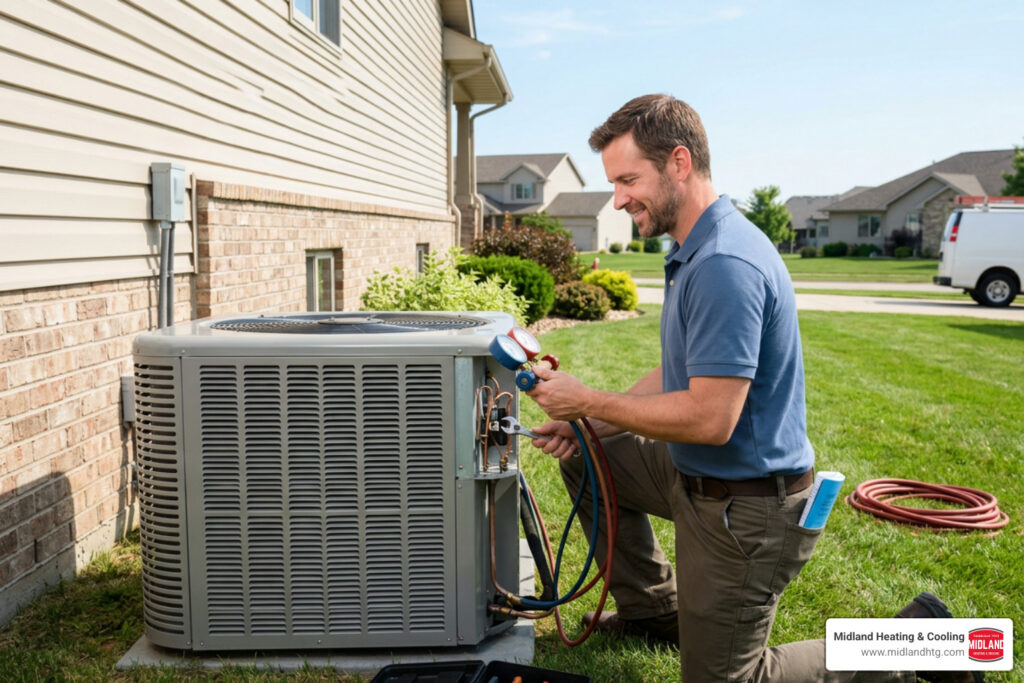
Why AC Tune-Ups Prevent Breakdown During the First Heat Wave
Understanding why ac tune-ups prevent breakdowns during the first heat wave could save you from a very uncomfortable — and expensive — summer. Here’s the short answer:
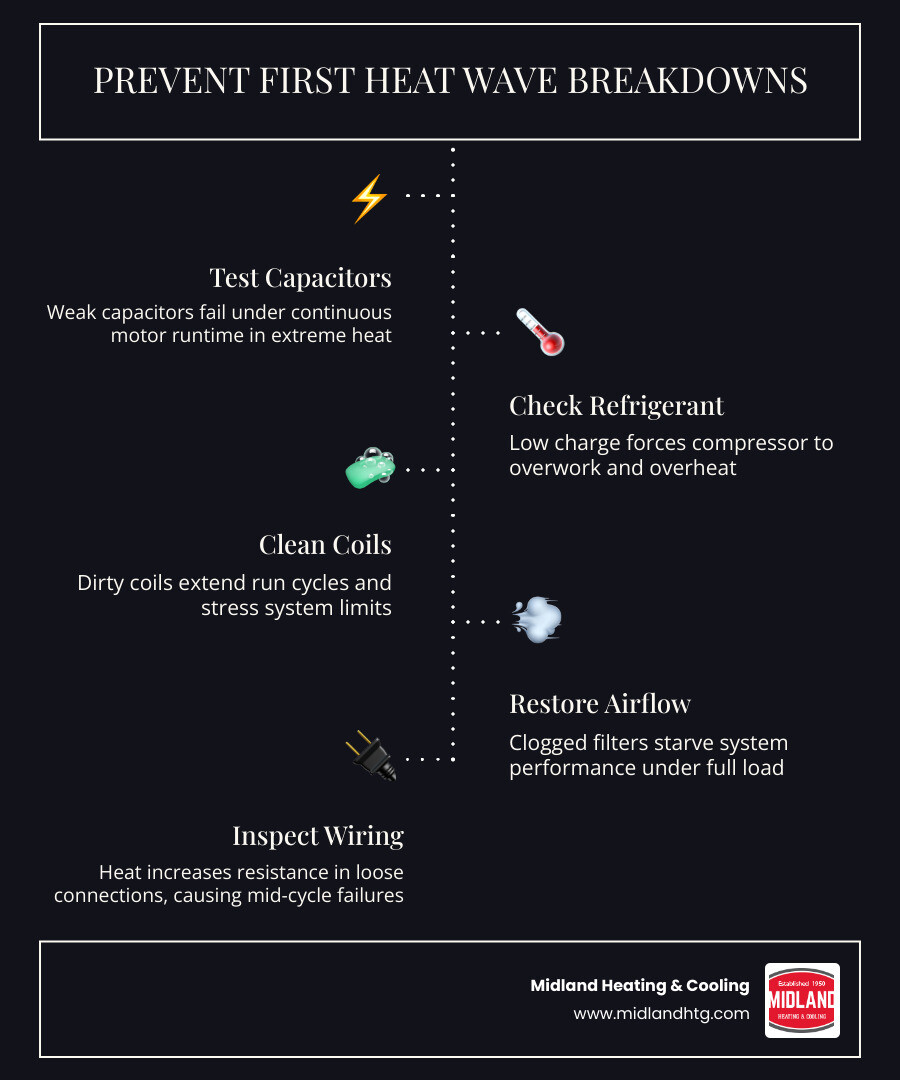
AC tune-ups prevent first heat wave breakdowns because they catch hidden problems before extreme heat exposes them:
- Capacitors tested — weak capacitors fail when motors run continuously for hours in peak heat
- Refrigerant levels checked — low charge causes the compressor to overwork and overheat
- Coils cleaned — dirty coils force longer run cycles that push components past their limits
- Airflow restored — clogged filters and blocked vents starve the system under full load
- Electrical connections inspected — heat increases resistance in loose wiring, triggering failures mid-cycle
- Condensate drains cleared — peak condensation volume clogs neglected drains, shutting the system down
Your air conditioner rarely fails on a mild spring day. It fails during the first sustained stretch of 90°F-plus heat — exactly when every HVAC technician in the Twin Cities is already booked solid. That’s not bad luck. It’s physics. Systems that have sat dormant through fall and winter accumulate dust, develop small amounts of wear, and lose efficiency quietly. None of that matters much when the AC only runs for an hour on a comfortable afternoon. But when temperatures spike and the system has to run for 12 or more hours straight, every small weakness becomes a real problem.
Only about 42% of homeowners invest in annual HVAC maintenance — which means the majority are rolling the dice every summer. A pre-season tune-up is how you get off that list.
Why ac tune-ups prevent breakdowns during the first heat wave vocab to learn:
Why AC Tune-Ups Prevent Breakdowns During the First Heat Wave
To understand why your air conditioner is highly vulnerable during the very first heat wave of the summer, we have to look at how thermal stress, dormant dust, and electrical resistance interact under heavy system load.
When your cooling system sits idle during our chilly Minnesota winters and mild spring months, it is completely out of the spotlight. During this dormant period, several silent issues develop. Dust settles in thick layers over the internal components, electrical connections loosen slightly due to natural thermal expansion and contraction, and small refrigerant leaks can slowly drain the system’s lifeblood.
Once the first major heat wave of 2026 rolls into the Twin Cities, homeowners rush to their thermostats and drop the temperature. This sudden transition from complete dormancy to maximum system load acts as a violent mechanical shock.
Under normal, moderate conditions (say, a pleasant 75°F day in May), a compromised air conditioner can easily coast along. It only needs to run short cycles to keep your home comfortable. However, when outdoor temperatures climb past 90°F, the physics of heat transfer change:
- Extreme Thermal Stress: The outdoor condenser unit must shed heat into air that is already scorching. If the coils are coated in dirt, the heat has nowhere to go. This forces the compressor to run hotter and longer.
- Rising Electrical Resistance: As temperatures rise, electrical resistance in the wiring increases. If you have loose electrical contacts or a degrading capacitor, this added resistance can cause wires to overheat, melt, or trigger a safety shutdown.
- Continuous System Load: Instead of running for 15 minutes at a time, your system may run continuously for hours. Any underlying weakness—whether it is a tiny refrigerant leak or a slightly worn motor—will be pushed past its breaking point under this relentless demand.
By investing in early preventative care, you can ensure your system is primed for summer 2026 readiness. Routine care transitions your system from a compromised baseline to a clean, calibrated state before the heavy operational season begins. It is the difference between starting a marathon in peak athletic shape versus running it with a sprained ankle. For more details on why early preparation is so critical, read about how to Prevent AC Problems Before Summer Arrives.
Step 1 & 2: Schedule Professional Maintenance and Keep Filters Clean
The first two steps to securing a breakdown-free summer are scheduling your professional tune-up early and establishing a strict air filter replacement routine.
When it comes to scheduling, timing is everything. We highly recommend following the 90-Day Rule: schedule your AC tune-up 60 to 90 days before the sustained summer heat actually hits. In the Twin Cities, this means booking your service in March, April, or early May.
Scheduling during this spring window provides several key advantages:
- Predictive Power: Industry data shows that up to 80% of peak-season HVAC failures are entirely predictable from inspection data collected 60 to 90 days earlier. A spring visit catches these issues before they turn into mid-summer disasters.
- Scheduling Flexibility: You avoid the mid-summer rush. During peak heat waves, HVAC call volume runs 2 to 4 times the annual daily average, with the first heat wave driving emergency spikes of 200% to 300% above baseline. Booking early means you get an appointment on your schedule, not ours.
- Lead Time for Parts: If a technician discovers a failing component, there is plenty of time to order and install the replacement part before you actually need to run the system.
To get ahead of the summer rush, you can easily Schedule Pre-Summer AC Maintenance with our team.
Alongside professional scheduling, maintaining clean filters is your primary defense against airflow restriction and high static pressure.
The Science of Why AC Tune-Ups Prevent Breakdowns During the First Heat Wave
To truly appreciate the value of a professional tune-up, we have to look at three critical mechanical areas: capacitors, refrigerant charge, and coil fouling.
1. Run Capacitors: The Single Most Common Point of Failure
Think of a run capacitor as a temporary storage battery that provides the electrical boost your AC’s motors need to start and run. Over time, heat and electrical stress degrade these components, causing them to lose their storage capacity (measured in microfarads).
During a professional tune-up, a technician uses a multimeter to test the capacitor under load. If a capacitor has degraded by even 5% to 10%, it will force the compressor and fan motors to draw excess amperage. On a mild day, this might go unnoticed. But during a heat wave, that excess amperage leads to rapid motor overheating and total compressor burnout. Replacing a weak capacitor during a routine spring visit is incredibly simple; replacing a burned-out compressor during a heat wave is a major, high-stress ordeal.
2. Refrigerant Charge: The Balancing Act
Your air conditioner does not “consume” refrigerant; it circulates a precise charge to absorb heat from inside your home and release it outdoors. If there is a microscopic pinhole leak in your copper lines, the refrigerant level will slowly drop over the winter.
A low refrigerant charge reduces the system’s cooling capacity, forcing it to run much longer cycles. Worse, because the compressor relies on the returning cool refrigerant vapor to keep itself cool, a low charge causes the compressor to overheat and cycle off on its thermal overload safety switch. During a professional tune-up, technicians measure superheat and subcooling to verify that the charge is exactly to manufacturer specifications.
3. Coil Fouling: The Insulating Blanket of Dirt
Your outdoor condenser coil and indoor evaporator coil must be clean to transfer heat effectively. Unfortunately, dust, pollen, and cottonwood seeds love to cling to these damp, metallic fins.
According to research from the Lawrence Berkeley National Laboratory on coil fouling, even minor dust buildup on coils causes a typical efficiency and capacity degradation of 2% to 5%. When coils are heavily fouled, dirty condenser coils alone can increase your system’s energy consumption by up to 30%. The insulating layer of dirt forces the system to work much harder to reject heat, driving up wear and tear on the compressor. Clean coils ensure rapid heat transfer and shorter, safer run cycles.
To understand why keeping these components in top shape is so essential to your home’s comfort, read more about Why Regular AC Service Crucial.
How Clean Filters and Why AC Tune-Ups Prevent Breakdowns During the First Heat Wave Work Together
While our certified technicians handle the complex internal calibrations, your job as a homeowner is to manage the air filter. These two maintenance tasks work hand-in-hand to protect your system from high static pressure.
Static pressure is essentially the resistance to airflow within your heating and cooling system. When an air filter becomes clogged with dust, pet dander, and hair, it acts as a physical barrier. The blower motor has to work twice as hard to pull air through the clogged filter, which drastically increases the system’s static pressure.
This restricted airflow triggers a dangerous chain reaction:
- Frozen Evaporator Coils: Without enough warm indoor air blowing across the cold evaporator coil, the refrigerant temperature inside the coil drops below freezing. Moisture from your indoor air condenses on the coil and quickly turns to ice, completely blocking airflow and potentially causing liquid refrigerant to flood back into the compressor (which can destroy it instantly).
- Blower Motor Overheating: The blower motor must run longer and hotter to circulate air, leading to premature motor failure.
- Spiking Energy Consumption: Replacing a dirty, clogged filter can lower your air conditioner’s energy consumption by 5% to 15% immediately.
When choosing a filter, pay close attention to MERV (Minimum Efficiency Reporting Value) ratings. While high-MERV filters (MERV 13+) are excellent for catching fine allergens, they can restrict airflow if your system is not designed to handle them. For most residential systems, a MERV 8 to 11 filter offers the perfect balance of filtration and airflow.
By combining monthly filter changes with a comprehensive professional tune-up, you optimize your system’s efficiency and dramatically reduce mechanical wear. If you want to dive deeper into what happens during our visits, you can read our guide: Don’t Sweat the Details of Your AC Tune-Up.
Step 3 & 4: Clear Outdoor Debris and Optimize Thermostat Settings
Steps three and four focus on maximizing your outdoor unit’s ability to reject heat and managing your indoor cooling demand intelligently.
Your outdoor condenser unit is responsible for releasing all the heat absorbed from inside your home. To do this efficiently, it requires unimpeded airflow. Over the autumn and winter, leaves, twigs, grass clippings, and overgrown garden plants can crowd the unit, creating an accidental physical barrier.
To optimize heat dissipation and prevent airflow blockage, maintain a clear perimeter around your outdoor condenser:
- The 2-Foot Rule: Clear at least 2 feet (24 inches) of open space on all sides of the outdoor unit. Trim back shrubs, weeds, and overhanging branches.
- The 4-Foot Rule: Ensure there is at least 4 feet of clear vertical space above the unit so that hot air blowing out of the top can rise and dissipate freely.
- Gently Rinse the Fins: Turn off the power to your outdoor unit and use a standard garden hose (never a high-pressure power washer, which can bend the delicate aluminum fins) to gently rinse away accumulated dirt and pollen from the exterior coils.
On the indoor side of things, optimizing your thermostat settings is one of the easiest ways to protect your AC from unnecessary stress during a heat wave.
Many homeowners make the mistake of setting their thermostat to an ultra-low temperature (like 65°F) on a hot day, thinking it will cool the house down faster. In reality, your air conditioner cools at the exact same rate regardless of the setting. Setting it lower simply forces the system to run continuously for hours on end, pushing it past its design limits.
Keep these thermostat best practices in mind:
- The 20-Degree Rule: Standard residential air conditioning systems are designed to achieve a maximum temperature differential of about 15 to 20 degrees between the outdoor air and the indoor air. If it is 95°F outside, expecting your home to reach 68°F is pushing your system beyond its mechanical limits. Aim for a comfortable 74°F to 78°F during peak heat.
- Pre-Cool Your Home: Run your AC at a slightly lower temperature during the cooler morning hours, then raise the thermostat by a few degrees in the afternoon. This utilizes thermal mass to keep your home cool and allows your AC to take well-deserved breaks during the hottest hours of the day.
- Minimize Internal Heat Sources: Avoid running heat-generating appliances like ovens, dryers, and dishwashers during the hottest afternoon hours.
- Verify Thermostat Calibration: During a professional tune-up, technicians check that your thermostat is calibrated correctly and not short-cycling your system due to poor placement or faulty wiring.

Implementing these basic adjustments keeps your system running smoothly and prevents it from operating in a continuous, high-load state. For a complete look at how we optimize both your indoor and outdoor components, check out our guide on Air Conditioning Preventative Maintenance Minneapolis MN.
Step 5: Recognize Early Warning Signs of System Struggle
The final step in preventing a catastrophic summer breakdown is learning how to identify the subtle warning signs that your air conditioner is struggling before it stops working entirely.
An air conditioner rarely breaks down completely without dropping a few hints first. If you can catch these warning signs in May or early June, you can address them during a scheduled visit rather than dealing with an after-hours emergency call in July.
Keep an eye and ear out for these three common warning signs:
1. Short Cycling
Short cycling occurs when your air conditioner turns on, runs for a few minutes, shuts off, and then turns back on again shortly after. This rapid on-and-off cycling places immense electrical and mechanical stress on the compressor and start capacitors. Short cycling can be caused by a variety of issues, including an oversized system, a clogged air filter, a failing thermostat, or low refrigerant levels.
2. Unusual Noises
While your AC will always make a gentle hum when running, you should never ignore new or loud sounds:
- Squealing or Screeching: Often points to a failing blower motor belt or worn bearings.
- Clanging or Banging: Usually indicates a loose component, such as a fan blade hitting a branch or a loose motor mount.
- Clicking: If you hear rapid clicking from the outdoor unit when it tries to start, it is a clear sign of a failing contactor or a weak capacitor struggling to kickstart the compressor.
- Hissing or Bubbling: A strong indicator of a refrigerant leak.
3. Weak or Warm Airflow
If you feel weak airflow coming from your supply registers, or if the air blowing out feels lukewarm rather than crisp and cool, your system is struggling to perform. This is often due to a severely clogged filter, a failing blower motor, or a frozen evaporator coil.
If you notice any of these symptoms, it is time to take action. Ignoring these issues will only accelerate system wear, eventually leading to a complete breakdown when the system is pushed hard during a heat wave. To help you decide whether a struggling system is worth fixing or if it is time to look at other options, read our practical guide: Fix It or Ditch It: How to Decide If Your AC Is Worth Repairing.
Frequently Asked Questions About Summer AC Performance
Why does my AC struggle specifically during the first major heat wave?
Your AC struggles during the first heat wave because it is suddenly transitioning from months of dormancy to maximum operational load. Over the winter, dust collects on the coils, electrical connections can loosen, and small refrigerant leaks may develop. When you suddenly demand that a compromised system run continuously for 12 or more hours in 90°F-plus weather, the extreme thermal stress and rising electrical resistance push weakened components—like run capacitors and fan motors—past their breaking points.
How often should I schedule professional AC maintenance in the Twin Cities?
We recommend scheduling professional AC maintenance once per year, ideally in the spring (March through May) before the hot weather arrives. If your system is more than 10 years old, or if you have multiple shedding pets, scheduling a semi-annual check-up can help you keep a closer eye on aging components and keep your system running efficiently. To book your local service, visit our AC Tune Up Minneapolis page.
What are the signs that my AC needs to be replaced instead of repaired?
Several factors indicate it may be time to replace your system rather than continuing to patch it up:
- System Age: Most central air conditioners have a lifespan of 15 to 20 years. If your system is over 15 years old and needs a major repair, replacement is often the smarter financial choice.
- Frequent Breakdowns: If you find yourself calling for repairs multiple times a season, those costs quickly add up.
- Skyrocketing Energy Bills: Older, neglected systems lose efficiency over time, driving up your monthly utility costs.
- Major Component Failure: If your compressor fails or you have a major refrigerant leak on an older system, replacing the unit is often more practical.
To help evaluate your system’s condition ahead of the colder months, read our guide on the Signs AC Needs Replacement This Winter.
Conclusion
Preventing a mid-summer air conditioning breakdown does not require luck; it requires a little bit of proactive planning. By scheduling your professional tune-up early, keeping your filters clean, maintaining outdoor clearance, optimizing your thermostat, and acting quickly on early warning signs, you can enjoy complete peace of mind all summer long.
At Midland Heating & Cooling, we have spent over 70 years serving our neighbors across the Twin Cities—including St. Louis Park, Minneapolis, Edina, Eden Prairie, Minnetonka, Hopkins, Bloomington, Wayzata, Excelsior, and St. Paul. As a local, family-owned business, we are committed to providing certified expertise and 100% customer satisfaction.
Don’t wait for the first major heat wave of 2026 to test your air conditioner’s limits. Protect your home’s comfort, restore your system’s efficiency, and avoid the stress of emergency repairs. Schedule your professional AC maintenance today with Midland Heating & Cooling.