

Is It Normal for Your AC to Run All Day During a Heat Wave?
AC running constantly during a heat wave is, in many cases, completely normal — and understanding why can save you a lot of unnecessary worry (and unnecessary service calls).
Quick Answer: Normal vs. Not Normal
| Situation | What It Means |
|---|---|
| AC runs non-stop when it’s 95°F+ outside | Usually normal — system is working at capacity |
| Home stays at or near your set temperature | System is coping well, even if it never fully shuts off |
| Home never reaches set temperature + warm air blowing | Likely a mechanical issue worth investigating |
| Ice on refrigerant lines or weak airflow from vents | Sign of a real problem — don’t ignore it |
| AC runs constantly even in mild 80°F weather | Something is wrong — time to troubleshoot |
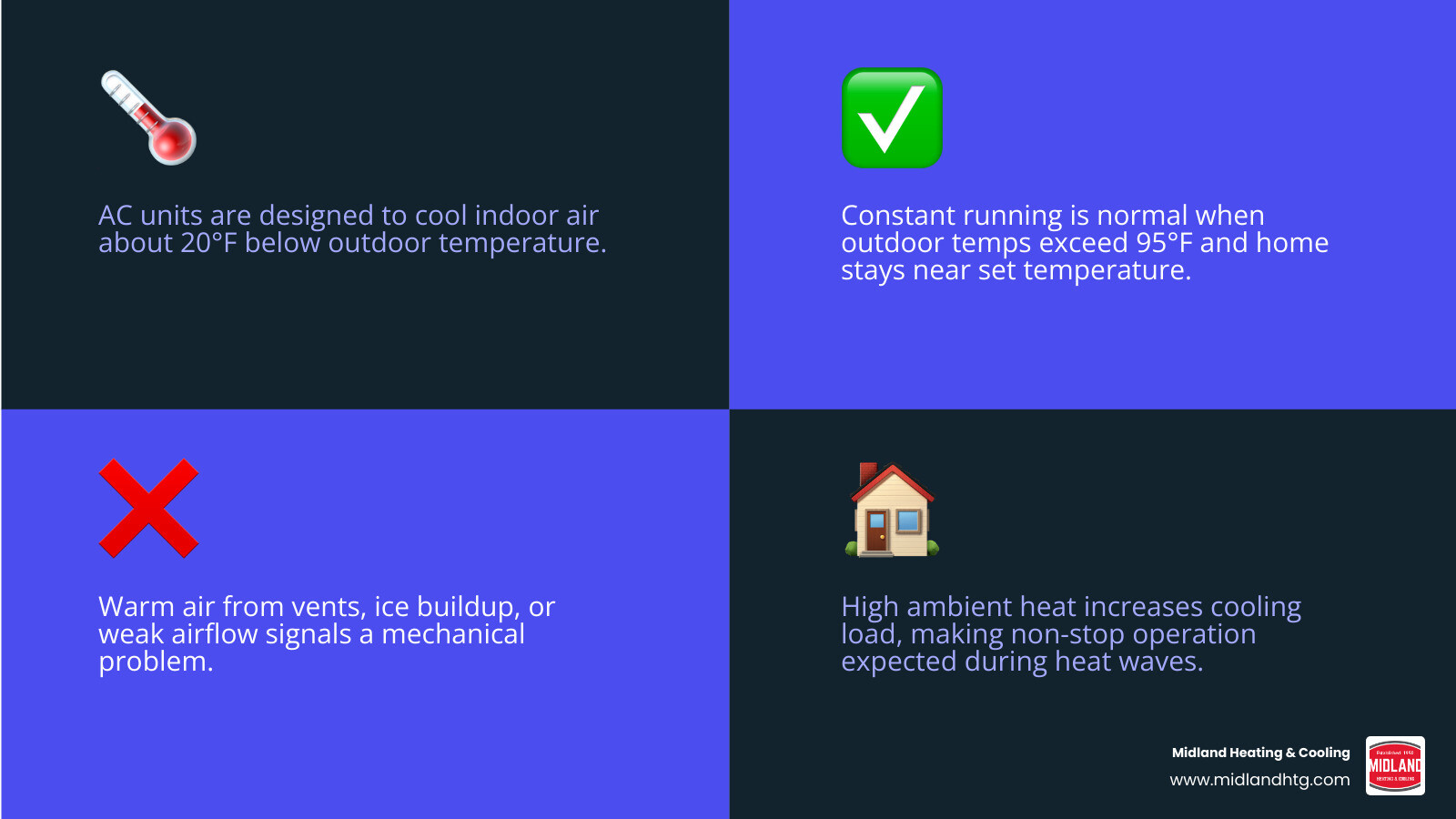
Here’s the simple truth: air conditioners are designed to cool your home to roughly 20°F below the outdoor temperature. When it’s 100°F outside, your system is already pushing its physical limits just to hold things at 78–80°F indoors. On days like that, running non-stop isn’t a red flag — it’s your AC doing exactly what it was built to do.
That said, constant running can point to real problems — dirty filters, low refrigerant, poor insulation, or an undersized system — that will get worse if left alone. Knowing the difference matters, especially for Twin Cities homeowners heading into another brutal summer.
This guide walks you through everything: what’s normal, what’s not, and what to do about it.
Why Your AC Running Constantly During a Heat Wave Might Be Normal
In the middle of a May 2026 heat wave in Minneapolis or Bloomington, it’s easy to panic when the outdoor unit never seems to cycle off. However, we often find that a system is simply meeting its design capacity. Air conditioners aren’t like light switches; they are heat exchangers. Their job is to pull heat out of your home and dump it outside. When the “ambient temperature” (the air outside) is extremely high, that heat exchange takes much longer.
Most residential systems are sized to handle the “average” hot day. When we hit a record-breaking stretch where temperatures soar above 95°F, the “heat load” on your home—the amount of heat entering through walls, windows, and the roof—increases dramatically. In these conditions, it is typical for an AC to jump from its usual 8–12 hours of total daily runtime to 12–16 hours or even continuous operation during the peak afternoon sun.
If your home is staying comfortable and the temperature on the thermostat is matching (or staying very close to) your set point, your ac running constantly during a heat wave is likely just a sign of a hard-working, functional system. If the air coming out of the vents is cold but the unit isn’t stopping, it’s simply a battle of physics: the AC is removing heat at the same rate the sun is adding it. You can learn more about this in our guide on Ac Running Constantly Without Cooling Properly.
Understanding the 20-Degree Cooling Rule
One of the most important things we teach homeowners in the Twin Cities is the “20-degree rule.” Most standard air conditioning systems are designed to maintain an indoor temperature that is roughly 20 degrees cooler than the outdoors.
This isn’t a flaw in your specific unit; it’s a limitation of how refrigerant transfers heat. If it is 100°F in St. Louis Park, a perfectly functioning AC might only be able to pull the indoor temperature down to 80°F. If you have your thermostat set to 72°F on a triple-digit day, the system will never reach that goal. It will run indefinitely, “marathon-style,” trying to achieve the impossible.
Furthermore, your AC has a second job: removing humidity. In our humid Minnesota summers, the system may run longer cycles specifically to pull moisture out of the air, which makes 78°F feel much cooler than it would otherwise.
When Constant AC Running During a Heat Wave Signals a Problem
While long runtimes can be normal, there is a line where “working hard” turns into “working poorly.” You should be concerned if you notice the following:
- Warm Air: If the air blowing from your vents feels lukewarm or room-temperature, the system is running but not actually cooling. This is often a sign of a Why Is Ac Not Cooling Properly issue.
- Weak Airflow: If you can barely feel air coming out of the registers, your blower motor or ductwork may be compromised.
- Ice Buildup: Seeing frost or ice on the copper refrigerant lines (the “line set”) or the indoor evaporator coil is a major red flag. This usually indicates a Signs Ac Refrigerant Needs Inspection or a severe airflow blockage.
- Unusual Noises: Hissing, bubbling, or banging sounds suggest mechanical failure or refrigerant leaks.
Mechanical Issues That Force Non-Stop Operation
If your system is running 24/7 and your home is still uncomfortably warm, physics isn’t the only thing at play—mechanics are likely failing. In Minneapolis, the most frequent culprit for an overworked AC is restricted airflow.
When air can’t move freely through the system, the heat exchange process stalls. The system has to run twice as long to move the same amount of “coolth” into your living space. This puts immense strain on the compressor and the blower motor, often leading to premature failure. If you are experiencing these issues, our Minneapolis Ac Repair Ultimate Guide offers a deep dive into local solutions.
Airflow Restrictions and Dirty Filters
We cannot stress this enough: the humble air filter is the “lung” of your HVAC system. A dirty, clogged filter increases “static pressure,” forcing the blower motor to work significantly harder to pull air through the return.
During a heat wave, we recommend checking your filter every 30 days. If the filter is opaque, grey, or covered in dust, replace it immediately. A clean filter can often resolve a ac running constantly during a heat wave by allowing the system to complete its cooling cycles faster. Beyond the filter, ensure that furniture, rugs, or drapes aren’t blocking your return air grilles. For more preventative steps, see our Essential Ac Maintenance Tips.
Troubleshooting Your AC Running Constantly During a Heat Wave
Before you call for emergency service in Edina or Minnetonka, there are a few things you can check yourself:
- Thermostat Calibration: Sometimes the thermostat is simply reading the wrong temperature. If it’s installed near a sunny window or a hot kitchen, it might “think” the house is 85°F when it’s actually 75°F.
- Refrigerant Leaks: Refrigerant is the lifeblood of your AC. It doesn’t get “used up” like gas in a car; it stays in a closed loop. If levels are low, you have a leak. Signs include a gurgling sound or Ac Freezing Up During Hot Summer Days.
- Undersized Systems: If you’ve recently added a sunroom or finished a basement without upgrading your HVAC, your current unit might be too small for the new “heat load.”
- Dirty Condenser Coils: The outdoor unit (the condenser) needs to breathe. If it’s clogged with cottonwood seeds, grass clippings, or dirt, it can’t release heat effectively.
For a step-by-step DIY checklist, refer to our Home Ac Troubleshooting Guide What To Check Before Calling Hvac.
Simple Steps to Reduce Cooling Load in the Twin Cities
Your AC doesn’t exist in a vacuum; it’s fighting against your home’s “envelope.” In May 2026, as we face rising summer peaks, improving your home’s efficiency is the best way to give your AC a break.
Statistics show that up to 30% of unwanted heat comes through your windows during a heat wave. By simply closing your blinds or curtains on the south and west-facing sides of your home, you can significantly reduce the workload on your AC. Additionally, attics in places like Eden Prairie can reach a staggering 140°F on a 100-degree day. If your attic insulation is thin, that heat radiates directly through your ceiling. Proper insulation can prevent up to 40% of heat transfer, according to the EPA.
| Thermostat Setting | Energy Impact | Comfort Level |
|---|---|---|
| 72°F | High Energy Use (System runs 100% of time) | Very Cool |
| 75°F | Moderate Energy Use | Comfortable |
| 78°F | Optimal Efficiency (Recommended by DOE) | Balanced |
| 82°F (Away) | Lowest Energy Use | Warm but Safe |
Optimizing Your Thermostat Settings for 2026
The U.S. Department of Energy recommends setting your thermostat to 78°F when you are home. We know that sounds high to some, but for every degree you set it below 78°F, your energy consumption increases by about 8%.
During extreme heat, we suggest avoiding the “on-and-off” method. Some people turn the AC off when they leave for work and then “crank it down” to 70°F when they get home. This actually strains the system more because it has to remove hours of built-up heat from the walls and furniture. Instead, use a 5-to-10 degree buffer. If you like it at 75°F, set it to 80°F while you’re away. This keeps the humidity in check and prevents the system from having to “start from scratch” during the hottest part of the day. For more on preparing for the season, check out how to Prevent Ac Problems Before Summer Arrives.
The Risks of Ignoring a Struggling System
Allowing an ac running constantly during a heat wave to continue when there is an underlying mechanical issue is a recipe for a breakdown. The compressor is the most expensive part of your system, and it is most vulnerable during extended runtimes. If the system is struggling due to low refrigerant or dirty coils, the compressor can overheat, causing the internal lubricating oil to turn acidic and eventually “burn out” the motor.
Furthermore, electrical components like capacitors are highly sensitive to heat. They often fail during the first major heat wave of the year because they can’t handle the continuous electrical load. Ignoring these signs doesn’t just lead to a higher energy bill—it can lead to a total system replacement. If your system is showing signs of distress, don’t wait for it to stop completely; contact our Emergency Ac Services team.
Frequently Asked Questions About Constant AC Use
Is it better to leave the AC on or turn it off and on during a heat wave?
It is almost always better to leave the AC on at a consistent, slightly higher temperature than to toggle it on and off. AC units use a massive surge of electricity to start up. Once they are running at a “steady state,” they are much more efficient. Plus, continuous running allows for better dehumidification, which is essential for comfort in the Twin Cities.
Will running my AC all day significantly increase my energy bills?
Yes, your bill will be higher during a heat wave simply because of the increased runtime hours. However, you can minimize the “sticker shock” by following the 78°F rule and ensuring your system has a high SEER (Seasonal Energy Efficiency Ratio) rating. An older, low-efficiency unit will cost significantly more to run 24/7 than a modern, high-efficiency system.
How can I tell if my AC is undersized for my home?
If your AC runs for 40+ minutes at a time even when it’s only 80°F outside, or if it never reaches the set temperature even at night, it might be undersized. This often happens after home renovations or if the original installer didn’t perform a proper “Manual J” heat load calculation. If you’ve recently finished a basement in Wayzata or Excelsior, your original unit may no longer be able to keep up.
Conclusion
At Midland Heating & Cooling, we’ve spent over 70 years helping our neighbors in Minneapolis, St. Paul, and the surrounding suburbs stay cool. We know that a Twin Cities summer can be unpredictable, and seeing your ac running constantly during a heat wave can be stressful.
Whether your system just needs a professional cleaning to get back to peak efficiency or you’re ready to upgrade to a more reliable unit, our certified technicians are here to help. We pride ourselves on 100% customer satisfaction and deep local expertise. Don’t let the heat get the best of your home this year.
Schedule Pre Summer Ac Maintenance today to ensure your system is ready for the next “scorch,” or Contact our Twin Cities cooling experts today for a comprehensive system inspection. Stay cool, Minnesota!