
When Midwest Heat Hits Hard, Your AC Pays the Price
If you’re wondering how to help your AC keep up during extreme heat in the Midwest, here’s a quick answer:
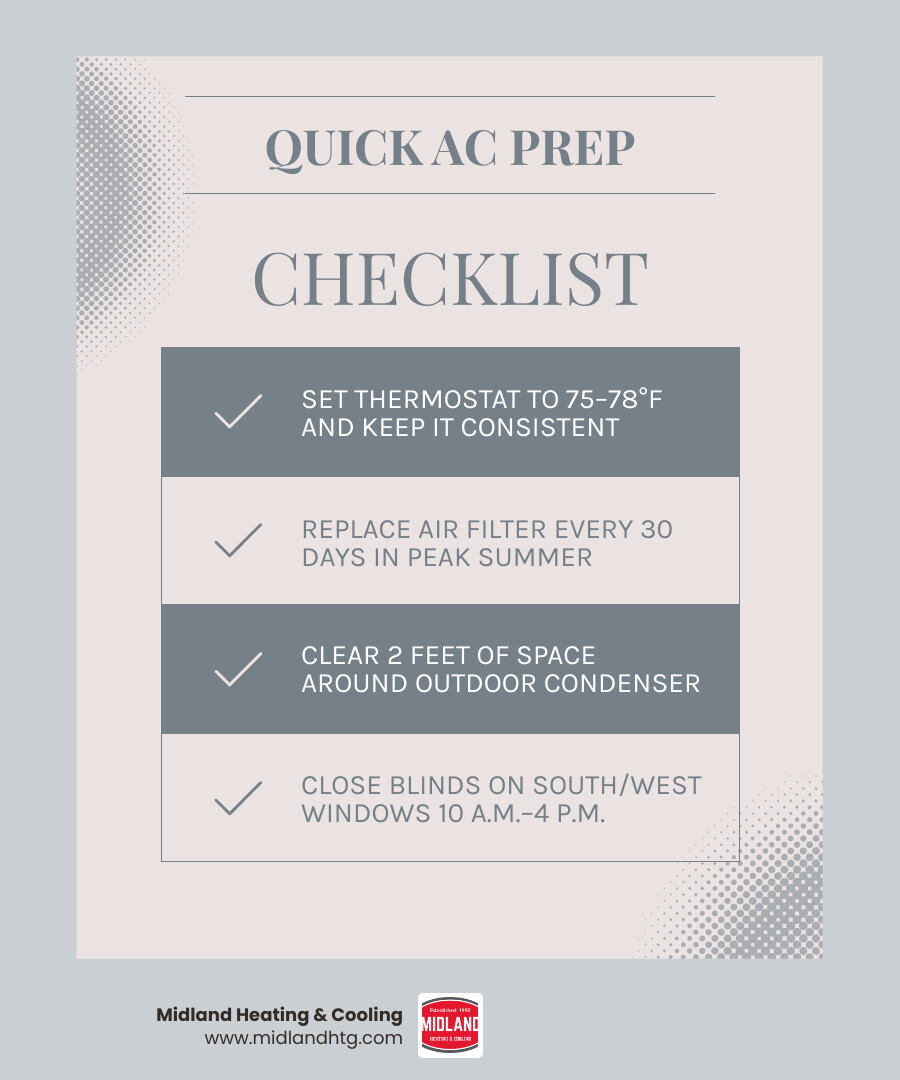
- Set your thermostat to 75–78°F and keep it consistent — don’t crank it lower hoping for faster results.
- Replace your air filter every 30 days during peak summer.
- Clear at least 2 feet of space around your outdoor condenser unit.
- Close blinds and curtains on south- and west-facing windows during peak sun hours (roughly 10 a.m. to 4 p.m.).
- Pre-cool your home in the morning before outdoor temps peak.
- Use ceiling fans in occupied rooms so you can raise the thermostat a few degrees without losing comfort.
- Schedule a professional tune-up before or early in the season — not after your system breaks down.
Every summer across the Twin Cities and greater Midwest, the same thing happens: temperatures spike into the 90s, humidity climbs, and air conditioners that seemed perfectly fine in May suddenly can’t keep up. It’s not always a fluke. Midwest summers are uniquely punishing for cooling systems because they combine intense heat with high humidity — meaning your AC has to work harder than a system in a dry climate just to achieve the same level of indoor comfort. Add in the fact that most systems sit idle for months before the first real heatwave arrives, and you’ve got a recipe for breakdowns at the worst possible time.
The good news is that most AC struggles during a heatwave are preventable. The right habits, a little maintenance, and a realistic understanding of what your system can and can’t do go a long way.
Basic how to help your ac keep up during extreme heat in the midwest terms:
- ac running constantly during a heat wave
- undersized ac unit signs and problems in a four-season climate
Why Midwest Heatwaves Stress Your Cooling System
When a summer heatwave settles over Minneapolis, St. Paul, or Bloomington, it’s not just a matter of high numbers on the thermometer. Our local climate presents a double-whammy of high temperatures and thick, heavy humidity. This combination places an extraordinary physical load on your home’s cooling system.
To make matters worse, homes themselves act like giant heat sponges. During a prolonged heatwave, the building materials of your house—the wood framing, drywall, brick, and siding—absorb thermal mass during the day and radiate that heat inward long after the sun goes down. This means your air conditioner gets no relief.
When your system must run continuously to combat this relentless thermal radiation, you might notice your AC Running Constantly Without Cooling Properly. Is this continuous operation normal? While some extended runtime is expected on a 95-degree day, a system that never turns off and fails to reach your target temperature is under extreme mechanical stress. For a deeper look into this phenomenon, read about The Nonstop Hum: Is It Normal for AC to Run All Day?.
Understanding How to Help Your AC Keep Up During Extreme Heat in the Midwest
To understand how to help your air conditioner, it helps to understand what it actually does. Many homeowners believe an AC simply blows cold air into a room. In reality, an air conditioner is a heat and moisture remover. It works by absorbing sensible heat (the heat you can feel on your skin) and latent heat (the energy stored in airborne water vapor) and moving it outside.
In the Twin Cities, our high moisture load means your air conditioner must spend a massive portion of its cooling capacity just pulling water out of the air before it can effectively lower the indoor temperature. When humidity is high, the air feels sticky and warm even if the temperature is technically dropping. If your system cannot handle this dual workload, indoor comfort plummets.
Why the First Heatwave of the Season is the Most Dangerous
The first major spike of 90-degree weather in June 2026 is often when HVAC companies receive a flood of emergency calls. Why? Because after sitting idle all winter and spring, your air conditioner is suddenly shocked into maximum capacity.
This abrupt transition from zero to one hundred percent effort exposes every hidden vulnerability in your system. Small mechanical issues that went unnoticed during mild spring days—such as a slightly weak capacitor, a minor refrigerant leak, or a thin layer of dust on the coils—quickly escalate into complete system failures under sudden strain. Electrical components overheat inside the outdoor cabinet, and the high mechanical stress on the compressor can cause older units to give out entirely.
How to Help Your AC Keep Up During Extreme Heat in the Midwest
Fortunately, you don’t have to sit back and hope for the best. There are practical, everyday habits you can adopt to actively reduce the burden on your cooling system.

Smart Thermostat Settings and Pre-Cooling Strategies
One of the most effective ways to manage your system’s workload is to use your thermostat strategically. Many homeowners return home to a hot house and crank the thermostat down to 65°F, thinking it will cool the home faster. It won’t. Your AC runs at the exact same speed regardless of how low you set the temperature.
Instead, aim for a realistic temperature difference. Most standard residential air conditioners are engineered to maintain a maximum temperature difference of 15 to 20 degrees between the indoor air and the outdoor environment. If it is 98°F in Edina or Eden Prairie, expecting your home to stay at 68°F is asking your system to perform beyond its physical capabilities.
To maximize energy efficiency and protect your equipment, try these strategies:
- Pre-cool your home: Lower your thermostat by 2 to 3 degrees during the cooler morning hours (4 to 6 hours before peak afternoon heat). This leverages your home’s thermal mass, cooling down walls and furniture early so your AC doesn’t have to fight as hard when outdoor temperatures peak.
- Keep settings consistent: Avoid frequent, dramatic thermostat adjustments, which force your system to cycle on and off rapidly.
- Leverage smart programming: Utilize a programmable or smart thermostat to automate these adjustments. For more detailed operational guidance, check out these Essential AC Maintenance Tips.
Practical Habits to Reduce Indoor Heat Gain
Your air conditioner is constantly fighting a battle against heat entering your home. You can help it win by minimizing indoor heat sources:
- Block solar heat gain: Keep your blinds, drapes, or shades fully closed during peak sun hours (typically 10 a.m. to 4 p.m.), especially on south- and west-facing windows. External shades or heavy blackout curtains are incredibly effective at keeping solar radiation out.
- Avoid heat-producing appliances: Postpone using the oven, stove, dishwasher, or clothes dryer until late in the evening when temperatures drop. These appliances dump massive amounts of sensible heat and moisture directly into your living spaces.
- Utilize ceiling fans correctly: Ensure your ceiling fans are rotating counterclockwise to create a wind-chill effect. Fans cool people, not rooms—turn them off when you leave the room to save electricity.
- Smart ventilation: Keep bathroom and kitchen exhaust fans running for a short period after showering or cooking to pull excess humidity out of the house, but don’t leave them on all day, or they will pull hot, humid air in from the outside.
Essential Maintenance Steps to Prevent Summer Breakdowns
A well-maintained air conditioner is far more resilient against extreme heat than one that has been neglected. Taking proactive steps can prevent costly emergency repairs when the weather is at its worst.
DIY Maintenance: Filters and Condenser Clearance
There are several critical maintenance tasks that you can perform yourself to ensure optimal airflow and system health:
- Replace your air filter regularly: A dirty, clogged filter restricts airflow, forcing your blower motor to work harder and reducing the system’s ability to pull heat from your home. During heavy summer usage, check your filter every 30 days and replace it if it looks gray or dusty.
- Clear the outdoor unit: Your outdoor condenser unit needs to release the heat it gathered from inside your home. If it is surrounded by tall grass, weeds, shrubs, or mulch, that heat gets trapped. Maintain at least a 2-foot clearance around the entire unit.
- Gently clean the exterior: Turn off the power to the unit and use a garden hose (never a pressure washer, which can bend the delicate aluminum fins) to gently wash away accumulated cottonwood seeds, dirt, and lawn debris from the exterior coils.
For a complete guide on preparing your home’s system, read how to Prevent AC Problems Before Summer Arrives.
Proactive Steps: How to Help Your AC Keep Up During Extreme Heat in the Midwest
While DIY steps are incredibly valuable, some tasks require the tools and expertise of a certified professional. Dust and debris accumulation on your indoor evaporator coil can quietly degrade your system’s efficiency. In fact, a dirty coil can drop a 16 SEER unit down to a 12 SEER in just one season, leading to spiking energy bills and poor cooling performance.
During a professional tune-up, a technician will:
- Check and clean the evaporator and condenser coils.
- Measure refrigerant levels (a system that is just 10% low on refrigerant can cost 20% more to operate and put the compressor at risk of failure).
- Test electrical connections, capacitors, and contactors to ensure they aren’t running dangerously hot.
- Inspect the ductwork for leaks (leaky ducts can waste 20% to 40% of your conditioned air before it even reaches your living spaces).
To get your system ready for the peak of summer, we highly recommend that you Schedule Pre-Summer AC Maintenance and review The Ultimate Twin Cities Spring AC Maintenance Checklist. If you’re wondering why these steps are so vital, discover Why Regular AC Service Is Crucial and remember to Don’t Sweat the Details of Your AC Tune-Up.
Troubleshooting: Is Your AC Struggling, Failing, or Wrongly Sized?
When the indoor temperature starts climbing despite your AC running, you need to know whether you’re dealing with a simple settings issue, a mechanical failure, or a system that is fundamentally wrong for your home.
Recognizing Signs of AC Strain and Impending Failure
Your air conditioner will often drop hints before it breaks down completely. Knowing these signs can help you schedule a repair before you’re left sweating in a hot house:
- Weak or warm airflow: If the air coming out of your vents feels weak or lukewarm, you could be dealing with a blower motor issue, restricted airflow, or a refrigerant leak. Learn How to Fix AC Blowing Warm Air.
- Short-cycling: If your AC turns on and off every few minutes without ever completing a full cooling cycle, it is short-cycling. This places immense wear and tear on your compressor. Find out Why Your AC Is Acting Like a Light Switch and How to Fix It.
- Ice on the refrigerant lines or indoor coil: If you see frost or ice forming on the copper lines leading to your outdoor unit or on the indoor evaporator coil, turn the system off immediately. Running a frozen system can destroy the compressor. Read more about AC Freezing Up During Hot Summer Days.
- Unusual noises or tripped breakers: Loud screeching, clanging, or a constant electrical hum are clear indicators of mechanical strain. If your AC repeatedly trips the circuit breaker, it is drawing too much electrical current and needs immediate professional attention to avoid AC Compressor Failures in Summer.
Is Your AC the Wrong Size or Nearing End of Life?
Sometimes, an air conditioner struggles simply because it isn’t the right fit for the home. A system that is too small (undersized) will run constantly without ever cooling the house down. Conversely, an oversized system will cool the home too quickly without running long enough to remove humidity, leaving you feeling cold and clammy.
To determine the exact cooling capacity your home needs, a professional must perform a Manual J load calculation, which accounts for your home’s square footage, insulation levels, window orientation, and local climate.
If your system is over 10 to 12 years old, its natural efficiency has likely declined. Upgrading to a modern, high-efficiency system can dramatically lower your energy bills while providing superior comfort.
| System Type / SEER2 Rating | Average Cooling Cost Reduction | Best Suited For |
|---|---|---|
| Older Standard Unit (10 SEER) | Baseline | Older homes; high energy consumption |
| Mid-Efficiency Unit (14–16 SEER2) | 15% – 25% savings | Budget-conscious homeowners wanting reliable performance |
| High-Efficiency Unit (20+ SEER2) | 30% – 50% savings | Homeowners seeking maximum energy savings and precise climate control |
If you are considering options for our variable Minnesota climate, modern variable-speed compressors, dual-fuel systems (which pair a high-efficiency heat pump with a gas furnace), or ductless mini-splits offer incredible year-round performance.
To help make the right choice for your home, explore these resources:
- Signs AC Needs Replacement This Winter
- How Long Does an AC Actually Last in Minnesota?
- The Short Season Struggle: When to Replace Your Aging Minnesota AC
- Fix It or Ditch It: How to Decide If Your AC Is Worth Repairing
- Why Your Tiny AC Can’t Handle the Big Seasons
- 5 Clear Signs Your 12-Year-Old AC Is Nearing End of Life
Frequently Asked Questions about Midwest AC Performance
Before you pick up the phone to call for service, review these common questions and basic checks to see if your issue has a simple fix. For a complete self-check list, see our Home AC Troubleshooting Guide: What to Check Before Calling HVAC and The My House Is Still Hot AC Troubleshooting Guide.
Why is my AC running constantly but not cooling my house?
This is usually caused by restricted airflow or an inability to transfer heat. First, check your air filter—if it is clogged with dust, it will starve the system of air. Next, inspect your outdoor condenser unit to ensure it isn’t covered in debris or blocked by plants. If the airflow is clear and the outdoor unit is clean, you may have a low refrigerant charge or dirty internal coils, both of which require professional diagnostic tools to resolve.
What temperature should I set my thermostat during a Midwest heatwave?
The U.S. Department of Energy and Energy Star recommend setting your thermostat to 78°F when you are at home during the day. If that feels too warm, pairing a setting of 75°F to 76°F with a ceiling fan can keep you perfectly comfortable. Keeping your thermostat just 7 to 10 degrees warmer than your usual setting for eight hours a day can save you up to 10% a year on your cooling costs.
How does high humidity affect my air conditioner’s efficiency?
High humidity increases the “latent heat” load on your system. Your AC must work to condense moisture out of the air before it can effectively lower the indoor temperature. This means a significant portion of your system’s electrical consumption goes toward dehumidification rather than cooling, which reduces overall cooling efficiency and can make the air inside feel sticky if the system is oversized or struggling.
Conclusion
Keeping your home cool and safe during intense Midwest heatwaves doesn’t have to be a source of summer stress. By adopting smart thermostat habits, minimizing indoor heat sources, and staying on top of simple DIY maintenance like filter changes, you can significantly reduce the strain on your air conditioner.
When your system needs a professional touch, Midland Heating & Cooling is here to help. Serving the Twin Cities—including Minneapolis, St. Paul, Bloomington, Edina, Eden Prairie, Minnetonka, Hopkins, St. Louis Park, Wayzata, and Excelsior—for over 70 years, we are a local, family-owned business dedicated to 100% customer satisfaction. Our certified technicians have the experience and local expertise to keep your home comfortable through the hottest summers and coldest winters.
Don’t wait for your system to break down in the middle of a heatwave. Schedule professional cooling services today with Midland Heating & Cooling to keep your home cool, dry, and efficient all summer long!