

Should I Repair or Replace My Air Conditioner? Here’s How to Decide Fast
Wondering should I repair or replace my air conditioner is one of the most stressful decisions a Twin Cities homeowner can face — especially when summer heat is already here and your system is struggling to keep up.
Here is a quick-reference guide to help you decide right now:
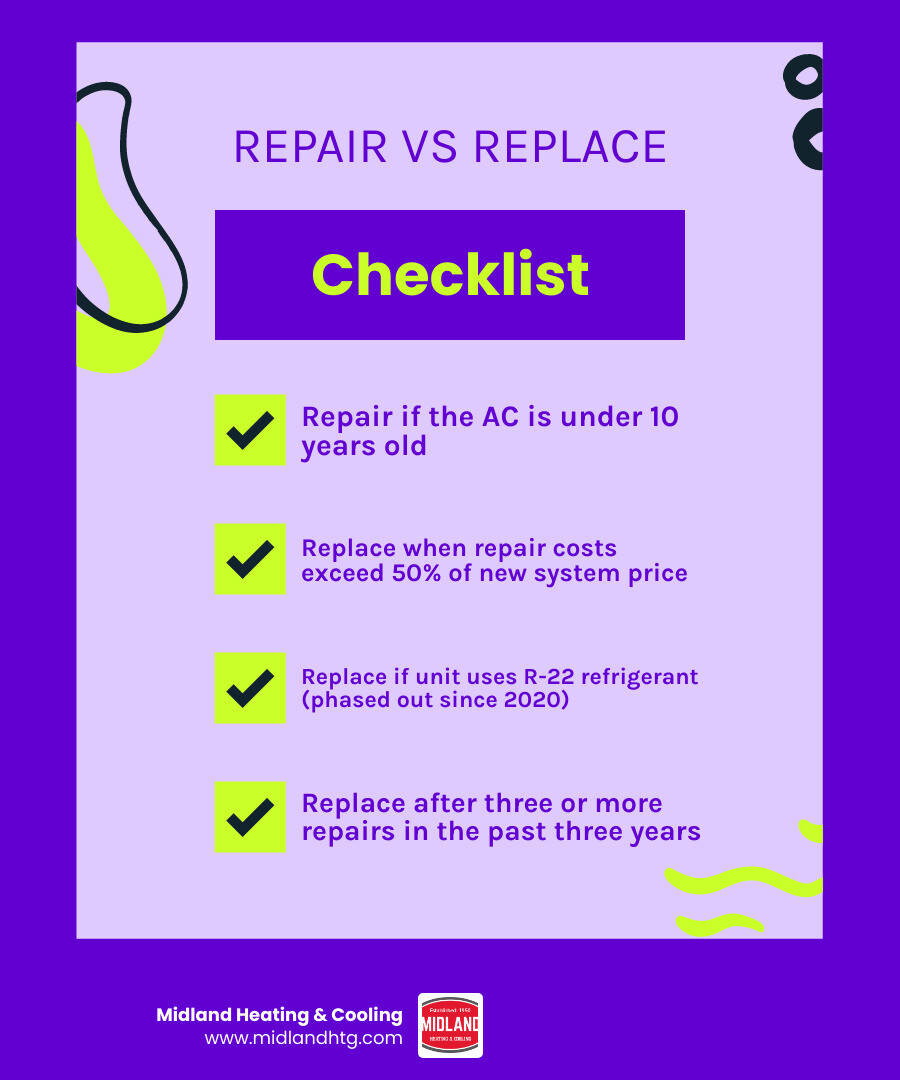
Repair your AC if:
- The unit is under 10 years old
- The repair cost multiplied by the unit’s age is under $5,000
- The repair is a single, minor issue
- Your energy bills have been stable
Replace your AC if:
- The unit is 10–15+ years old
- The repair cost exceeds 50% of a new system’s price
- You’ve had three or more repairs in the past three years
- Your energy bills keep climbing with no clear cause
- Your system uses R-22 refrigerant (phased out since 2020)
The honest truth is there is no single right answer for every home. Your system’s age, repair history, energy efficiency, and your own plans for the home all play a role. The good news is that a few straightforward rules — backed by real data — can cut through the confusion fast.
In this guide, Midland Heating & Cooling walks you through every factor that matters so you can make a confident, informed decision.
Handy should i repair or replace my air conditioner terms:
- ac repair vs replace — decision guide
- federal and utility rebates that reduce ac replacement cost in minnesota
- is a 15 year old ac worth fixing in minnesota
How to Decide: Should I Repair or Replace My Air Conditioner?
When your air conditioner begins to falter during the dog days of summer, it is easy to feel overwhelmed. You are suddenly caught between two options: pay for a temporary fix or make a long-term investment in a brand-new system.
Making the right choice requires looking at several variables, including the frequency of breakdowns, the overall reliability of the unit, and how well it keeps up with the humid summer weather we experience here in Minnesota. Before you make any hasty decisions, it helps to run through a basic diagnostic checklist. You might find that the issue is a simple, low-cost fix you can handle yourself. For a complete breakdown of things to inspect before picking up the phone, take a look at our Home Ac Troubleshooting Guide What To Check Before Calling Hvac.
If basic troubleshooting does not resolve the issue, you will need to weigh the age of your equipment against the financial reality of ongoing repairs.
Age and Lifespan: Should I Repair or Replace My Air Conditioner Now?
The mechanical lifespan of a standard central air conditioner is typically between 10 and 20 years. However, here in the Twin Cities, our systems endure unique stress. They sit completely idle through freezing, snowy winters, only to be run hard during our steamy, high-humidity summers. This extreme temperature swing can accelerate the degradation of delicate electrical components and outdoor coils.
If your system is under 10 years old, it is generally considered to be in its “prime.” Investing in repairs for a younger system is almost always the smarter financial move. However, once a system crosses the decade mark, it enters its twilight years. Components become more susceptible to rust, corrosion, and general wear. If you find yourself scheduling service calls for a system that has been running since 2016 or earlier, you are likely dealing with an aging unit on borrowed time. To learn more about how winter idle periods and aging affect your system, read about the Signs Ac Needs Replacement This Winter.
The Financial Formula: Should I Repair or Replace My Air Conditioner Based on Math?
Rather than relying on guesswork, HVAC professionals use two trusted mathematical formulas to remove the emotional stress from this decision.
- The $5,000 Rule: Multiply the age of your air conditioner by the estimated cost of the repair. If the resulting number is under $5,000, go ahead and repair it. If the total exceeds $5,000, that money is better spent on a replacement. For example, if an 11-year-old system needs a repair that is moderately expensive, multiplying 11 by that repair cost will easily push you over the threshold, indicating that a replacement is the wiser investment.
- The 50% Rule: If a single repair estimate costs 50% or more of what it would cost to install a brand-new, modern system, replacement is almost always the more logical choice.
Additionally, look at your repair history over a rolling three-year window. If you have needed three or more repairs within the last three years, your system is telling you that its components are failing one by one. Instead of paying for piecemeal fixes, it is often more economical to start fresh. If your system is still a great candidate for a quick fix, we can help you get back up and running with our Quick Reliable Ac Repair Services.
Common Signs Your AC Needs Immediate Attention
Your air conditioner will rarely fail without warning. Usually, it will send out clear distress signals long before it shuts down completely. Recognizing these warning signs early can save you from a complete system breakdown during a heatwave.
Common warning signs include:
- Warm air blowing from the supply registers
- Weak or restricted airflow throughout the house
- Frequent “short-cycling” (turning on and off rapidly)
- Ice forming on the indoor evaporator coil or outdoor refrigerant lines
- Strange noises like grinding, squealing, or hissing
If your system is running constantly but your home still feels warm, you need to determine exactly why. Read our guide on Why Is Ac Not Cooling Properly to isolate the root cause. If you notice physical ice building up on your system even when it is hot outside, turn the system off immediately to protect the compressor and read about Ac Freezing Up During Hot Summer Days. Lastly, if your system is constantly starting and stopping, you are likely experiencing a highly stressful condition known as short-cycling. Learn how to address this by reading our article on Troubleshooting Ac Short Cycling.
Performance and Comfort Issues
An air conditioner’s job is not just to lower the temperature; it is also designed to manage indoor humidity and ensure consistent airflow. When a system begins to fail, you will notice distinct comfort issues.
Perhaps your living room feels like an icebox while your upstairs bedrooms remain stuffy and warm. This uneven cooling often points to an aging blower motor, failing ductwork, or an improperly sized system. Furthermore, if your home feels “sticky” or humid even when the AC is running, your system is failing to extract moisture from the air effectively. When an AC runs continuously without actually cooling, it wastes energy and places immense stress on its internal parts. If you are experiencing this, check out our resources on Ac Running Constantly Without Cooling Properly and explore how humidity impacts your controls in Ac Thermostat Problems In Humid Weather.
Safety Concerns and Strange Noises
While comfort issues are annoying, safety hazards and mechanical failures require immediate professional intervention.
Water pooling around your indoor furnace or AC unit is a common issue usually caused by a clogged condensate drain line. While a simple leak might seem harmless, water can quickly damage your home’s structure or drip onto sensitive electrical components, creating a fire hazard. Learn how to handle this by reading Address Water Leaking From Ac Unit.
Noises are another major indicator of system health. A hissing or whistling sound often points to a dangerous refrigerant leak or high-pressure buildup inside the compressor. If you hear these specific sounds, turn off your system immediately and read When Ac Makes Hissing Or Whistling Sound. For all other unusual sounds like banging, rattling, or grinding, refer to our comprehensive guide on What To Do When Ac Makes Strange Noises.
The Role of Energy Efficiency and Refrigerant Standards
When deciding whether to repair or replace, you must look beyond the immediate repair bill and consider your monthly operating costs. Modern air conditioners are vastly more efficient than systems built just a decade ago.
Cooling efficiency is measured by the Seasonal Energy Efficiency Ratio (SEER), which was updated to the more rigorous SEER2 standard in January 2023. Older systems in many Twin Cities homes operate at ratings as low as 10 or 12 SEER. By contrast, modern entry-level systems start at 13.4 SEER2 (equivalent to 14 SEER), with high-efficiency models reaching 20 SEER2 or higher. Upgrading from an old 12 SEER unit to a modern 16 SEER2 unit can cut your cooling-related energy consumption by up to 40%. Taking proactive steps to evaluate your system’s efficiency can prevent major headaches later. Learn how to Prevent Ac Problems Before Summer Arrives.
Outdated R-22 Refrigerant Phase-Out
If your air conditioner was installed before 2010, there is a very high probability that it uses R-22 refrigerant (commonly known as Freon). Because R-22 is an ozone-depleting chemical, the U.S. Environmental Protection Agency (EPA) officially banned its production and import in 2020.
Today, the only R-22 available for repairs is reclaimed or recycled gas, making it incredibly scarce and astronomically expensive. If your older system develops a refrigerant leak, recharging it can cost nearly as much as a significant system repair. Furthermore, a system using R-22 is already well past its expected operational lifespan. Investing money into finding and fixing leaks in an obsolete system is rarely a sound investment. If you suspect your system is low on refrigerant, read about how to Address Low Refrigerant Issues In Ac System and learn the signs to watch for in Signs Ac Refrigerant Needs Inspection.
Financial Incentives and Modern Upgrades
Fortunately, transitioning to a modern, eco-friendly cooling system is highly supported by federal and local incentives. Under the Inflation Reduction Act, homeowners can claim federal tax credits covering up to 30% of the cost of qualifying high-efficiency air conditioners or heat pumps (up to $2,000).
Additionally, local Twin Cities electric and gas utilities offer excellent rebates for installing energy-efficient systems. When you combine these tax credits and utility rebates with the monthly energy savings of a new SEER2 system, a replacement quickly begins to pay for itself. We can help you navigate these savings with our Affordable Ac Services.
Frequently Asked Questions about AC Replacement
How long does a typical central air conditioner last in Minnesota?
In Minnesota, a professionally maintained central air conditioner typically lasts between 10 and 20 years. However, our harsh winters mean outdoor units sit exposed to heavy snow, ice, and freezing temperatures for up to seven months of the year. If moisture gets trapped inside the unit during the freeze-thaw cycles of spring, it can cause rust and electrical issues. Proactive maintenance is the single best way to ensure your system reaches its maximum lifespan. Discover why keeping up with annual maintenance is so vital by reading Why Regular Ac Service Crucial.
Should I replace my furnace at the same time as my air conditioner?
In most cases, yes, especially if your furnace is over 12 to 15 years old. Your furnace and air conditioner share the same indoor blower motor and duct system. When you install a new, high-efficiency AC next to an old, failing furnace, you create a “mismatched system.” This can prevent the new AC from reaching its rated SEER2 efficiency and may even void the manufacturer’s warranty. Replacing both systems simultaneously also saves you significant money on labor costs, as our technicians only have to modify your plenum and electrical connections once. Explore our full range of heating and cooling services to see how we install matched comfort systems.
Is it worth repairing an AC if I plan to move soon?
If you plan to sell your home within the next year or two, you will want to minimize your upfront expenses. A minor repair is usually the most sensible path, provided the system is safe to operate. However, if your system is completely broken down, uses phased-out R-22 refrigerant, or has a cracked heat exchanger, you will likely need to address it before putting the home on the market. Home inspectors will flag a non-functional or unsafe HVAC system immediately. A brand-new, energy-efficient system with a transferable warranty can serve as a major selling point that increases your home’s buyer appeal. If you need a professional evaluation to help make this decision, you can Request Service today.
Conclusion
Deciding should I repair or replace my air conditioner does not have to be a guessing game. By looking at your system’s age, calculating your repair costs using the $5,000 rule, and evaluating your energy bills, the right path forward usually becomes very clear.
At Midland Heating & Cooling, we have spent over 70 years helping homeowners across the Twin Cities — from Minneapolis and St. Paul to Bloomington, Edina, Minnetonka, and beyond — keep their homes comfortable. As a local, family-owned business, we pride ourselves on honest advice, certified technicians, and a 100% customer satisfaction guarantee. We will never push you into a replacement you do not need, and we will never recommend a costly repair on a system that is truly on its last legs.
Ready to get an honest, expert opinion on the state of your cooling system? Schedule your professional AC evaluation with Midland Heating & Cooling today, and let us help you stay cool all summer long!