
How Federal and Utility Rebates That Reduce AC Replacement Cost in Minnesota Can Save You Money
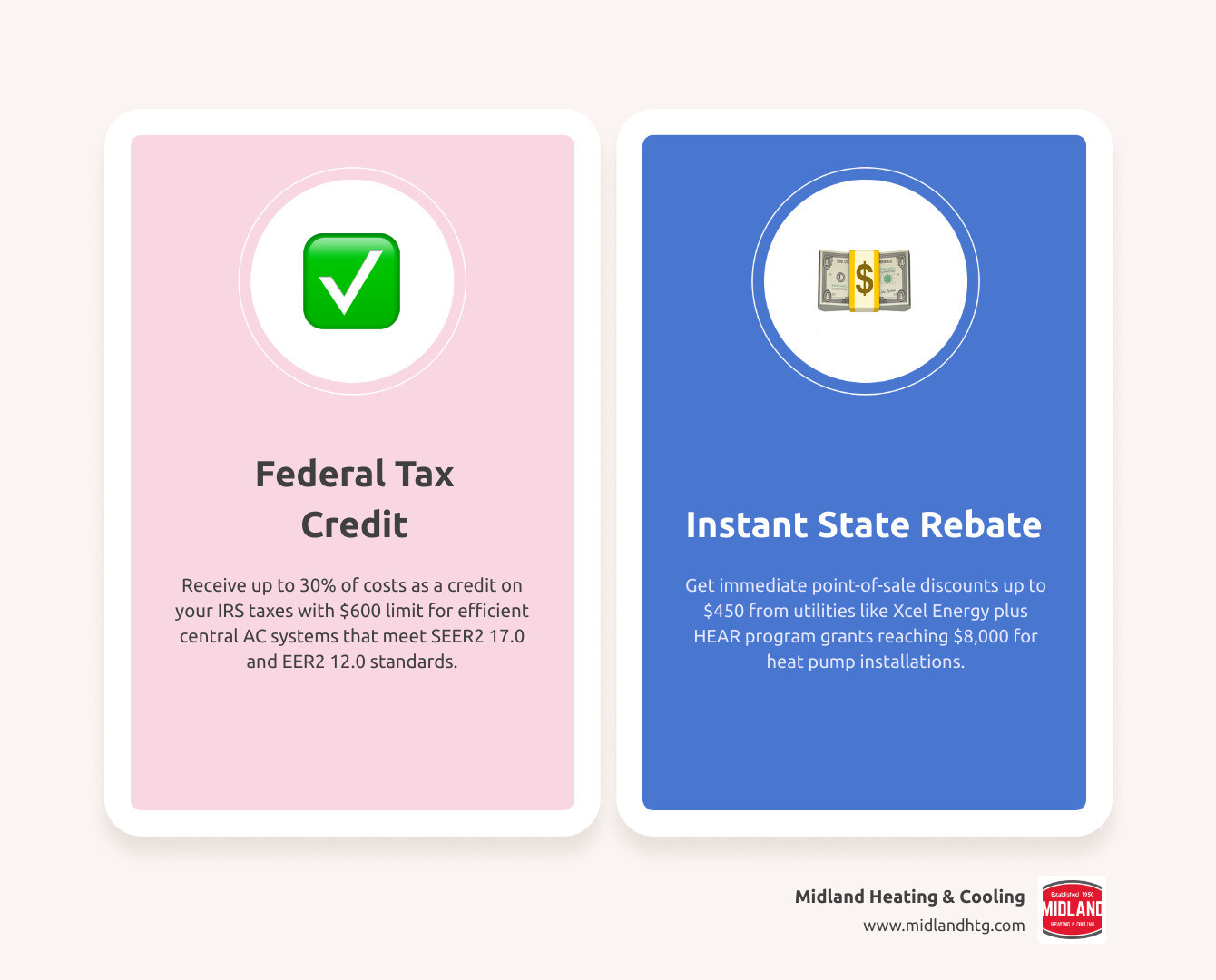
The federal and utility rebates that reduce AC replacement cost in Minnesota are real, stackable, and available right now — but knowing where to look makes all the difference. Here is a quick breakdown of the main ways Minnesota homeowners can lower what they pay for a new air conditioner:
Main incentives available in Minnesota (as of May 2026):
| Incentive Type | Who Offers It | Max Benefit |
|---|---|---|
| Federal Tax Credit (§25C) | IRS / Federal Government | Up to $600 for central AC |
| Federal Tax Credit (§25C) | IRS / Federal Government | Up to $2,000 for qualifying heat pumps |
| Xcel Energy Rebate | Xcel Energy | Up to $450 for central AC |
| HEAR Program (pending launch) | Save Energy Minnesota | Up to $8,000 for qualifying heat pumps |
| Coon Rapids Green Homes | City of Coon Rapids | Up to $250 match on utility rebate |
| Minnesota Power (seasonal) | Minnesota Power | Up to $1,200 for cold-climate heat pumps |
Replacing an aging central air conditioner in the Twin Cities is already a big decision. When your system fails during a Minnesota summer, the last thing you want is to overpay. The good news is that a combination of federal tax credits, utility rebates, and state programs can meaningfully reduce what you spend — if you know which incentives apply to your situation, which equipment qualifies, and how to claim each one correctly.
This guide covers everything Twin Cities homeowners need to know: what is available right now, what is still pending, how to stack incentives, and exactly what steps to follow to make sure you do not leave money on the table.
Federal and utility rebates that reduce ac replacement cost in minnesota glossary:
- ac repair vs replace — decision guide
- is a 15 year old ac worth fixing in minnesota
Understanding Federal Tax Credits and IRS Form 5695
When we talk about federal help for your cooling system, we are primarily looking at the Energy Efficient Home Improvement Credit, often referred to by its tax code section, 25C. This isn’t a check that arrives in the mail; rather, it is a credit you claim on your federal income taxes. It directly reduces the amount of tax you owe, dollar for dollar.
As of May 2026, the 25C credit allows you to claim 30% of the project cost for a qualifying central air conditioner, up to a maximum of $600. If you decide to go with a high-efficiency air-source heat pump instead (which handles both heating and cooling), that annual limit jumps significantly to $2,000.
To qualify, the equipment must be installed in your primary residence. Sorry, landlords—this particular credit is for homeowners and even renters who make eligible improvements to their main living space. You’ll claim these credits using IRS Form 5695 when you file your taxes. It’s a good idea to keep a folder with all your receipts and the manufacturer’s certification statement, just in case the IRS has questions later.
If you are currently staring at a unit that’s making more noise than a Twin Cities construction crew in July, you might be wondering if it’s time to pull the trigger. Our guide on Fix It or Ditch It: How to Decide If Your AC Is Worth Repairing can help you determine if a repair is a band-aid or if a replacement is the smarter financial move.
Qualifying Efficiency Standards for Federal Incentives
Not every air conditioner on the market qualifies for the $600 tax credit. The federal government wants to reward you for choosing the “best of the best” in terms of efficiency. For split systems (the most common type in places like Edina and St. Louis Park), the unit must generally meet or exceed the highest efficiency tier established by the Consortium for Energy Efficiency (CEE).
As of 2025 and 2026, this typically means:
- SEER2 Rating: Must be 17.0 or higher.
- EER2 Rating: Must be 12.0 or higher.
- Packaged Units: These have slightly different requirements, usually around 16.0 SEER2 and 11.5 EER2.
By aiming for these higher standards, you aren’t just getting a tax break; you are also ensuring your monthly energy bills stay as low as possible during those humid Minnesota Augusts.
Navigating State-Level Savings: HEAR, HOMES, and Save Energy Minnesota
Minnesota is currently working through the rollout of two major rebate programs funded by the federal Inflation Reduction Act: the Home Electrification and Appliance Rebates (HEAR) and the Home Efficiency Rebates (HOMES). Together, these fall under the “Save Energy Minnesota” umbrella managed by the Minnesota Department of Commerce.
The HEAR program is the one most people are excited about because it offers “point-of-sale” or instant rebates. This means the discount is applied right when you buy the system, rather than waiting until tax season. It targets middle-to-low-income households. If your household income is at or below 80% of the Area Median Income (AMI), you could receive up to $8,000 for a qualifying heat pump. If you are between 80% and 150% of the AMI, you still qualify for a 50% rebate.
The HOMES program, on the other hand, is based on how much energy you actually save. It requires a professional energy assessment before and after the installation to model the energy reduction. This program is great for whole-home upgrades and can offer between $2,000 and $8,000 depending on the efficiency gains.
For many of our neighbors in Minneapolis and St. Paul, the Central Air Installation Process is the perfect time to look into these electrification options. Heat pumps have become incredibly popular in Minnesota because modern “cold-climate” models can handle our winters while providing superior cooling in the summer.
How Federal and Utility Rebates That Reduce AC Replacement Cost in Minnesota Stack with State Programs
One of the most common questions we get is, “Can I use more than one program?” The answer is usually yes! This is called “stacking,” and it is the secret to maximizing your savings.
For example, you might receive an instant $4,000 HEAR rebate at the time of purchase, then claim a $2,000 federal tax credit on your next tax return, and finally collect a $450 rebate from Xcel Energy. However, there are some rules to keep in mind:
- Annual Aggregate Limits: The federal tax credit has an annual limit of $3,200 total (combining heat pumps, AC, and other weatherization).
- Household Caps: The HEAR program has a lifetime limit of $14,000 per household.
- Income Verification: You will need to provide proof of income to qualify for the higher HEAR and HOMES rebate tiers.
Maximizing Federal and Utility Rebates That Reduce AC Replacement Cost in Minnesota
Our local utility providers are some of the biggest advocates for energy efficiency. Companies like Xcel Energy and CenterPoint Energy offer their own “Conservation Improvement Program” (CIP) rebates that are often much easier to claim than federal credits.
Xcel Energy currently offers up to $450 for high-efficiency central air conditioners. To get the full amount, the system must meet specific SEER2 and EER2 ratings and be installed by a contractor who performs a “Quality Installation” (QI). This involves specific testing to ensure the refrigerant charge and airflow are perfect. We’ve seen many homeowners in Bloomington benefit from these rebates by choosing systems that are just one or two steps above the base model.
CenterPoint Energy and Minnesota Power also have robust programs. CenterPoint focuses heavily on high-efficiency furnaces and heat pumps, with rebates often ranging from $400 to $1,100. Minnesota Power sometimes offers “seasonal enhancements,” such as an extra $1,200 for cold-climate air-source heat pumps installed during the spring months.
To qualify for these, your equipment almost always needs an AHRI (Air-Conditioning, Heating, and Refrigeration Institute) certificate. This document proves that the specific combination of your outdoor unit and indoor coil works together to achieve the promised efficiency.
Local Incentives for Federal and Utility Rebates That Reduce AC Replacement Cost in Minnesota
Depending on where you live in the Twin Cities, you might have access to even more “hyper-local” money.
- Coon Rapids: The Green Homes Program offers a 50% match of your utility rebate, up to $250, for qualifying central AC replacements.
- Plymouth: While they focus heavily on solar and EV charging, they often have supplemental grants for residents who complete a home energy audit.
- Anoka Municipal Utility: They offer their own set of residential cooling rebates that vary based on the SEER2 rating of the unit you choose.
- Minneapolis Green Cost Share: This program can sometimes cover a significant portion of project costs for properties looking to achieve high levels of energy efficiency.
Check with your city hall or local municipal utility website. These programs are often “first-come, first-served,” so it pays to apply early in the year.
Technical Requirements and Efficiency Standards for 2026
Understanding the alphabet soup of HVAC ratings is the first step to ensuring you buy the right equipment. In 2023, the industry moved to “SEER2” and “HSPF2,” which are more rigorous testing standards that better reflect how units actually perform in a home.
| Program | Equipment Type | Minimum Standard (Typical) |
|---|---|---|
| Federal Tax Credit | Central AC | 17.0 SEER2 / 12.0 EER2 |
| Federal Tax Credit | Heat Pump | 16.0 SEER2 / 9.0 HSPF2 |
| Xcel Energy Rebate | Central AC | 13.4 SEER2 (with QI) |
| Save Energy MN (HEAR) | Heat Pump | Energy Star Certified |
| MN Power | Cold-Climate ASHP | Efficient down to 5°F |
In Minnesota, we are in the “Northern Region” for Department of Energy standards. This means the absolute minimum SEER2 allowed for any new split-system installation is 13.4. However, to see the federal and utility rebates that reduce ac replacement cost in minnesota, you’ll want to look at units in the 16.0 to 18.0 SEER2 range.
If you are curious about how these systems work, our page on Air Conditioning explains the technology behind these high-efficiency ratings.
Step-by-Step Guide to Claiming Your AC Replacement Incentives
Ready to upgrade? Don’t just buy the first unit you see. Follow this path to ensure you get every dollar you’re entitled to.
- Start with an Energy Audit: Many programs, including the HOMES rebate, require a professional energy assessment before you start. In the Twin Cities, the Home Energy Squad (partnership between Xcel and CenterPoint) is a fantastic, low-cost way to get this done.
- Choose a “Participating Contractor”: Some utility rebates and state grants are only available if you work with a contractor who is registered with the program. This ensures the Benefits of Hiring Professionals for Central AC are fully realized through proper sizing and installation.
- Verify the AHRI Certificate: Before you sign a contract, ask for the AHRI reference number. You can check this on the AHRI Directory website to confirm it meets the tax credit or rebate thresholds.
- The 55-Degree Rule: For many utility rebates (like Xcel’s), the technician must test the unit when it is at least 55°F outside. If you install your AC in April, you might have to wait for a warm day for the final “Quality Installation” sign-off.
- Collect Your Paperwork: You will need the itemized invoice, the AHRI certificate, and potentially a “Load Calculation” (Manual J) which shows the unit is properly sized for your home.
- File Promptly: Most utility rebates must be submitted within 60 to 90 days of installation. Federal tax credits are filed with your annual return.
Key Differences Between Instant Rebates and Federal Tax Credits
It is important to distinguish between these two because they affect your bank account differently.
Instant Rebates (like HEAR):
- When: Applied at the point of sale.
- Effect: Lowers the actual price you pay the contractor.
- Eligibility: Usually based on household income.
- Paperwork: Mostly handled by the contractor and the state portal.
Federal Tax Credits (25C):
- When: Claimed when you file taxes the following year.
- Effect: Reduces your tax liability. If you don’t owe taxes, you might not get the full benefit (it is non-refundable).
- Eligibility: Based on equipment efficiency, not income.
- Paperwork: Handled by you or your tax preparer using Form 5695.
Frequently Asked Questions About Federal and Utility Rebates That Reduce AC Replacement Cost in Minnesota
Can I combine federal tax credits with my Xcel Energy rebate?
Yes! You can claim the federal tax credit on your tax return and still apply for and receive the Xcel Energy residential cooling rebate. They are separate programs with separate funding.
What is the income limit for the HEAR instant rebate program?
Eligibility is based on your county’s Area Median Income (AMI). Generally, households earning less than 80% of the AMI qualify for the largest rebates (up to 100% of costs for some items), while those earning between 80% and 150% of the AMI qualify for a 50% rebate.
Do I need a home energy assessment to qualify for the HOMES program?
Yes. The HOMES program is performance-based, meaning it rewards actual energy savings. You typically need a “before” and “after” audit to prove how much more efficient your home has become after the AC or heat pump replacement.
Conclusion
Navigating federal and utility rebates that reduce AC replacement cost in Minnesota might seem like a full-time job, but the savings are well worth the effort. By combining a $600 federal tax credit, a $450 Xcel rebate, and potentially thousands in state electrification grants, you can upgrade to a top-tier, whisper-quiet system for a fraction of the sticker price.
At Midland Heating & Cooling, we have spent over 70 years helping our neighbors in Minneapolis, St. Louis Park, Edina, and across the Twin Cities stay comfortable. As a family-owned business, we take pride in staying on top of these complex programs so you don’t have to. Our certified technicians don’t just install equipment; they ensure it meets the “Quality Installation” standards required for the best rebates.
If your current AC is struggling to keep up or you’re ready to explore the benefits of a modern heat pump, we are here to help. From the initial load calculation to the final rebate paperwork, we’ll guide you every step of the way.
Ready to see how much you could save? Explore our Air Conditioning services or give us a call today to schedule your assessment. Let’s make sure your home stays cool all summer long without breaking the bank.