

What Is a High Velocity Air Conditioning System — And Is It Right for Your Home?
What is a high velocity air conditioning system? It is a small-duct cooling solution that pushes air through flexible 2-inch tubing at high pressure, delivering fast, even temperatures throughout your home — without the need for large, bulky ductwork.
Quick answer:
| Feature | High Velocity AC |
|---|---|
| Duct size | 2-inch flexible insulated tubing |
| How it works | High-pressure airflow through small ducts |
| Best for | Older homes, historic properties, retrofits |
| Key benefit | Even temperatures, up to 30% more humidity removal |
| Noise level | Can stay below 45 decibels with proper installation |
If you own an older home in the Twin Cities — one with plaster walls, a boiler, or no existing ductwork — you have probably run into the same frustrating problem: traditional central air just does not fit. Standard AC systems rely on 6-inch metal ducts fed by trunk lines that can measure 8 by 18 inches. Running those through a historic home means tearing out walls, adding soffits, and sacrificing the character that made you love the home in the first place.
High velocity systems solve that problem. The 2-inch flexible ducts weave through existing walls, floors, and ceilings much like a central vacuum system — with minimal demolition and no major structural changes.
And with heating and cooling accounting for roughly 50% of a typical home’s energy use, choosing the right system matters more than ever in 2026.

What is a high velocity air conditioning system?

When we talk about a High Velocity system, we are referring to a specialized type of HVAC setup technically known as a Small-Duct High-Velocity (SDHV) system. Unlike the standard central air you might see in a modern suburban build, these systems are engineered to move air at a much higher pressure through significantly smaller channels.
The heart of the system is the 2-inch diameter flexible tubing. This tubing is less than half the size of conventional 6-inch metal ducts. Because it is flexible and insulated, we can snake it through the “cavities” of your home—the spaces between studs, under floorboards, and above ceilings—without the need for major demolition. It is a seamless integration that provides modern comfort while ensuring architectural preservation.
Key components of this system include:
- A Compact Air Handler: Usually one-third the size of a traditional unit, making it easy to hide in attics, crawlspaces, or even closets.
- The Main Plenum: A smaller supply trunk (often 8 to 10 inches) that distributes air to the smaller branch ducts.
- Supply Tubing: The specialized 2-inch insulated flex ducts designed to maintain high pressure and absorb sound.
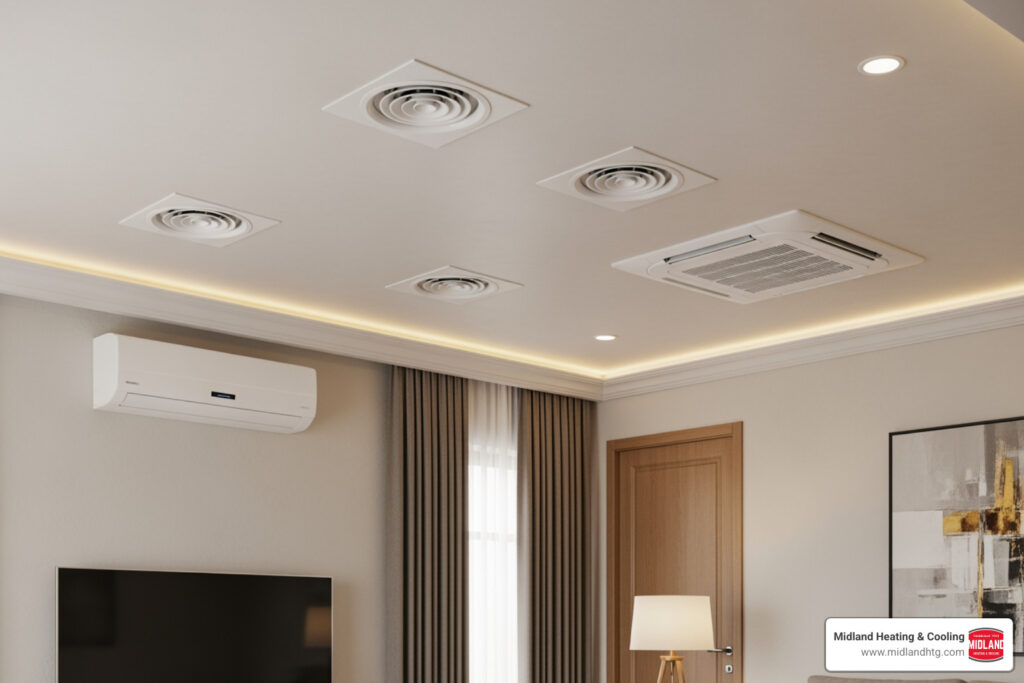
- Discreet Vents: Instead of large metal grilles, you’ll see small, round outlets about the size of a CD-ROM.
How high-velocity technology provides even temperatures in every room
One of the most common questions we hear is: “If the ducts are so small, how does the air actually cool the room?” The secret lies in a physics concept called the aspiration principle.
Traditional AC systems use the “diffusion method.” They “dump” cold air into a room, where it slowly sinks to the floor. This often creates “hot spots” near the ceiling and “cold spots” near the vents. High-velocity systems operate differently. By delivering air at nearly four times the velocity of traditional systems—about 200 CFM (cubic feet per minute) per ton—the air enters the room with enough force to create a gentle suction. This suction pulls the existing room air into the stream, creating a continuous mixing effect.
This air mixing ensures:
- Elimination of hot spots: No more walking from a freezing hallway into a stuffy bedroom.
- Consistent comfort: These systems typically maintain a temperature variance of no more than 2 degrees throughout the entire home.
- Rapid cooling: Because the air is moving faster and mixing better, the room reaches your desired temperature much quicker.
If you have struggled with poor air distribution in the past, you might find that Solving Airflow Problems With Ductless Ac or high-velocity systems provides the high-pressure delivery needed to finally achieve total home comfort.
Why homeowners in Minneapolis prefer small-duct systems over traditional AC
In a city like Minneapolis or St. Paul, where we take immense pride in our historic architecture, high-velocity systems are often the “gold standard” for retrofitting. If you live in a neighborhood like Edina or Wayzata with beautiful plaster walls and original woodwork, the thought of a contractor with a sledgehammer is enough to keep you using window units forever.
Here is how high-velocity compares to the traditional alternative:
| Comparison Factor | Traditional Central AC | High-Velocity (SDHV) |
|---|---|---|
| Duct Diameter | ~6 inches (plus 18″ trunk lines) | ~2 inches |
| Energy Loss | 25-40% due to leaks | Minimal (sealed, small-duct design) |
| Installation | Requires soffits/wall tear-outs | Snaked through existing spaces |
| Humidity Control | Standard | Up to 30% more moisture removal |
| Aesthetics | Large metal grilles | Small, discreet outlets |
Traditional HVAC duct systems are notorious for losing 25-40% of their energy through leaks and conduction. Because high-velocity ducts are smaller and easier to seal tightly, they are incredibly efficient. Furthermore, Central Air Installation In Historic Homes becomes a reality without compromising the home’s integrity.
While some homeowners also look into Ductless Ac Systems In Older Homes to avoid ductwork entirely, high-velocity remains the preferred choice for those who want the look of central air without the bulky wall-mounted units associated with ductless mini-splits. It offers maximum space optimization with minimal visual impact.
Keeping your system efficient: Maintenance tips for 2026 and beyond
As we move through 2026, energy efficiency is more than just a buzzword; it is a necessity. High-velocity systems are built to last, but they do require specific care to maintain that high-pressure airflow.
- Regular Filter Replacements: Because these systems rely on high static pressure, a clogged filter can significantly degrade performance. We recommend checking your filters every month, especially during the peak of a humid Minnesota summer.
- Inspect the Air Handler: Your air handler often uses an “Energy Smart Motor” with a variable frequency drive. Having a professional check these components annually ensures the system stays whisper-quiet and efficient.
- Duct Integrity: While these ducts are durable, it is important to ensure there are no sharp bends or obstructions that could interfere with the air velocity.
- Seasonal Inspections: Before the first heatwave hits the Twin Cities, have a technician verify the refrigerant levels and coil cleanliness.
For those with ductless or high-velocity setups, maintaining indoor air quality is a major benefit. These systems often utilize high-efficiency filtration that reduces dust and allergens through continuous air circulation.
Frequently Asked Questions
Is a high velocity air conditioning system noisy?
This is a common concern because “high velocity” sounds like it might be loud. However, when properly installed, these systems are incredibly quiet. We use specialized sound-attenuating tubing (often called “mufflers”) for the last few feet of the duct run. This sound-absorbing insulation, combined with vibration isolation at the air handler, allows the system to operate at noise levels below 45 decibels—about the same as a quiet library.
How does a high velocity air conditioning system handle humidity?
One of the biggest advantages of high-velocity technology is its dehumidification performance. These systems are capable of removing up to 30% more moisture than standard AC units. Because the air spends more time in contact with the cooling coils and is delivered via the aspiration method, it effectively pulls humidity out of the air. This makes your home feel cooler at higher temperatures, potentially allowing you to set your thermostat a few degrees higher and save on energy.
Can high-velocity systems be used for heating?
Absolutely. While many people think of them as cooling-only, high-velocity air handlers are very versatile. They can be integrated with hydronic coils (connected to your existing boiler) or paired with a heat pump for year-round climate control. This is a game-changer for Twin Cities winters, as it allows you to utilize the same discreet vents for both heating and cooling.
Conclusion
At Midland Heating & Cooling, we have spent over 70 years helping Twin Cities homeowners stay comfortable in every season. As a family-owned business with deep roots in Minneapolis, St. Paul, and surrounding areas like Minnetonka and Bloomington, we understand the unique challenges of our local architecture.
Whether you are looking to preserve a historic gem or simply want the most efficient, even cooling available in 2026, a high-velocity system is a powerful solution. Our certified technicians are experts in small-duct technology, ensuring 100% customer satisfaction from the first consultation to the final inspection.
Ready to upgrade your home’s comfort without the renovation headaches? Request a high-velocity system consultation in Minneapolis today and let us help you find the perfect fit for your home.