

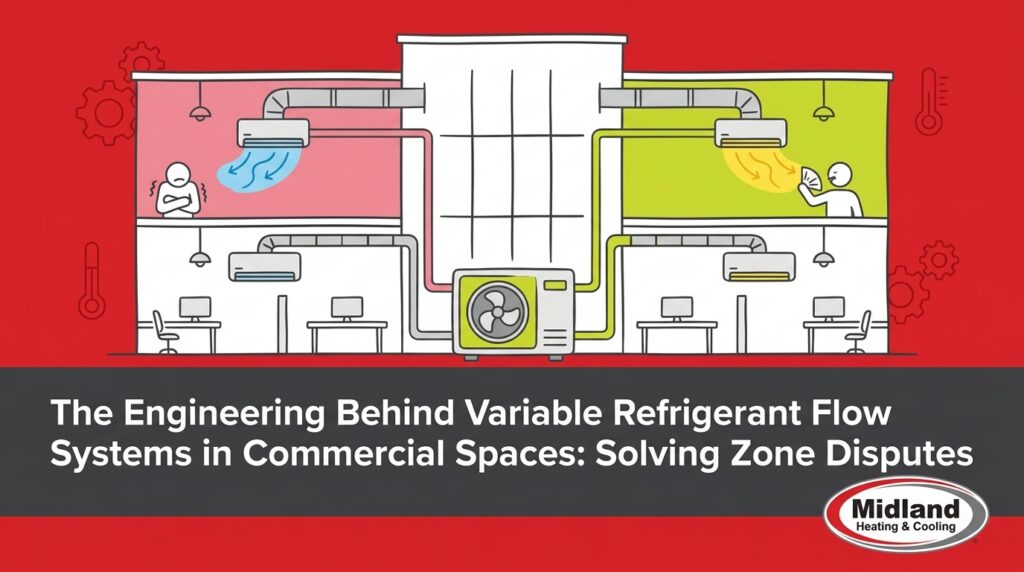
The Mechanics of the Multi-Tenant Climate Dispute
Your south-facing executive suites are sweltering under the peak July sun, yet your interior conference rooms feel like a refrigerator. Here at Midland Heating & Cooling, our commercial team fields calls every summer from facility managers fighting this same daily battle: the hot office/cold office complaint. Understanding the engineering behind variable refrigerant flow systems in commercial spaces is the first step toward definitively solving this issue. In our experience servicing St Louis Park MN commercial multi-tenant buildings, relying on outdated rooftop units to push a single temperature of air across drastically different thermal zones is a losing game. As a facility manager, you need a system that adapts to simultaneous, conflicting demands.
The underlying problem: Traditional commercial HVAC systems operate on a rigid, centralized model. They generate a massive amount of heated or cooled air and force it through extensive ductwork, using dampers to try and control the flow to different rooms. This brute-force method cannot account for the complex thermal dynamics of a modern office building. When the sun beats down on one side of the building, that specific zone requires intense cooling. Meanwhile, shaded interior zones with lower occupancy might actually need significantly less cooling or even slight thermal balancing to remain comfortable. A standard system simply cannot do both at the same time.
The engineering solution: Variable Refrigerant Flow (VRF) technology abandons the concept of moving massive volumes of conditioned air. Instead, it moves refrigerant directly to the specific zone that needs it. As highly technical commercial HVAC experts at Midland Heating & Cooling, we know that solving these complex multi-tenant climate control challenges requires a shift from brute-force air delivery to precise thermodynamic management. By utilizing advanced engineering principles, VRF systems treat each indoor unit as an independent climate zone, effectively ending the multi-tenant climate dispute once and for all.
Inverter-Driven Compressors and Partial Load Efficiency
The problem with traditional compressors: Standard commercial HVAC compressors operate on a simple binary principle: they are either 100% on or 100% off. When a zone calls for cooling, the compressor kicks on with a massive surge of electricity, blasts the space with maximum capacity until the thermostat is satisfied, and then abruptly shuts down. This constant cycling creates noticeable temperature swings, excessive wear and tear on mechanical components, and massive energy spikes.
The cause of the inefficiency: Buildings rarely need 100% of their HVAC capacity. For the vast majority of the year, a commercial space only requires a fraction of its total cooling power to maintain a setpoint. Traditional systems waste immense amounts of energy because they cannot scale their output to match this partial load.
The inverter solution: VRF systems utilize inverter-driven compressors, which are the mechanical heart of their efficiency. An inverter alters the frequency of the electrical current supplied to the compressor motor, allowing it to speed up or slow down smoothly. Instead of blasting at full capacity, an inverter compressor can modulate its output down to 10% or 20% to precisely match the exact thermal demand of the building.
During sweltering Minnesota summers with intense solar gain and fluctuating humidity, traditional systems short-cycle aggressively. An inverter compressor prevents this by continuously running at a low, steady speed, adjusting its RPMs in real-time as afternoon clouds pass or outdoor temperatures peak. This partial load efficiency drastically reduces energy consumption during heavy summer cooling demand.
Comparing Compressor Technologies
| Feature | Traditional Constant-Volume Compressor | VRF Inverter-Driven Compressor |
|---|---|---|
| Operation Mode | 100% On or 100% Off | Variable speeds (10% to 100% capacity) |
| Energy Consumption | High (massive amp draw on startup) | Low (smooth ramping eliminates startup spikes) |
| Temperature Control | Fluctuates 2-4 degrees around setpoint | Maintains exact setpoint (within 0.5 degrees) |
| Wear and Tear | High mechanical stress from constant cycling | Low mechanical stress due to continuous, low-speed operation |
The Thermodynamics of VRF Heat Recovery
When our technicians at Midland Heating & Cooling evaluate a struggling facility, we often look at the thermodynamics of heat recovery to truly understand how VRF solves climate disputes. There is a critical difference between standard VRF heat pumps and VRF heat recovery systems. A standard VRF heat pump can provide highly efficient cooling to a building, but it operates all zones in the same mode. If the system is in cooling mode, every indoor unit must cool.
VRF heat recovery systems, however, are engineered to provide simultaneous heating and cooling to different zones within the exact same building. This is where the thermodynamics become incredibly efficient, especially when cooling exterior offices while managing heavily air-conditioned interior server rooms.
The heat recovery process involves several key thermodynamic phases:
- Heat Absorption: Refrigerant travels to an indoor unit in a hot, sun-exposed office. As the liquid refrigerant evaporates into a gas, it absorbs the ambient heat from that room, effectively cooling the space.
- Thermal Redirection: Instead of pumping that absorbed heat all the way back to the outdoor condenser and dumping it into the atmosphere (which is what a traditional AC does), the system captures that thermal energy.
- Heat Deposition: The system routes that hot, high-pressure refrigerant gas directly to an indoor unit in a different zone that requires heating or thermal balancing—such as a shaded interior space. As the gas condenses back into a liquid, it releases the trapped heat into that space.
- Continuous Cycling: The newly condensed liquid refrigerant is then routed back to the cooling zones to absorb more heat, creating a continuous, highly efficient loop of thermal transfer.
Data from ASHRAE and the U.S. Department of Energy (DOE) consistently highlight the high simultaneous efficiencies of these systems. By recycling rejected heat rather than generating new energy from scratch, a VRF heat recovery system operates with unparalleled efficiency. In St Louis Park commercial multi-tenant buildings, where different businesses have vastly different operating hours and comfort preferences, this thermodynamic load balancing is the ultimate engineering solution.

Branch Controllers: The Brains Behind Simultaneous Zone Control
If the inverter compressor is the heart of a VRF system, the branch controller (BC) is the brain. The branch controller is a specialized mechanical box installed within the building’s infrastructure, sitting between the outdoor compressor unit and the various indoor air-handling units. Its sole purpose is to meter and direct the flow of refrigerant based on the real-time demands of every single thermostat in the facility.
Here is the mechanical sequence of how a branch controller eliminates the classic hot office/cold office dispute:
- Receiving the Refrigerant: The outdoor unit pumps a mixture of high-pressure liquid and high-pressure gas refrigerant to the branch controller.
- Phase Separation: Inside the branch controller, a gas-liquid separator uses gravity and centrifugal force to divide the refrigerant. The hot gas rises to the top, while the cooler liquid pools at the bottom.
- Demand Processing: The BC constantly communicates with the thermostats in every zone. It analyzes which rooms need heavy cooling, which need lighter balancing, and which are satisfied.
- Precision Routing: Using a complex series of electronic expansion valves and solenoid valves, the BC opens and closes microscopic pathways. It sends the hot gas to the indoor units calling for heat, and routes the cool liquid to the indoor units calling for air conditioning.
- Return and Recovery: After the refrigerant has done its job in the indoor units, it returns to the branch controller, where the BC mixes the returning phases and sends them back to the outdoor unit to complete the thermodynamic cycle.
Refrigerant Line Branching Mechanics
The engineering behind this routing depends on the specific manufacturer’s design, generally falling into two categories: 2-pipe and 3-pipe systems. In a 3-pipe system, the outdoor unit sends three distinct lines to the branch controller: a high-pressure gas line for heating, a low-pressure gas line for return, and a liquid line for cooling. The branch controller simply opens the appropriate valve to let the correct phase flow to the indoor unit.
In a 2-pipe system, the outdoor unit sends a mixture of high-pressure gas and liquid down a single supply pipe. The branch controller houses the phase separator that divides the gas and liquid on-site before distributing it to the zones. Both designs achieve the same result: precise, simultaneous climate control that easily manages extreme mid-July heatwaves where solar gain shifts dramatically from morning to afternoon.
Managing Solar Gain Disparities in Commercial Architecture
The architectural problem: Modern commercial buildings feature extensive glass facades. While aesthetically pleasing and great for natural light, commercial glass acts like a massive greenhouse during the peak of summer. By mid-July, the solar heat gain coefficient (SHGC) of your building’s envelope creates massive thermal disparities.
The cause of the disparity: As the sun moves across the sky, the thermal load on your building shifts dramatically. In the morning, east-facing offices absorb massive amounts of solar radiation and require heavy cooling. By 3:00 PM, the east side is shaded, but the south and west-facing zones are baking in the afternoon sun. All the while, interior hallways, windowless conference rooms, and server rooms have completely different, static thermal loads.
The VRF solution: VRF systems handle these extreme architectural disparities through dynamic load balancing. Because the inverter compressor can modulate its output and the branch controller can route refrigerant on a room-by-room basis, the system actively follows the sun load around the building.
Dynamic Load Profiling in Action
When the south-facing offices require maximum cooling load, the VRF system ramps up refrigerant flow specifically to those indoor units. The electronic expansion valves inside those specific units open wider, allowing more liquid refrigerant to evaporate and absorb the heavy solar heat.
Crucially, this happens without overcooling the interior zones. In a traditional VAV (Variable Air Volume) system, the main air handler would have to blast freezing air into the main trunk line to satisfy the hot offices, often causing the interior rooms to freeze in the process. VRF bypasses this entirely by only sending cooling capacity to the zones that actively request it. Our commercial installation teams at Midland Heating & Cooling have seen firsthand how this transforms tenant satisfaction. For St Louis Park commercial multi-tenant buildings, this means the architectural layout no longer dictates tenant comfort—the engineering of the HVAC system does.
Technical FAQs: VRF Engineering and Operations
How does a VRF system work in a commercial building?
A VRF system works by circulating refrigerant directly to individual indoor units rather than pushing air through large ductwork. An outdoor condenser connects to multiple indoor air handlers via small refrigerant pipes. The system uses an inverter-driven compressor to precisely vary the amount of refrigerant flowing to each zone based on its specific real-time temperature demand, providing highly efficient, localized climate control.
What is the difference between VRF heat pump and VRF heat recovery?
The core difference is that a VRF heat pump can only heat or cool a building at one time, while VRF heat recovery can do both simultaneously. Heat recovery systems use a branch controller to capture rejected heat from zones that are being cooled and route that thermal energy directly to zones that require heating, resulting in massive energy savings and customized comfort for every room.
Why is VRF so efficient?
VRF is highly efficient because it uses inverter compressors that modulate capacity to exactly match the building’s thermal load. Instead of turning on and off at 100% capacity like traditional systems, the compressor runs continuously at lower speeds, using only the precise amount of electricity needed. Additionally, eliminating large ductwork removes the energy losses associated with pushing air long distances.
How does VRF heat recovery solve uneven building temperatures?
It solves uneven temperatures by treating every indoor unit as an independent climate zone with its own thermostat. If a sun-facing office is too hot and an interior room is too cold, the system pulls heat out of the hot office and transfers it directly to the cold room. This thermodynamic balancing eliminates the classic hot office/cold office dispute entirely.
How do VRF branch controllers work?
Branch controllers work by acting as a mechanical traffic cop for refrigerant, separating liquid and gas phases to route heating or cooling on demand. Located between the outdoor unit and indoor units, the controller uses electronic solenoid valves to direct hot refrigerant gas to zones calling for heat, and cold liquid refrigerant to zones calling for air conditioning, enabling simultaneous multi-zone control.
Engineering a Definitive Solution for Facility Climate Control
Solving persistent tenant complaints requires more than just replacing an old rooftop unit with a newer version of the same outdated technology. It requires a fundamental shift in how you approach facility climate control. By understanding the underlying mechanics of VRF technology—from the partial load efficiency of inverter-driven compressors to the thermodynamic genius of branch controllers—you can easily justify the investment in a system upgrade.
VRF is not just a different type of air conditioner; it is a definitive engineering solution to the complex thermal dynamics of modern commercial architecture. In St Louis Park commercial multi-tenant buildings, where solar gain and shifting occupancy loads constantly battle against comfort, VRF provides the precise, adaptable control necessary to keep every tenant satisfied. If you are tired of fielding the same temperature complaints week after week, it is time to look at the engineering. At Midland Heating & Cooling, we encourage facility managers to explore their options and learn more about evaluating commercial HVAC bids to ensure your next system is engineered for long-term success.