

Why Verifying an HVAC Contractor License in Minnesota Matters Before You Hire
Knowing how to verify an HVAC contractor license in Minnesota could save you from a costly mistake. Here is the fastest way to check:
Quick Answer: How to Verify an HVAC Contractor License in Minnesota
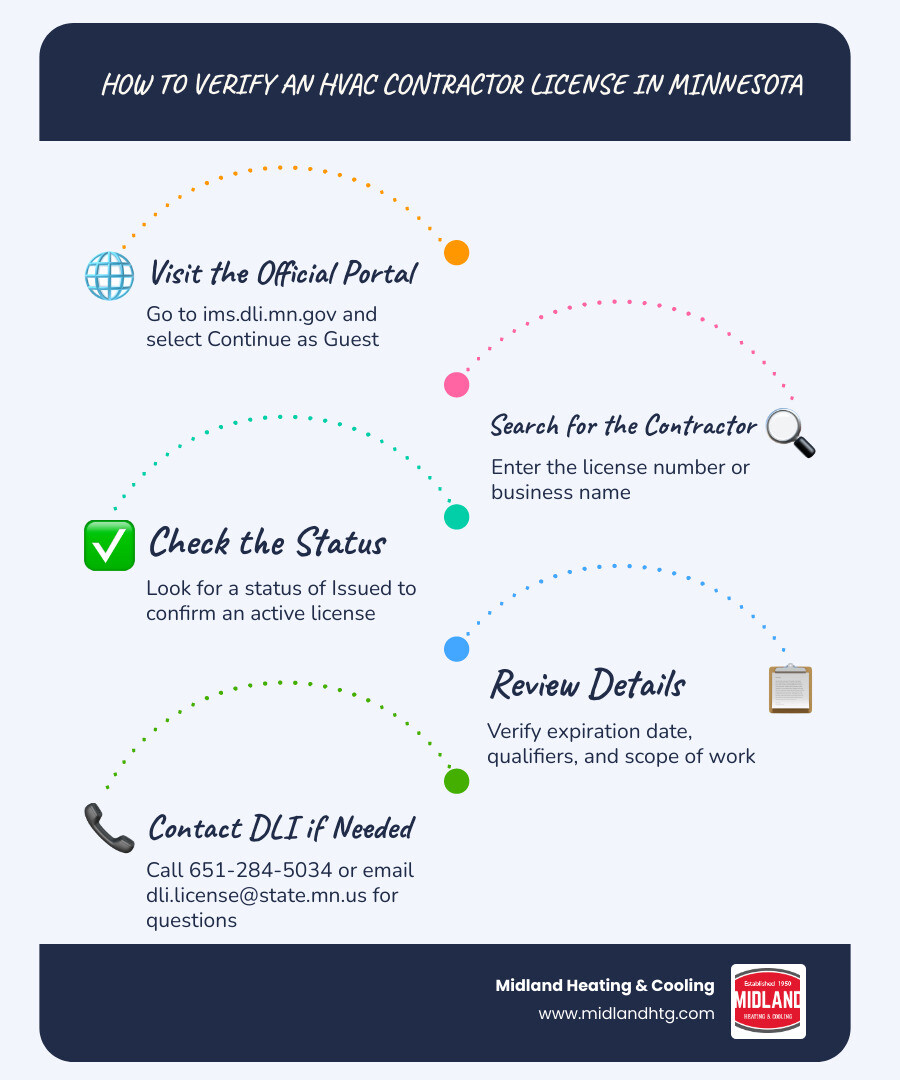
- Go to ims.dli.mn.gov
- Select “Continue as guest” — no account needed
- Enter the contractor’s license number or business name
- Look for a status of “Issued” to confirm an active license
- For questions, call the Construction Codes and Licensing Division at 651-284-5034 or email [email protected]
For Twin Cities homeowners with aging furnaces or boilers, the last thing you want is to hire the wrong person when your heat goes out in January. Minnesota requires HVAC contractors to hold a valid mechanical contractor license through the Minnesota Department of Labor and Industry (DLI), governed by Minnesota Statutes Chapter 326B. Without that credential, the contractor cannot legally pull permits — and unlicensed work can void your homeowner’s insurance, fail inspection, and put your family at risk.
About 2.7 out of every 10,000 Minnesota households have been victims of home improvement scams. A quick license check takes less than five minutes and is the single easiest way to protect yourself before anyone touches your heating system.
How to Verify an HVAC Contractor License in Minnesota Step by Step
If you want the official answer, always start with the Minnesota Department of Labor and Industry. DLI oversees license and registration records for many construction-related trades, and its iMS portal is the main public lookup tool.
The goal is simple: confirm that the contractor is actually authorized to do HVAC work, that the record is current, and that there are no obvious warning signs hiding in plain sight.
How to verify an hvac contractor license in minnesota using the official iMS lookup
The fastest official method is the iMS system at ims.dli.mn.gov. You do not need to create an account. That is one of the nicest parts of the process, because nobody wants to make a password just to check if a furnace installer is legit.
Here is the step-by-step process:
- Go to ims.dli.mn.gov
- Click Continue as guest
- Enter the contractor’s full license number if you have it
- If you do not have the number, search by business name
- Use the Search License/Registration holders option for more filters
- Open the record and review the status and license type
When reviewing the result, look for:
- Status listed as Issued
- The correct business name
- The right license or registration category for the work
- A valid expiration date
- Any visible enforcement or discipline information
If the contractor gave you a proposal, invoice, or business card, compare the name on that paperwork to the state record. Small mismatches can happen, but major differences should make you stop and ask questions.
How to verify an hvac contractor license in minnesota when you cannot find the contractor
If the search comes up empty, do not panic yet. Sometimes the issue is the search term, not the contractor.
Try these troubleshooting steps:
- Search with and without LLC, Inc., or Co.
- Try the legal business name instead of the marketing name
- Search by license number if the company gave one
- Use fewer words in the business name
- Double-check spelling
- Look for a registration instead of a license if the work scope is narrow
Minnesota also offers downloadable license data that is updated nightly. That can help if the portal search is being stubborn or if you want to filter records offline. The nightly update is useful because licensing records can change quickly.
If you still cannot find the contractor:
- Ask them for the exact license number
- Ask for the exact legal business name
- Contact DLI directly at 651-284-5034
- Email [email protected] for help interpreting the record
If a contractor gets defensive when you ask for a license number, that is not a great sign. A licensed contractor should expect this question. It is normal homeowner due diligence, not an insult.
What an active Minnesota HVAC license status means
In Minnesota’s iMS system, an active current license generally shows a status of Issued. That means the credential is active in the state system at the time you checked.
That does not mean you should stop reading after one green light. Also confirm:
- The license has not expired
- The business name matches the company you are hiring
- The license type fits HVAC work
- The record does not show enforcement problems relevant to your job
A current record means the contractor is authorized at that point in time. Because status can change, we recommend checking close to the date you sign a contract or authorize work.
What Licenses and Requirements Apply to HVAC Contractors in Minnesota
Minnesota treats HVAC work as mechanical work under state law. For homeowners, the key takeaway is that HVAC licensing is not just a generic contractor question. The scope matters.
A company replacing a furnace, installing ductwork, adding a heat pump, or handling larger HVAC system changes should have the proper mechanical licensing and permit authority required by the state and local jurisdiction.
Which state agency oversees HVAC contractor licensing in Minnesota
The main agency is the Minnesota Department of Labor and Industry, usually called DLI. Within DLI, the Construction Codes and Licensing Division handles licenses, bonds, certifications, and registrations.
Official resources include:
- iMS license lookup at ims.dli.mn.gov
- DLI’s broader license lookup directory
- Direct help from the Construction Codes and Licensing Division
Contact information:
- Phone: 651-284-5034
- Email: [email protected]
If you are unsure whether a contractor’s credential is enough for your project, DLI is the right place to ask.
HVAC license types or classes that may apply to the work
The exact credential can vary depending on the work being done, but common Minnesota HVAC-related categories include:
- Mechanical contractor business license
- Master mechanical qualifier
- Journeyman mechanical credential
- Refrigeration-related licensing for refrigeration-specific systems
- Other trade credentials if the project also involves electrical or plumbing work
For homeowners, the practical issue is scope matching. The license should fit the job.
Examples:
- Furnace replacement: mechanical contractor scope
- Central AC installation: mechanical contractor scope
- Heat pump installation: mechanical contractor scope
- Ductwork changes: mechanical contractor scope
- Refrigeration system work: may require refrigeration-specific authority
- Work involving gas piping or electrical changes: may involve additional licensed trades
Here is a simple comparison:
| Job Type | What to Verify |
|---|---|
| Residential furnace or AC replacement | Active mechanical contractor license, valid permit authority, insurance |
| Residential heat pump or ductwork project | Active mechanical contractor license, qualifier, permit handling |
| Commercial HVAC system work | Active mechanical contractor license, commercial permit compliance, proper scope |
| Refrigeration system installation or replacement | Mechanical authority plus any refrigeration-specific credential needed |
Minnesota research also points to an important distinction: businesses and individuals are not always the same thing in the licensing system. A business may need a licensed individual qualifier attached to it. In plain English, the company itself should be properly licensed, and the person qualifying that work should also hold the right credential.
Licensing requirements homeowners should understand before hiring
Before hiring any HVAC contractor in our Twin Cities service area, we recommend verifying these basics:
- The business has the proper Minnesota license or registration for the work
- The record is active, typically shown as Issued
- The contractor can pull the necessary permit
- The company carries liability insurance
- The company carries workers’ compensation coverage if required
- Any required bond is current
- The license type matches the actual project scope
Minnesota sources also note minimum liability coverage benchmarks often associated with contractor compliance:
- $100,000 per occurrence
- $300,000 aggregate
Those numbers are a useful baseline when you ask for proof of insurance.
What Else to Check Beyond the Basic License
A license check is step one, not the whole inspection. Think of it like checking whether your furnace has power. Important, yes. The whole diagnosis, no.
You should also verify insurance, bond status, enforcement history, permit handling, and whether the contractor’s scope matches the job in your home.
Check insurance, bond, and workers’ compensation before work begins
Ask for documentation before work starts, not after the equipment is already sitting in your driveway.
Here is what we recommend requesting:
- Certificate of general liability insurance
- Proof of workers’ compensation coverage if the contractor has employees
- Bond information if applicable
- Full legal business name
- License number
- Written contract showing the business identity and scope of work
A solid insurance review helps protect you if there is property damage or a jobsite injury. It also helps confirm that the business is operating like a real, accountable contractor and not just a pickup truck with a clever invoice template.
Review enforcement actions, complaints, and permit history
Minnesota’s license data can include enforcement actions, and that matters. An active license is good, but an active license with a troubling history deserves a closer look.
Review the record for:
- Enforcement or disciplinary actions
- Suspensions or revocations
- Repeated compliance issues
- Permit or inspection concerns
- A pattern of stop-work type problems
The downloadable state spreadsheet is updated nightly and may also help you review license-related actions. If you see something you do not understand, call DLI and ask for clarification.
For permit history, ask the contractor:
- Will you pull the permit?
- Which local jurisdiction will inspect the work?
- Who is listed on the permit application?
For HVAC replacement or installation work, permit handling should never sound vague. If someone says permits are unnecessary for equipment replacement, that is usually your cue to raise an eyebrow.
Confirm the license matches the job at your home
The contractor’s credential needs to match the work at your property. A company may be legitimate in one area but not properly qualified for another.
For example, these projects should align with mechanical HVAC authority:
- Furnace replacement
- Boiler replacement
- Air conditioner installation
- Heat pump installation
- Ductwork modification
- Major HVAC system alteration
This is also a good time to understand the actual scope of professional HVAC work. If you want a quick overview, see What an HVAC Technician Does.
And while state licensing is critical, qualifications beyond the license can still matter. Manufacturer training, EPA refrigerant credentials, and hands-on field experience are all useful extra checks for certain jobs.
Red Flags and Risks of Hiring an Unlicensed HVAC Contractor in Minnesota
Most homeowners do not plan to hire an unlicensed contractor. It usually happens because the warning signs are missed in a rush, especially during a no-heat emergency.
That is why a short verification process matters so much.
Warning signs that should make you pause
Watch for these red flags:
- No license number on the proposal or contract
- Refusal to provide the legal business name
- Pressure to skip permits
- Cash-only demands
- No written contract
- Vague promises about “taking care of it later”
- A business name that does not match the state record
- High-pressure sales tactics
- Claims that licensing is unnecessary for your project
One red flag alone may not prove a problem, but several together should make you walk away. Fast.
Why hiring unlicensed contractors can create bigger problems
In Minnesota, unlicensed contractors can face monetary fines of up to $10,000 per violation. That alone tells you the state takes compliance seriously.
For homeowners, the risks include:
- Failed inspections
- Permit denial
- Code violations
- Unsafe installation
- Poor workmanship
- Delays when the work has to be redone
- Insurance claim complications
- Reduced access to consumer protections
And with HVAC, the safety issues are not minor. Bad work can create combustion hazards, gas leak risks, ventilation problems, and even carbon monoxide dangers. This is not like hanging a crooked shelf. A bad HVAC install can affect your whole home’s safety and comfort.
Minnesota homeowners also face real scam risk. Research shows about 2.7 out of every 10,000 households in the state have been victims of home improvement scams. That is one more reason we always recommend verifying first and signing later.
Minnesota HVAC License Renewal, Residential vs Commercial Rules, and Where to Get Help
Even after you find a valid record, there are still a few practical questions to answer: how often licenses renew, whether residential and commercial rules differ, and where to go for official clarification.
How often Minnesota HVAC licenses need to be renewed
Minnesota contractor-related credentials commonly renew on a regular cycle, and the safest approach is to verify the status right before hiring. Do not rely on an old screenshot, an expired proposal, or “we’ve always used them.”
What matters most is the status on the date you check:
- Issued generally means active
- Expired means not currently valid
- A soon-to-expire record deserves a follow-up question
We recommend verifying again if:
- The project start date gets delayed
- The job will run for an extended period
- The contractor’s paperwork looks outdated
- You are signing weeks after receiving the estimate
A license that was active last month is not the same as one that is active today.
Are there separate residential versus commercial HVAC requirements
Yes, the rules can differ in practice even though both fall under Minnesota’s mechanical and building code framework.
Here is the simple version:
- State licensing still matters for both residential and commercial HVAC work
- Permit and inspection requirements can vary by local jurisdiction
- Some cities may have additional local licensing or registration requirements for certain work
- The project scope, building type, and equipment type affect what is required
For homeowners in our service region, local permit compliance matters just as much as state verification. That is especially true for work in cities like Bloomington, St. Louis Park, and Edina, where permit review and inspection expectations should be taken seriously.
If you are hiring for service in these areas, these local pages may help:
- Bloomington HVAC contractor services
- St. Louis Park HVAC contractor services
- Edina HVAC contractor services
The key takeaway is this: residential and commercial projects are not always interchangeable. A contractor should be able to explain the permit path and code requirements for your specific property type.
Where to contact Minnesota for license verification questions
If you need help confirming a record, interpreting a license status, or figuring out what credential applies to HVAC work, contact the Minnesota Department of Labor and Industry directly.
Construction Codes and Licensing Division:
- Phone: 651-284-5034
- Email: [email protected]
You can also start with the official iMS portal at ims.dli.mn.gov.
If you are ever unsure whether a record is valid, current, or appropriate for your project, ask DLI before work begins. It is much easier to make one phone call than to deal with a failed inspection after the fact.
Conclusion
Knowing how to verify an HVAC contractor license in Minnesota is one of the smartest steps you can take before scheduling a repair or replacement. In most cases, the process takes only a few minutes:
- Search the contractor in the Minnesota DLI iMS portal
- Confirm the status shows Issued
- Verify the license matches the work
- Check insurance, bond, and permit handling
- Review any enforcement history before signing
At Midland Heating & Cooling, we believe homeowners should feel confident about who is working in their home. If you want to learn more about the value of working with trained professionals, visit our page on Certified HVAC Technicians. You can also learn more about our team on our About Us page.
When in doubt, verify first. Your furnace, your home, and your peace of mind will thank you.