

How High-Velocity AC Works in Homes Without Traditional Ductwork
Understanding how does high velocity AC work in homes without ductwork starts with one key idea: instead of large metal ducts, a powerful air handler pushes conditioned air through slim, 2-inch flexible tubes that snake quietly through your walls, ceilings, and floors — no major demolition required.
Quick Answer: How High-Velocity AC Works Without Ductwork
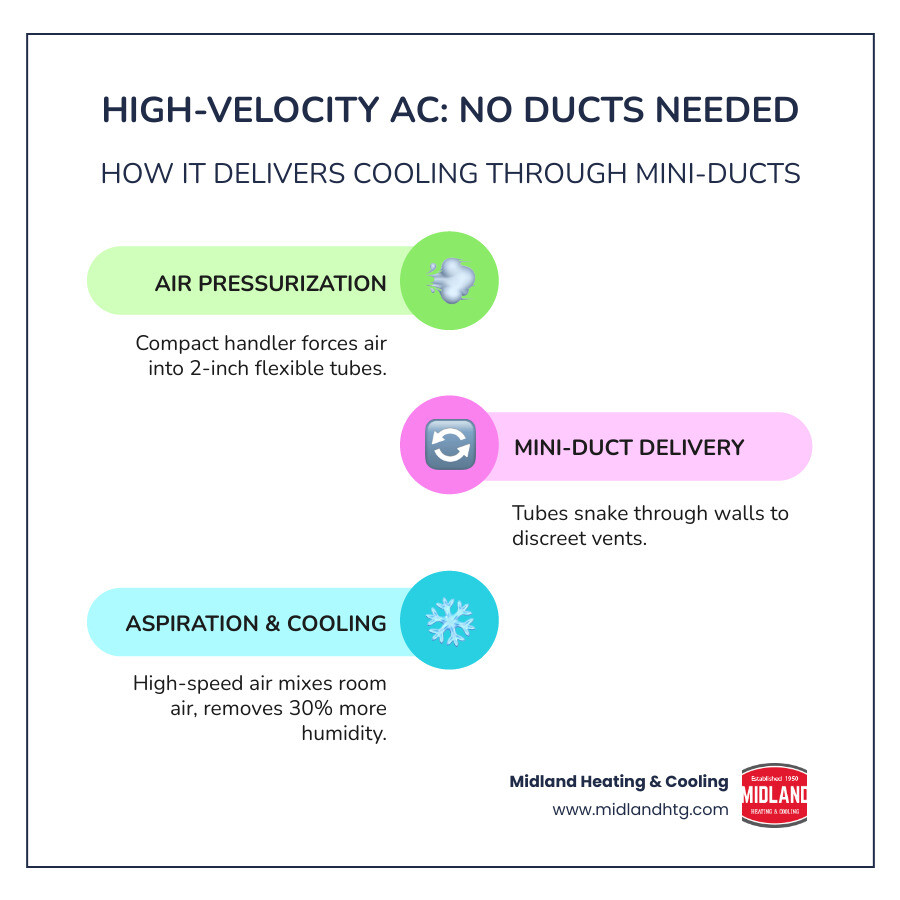
- A compact air handler (usually in an attic or closet) pressurizes conditioned air.
- That air travels through 2-inch flexible insulated tubing routed through existing wall cavities and floors.
- Air exits through small, discreet round vents — roughly the size of a CD — at four times the speed of traditional systems.
- The high-speed airflow creates an “aspiration” effect, pulling room air into the stream for even temperature distribution throughout every room.
- Because air moves faster and spends more time across the cooling coil, the system removes up to 30% more humidity than standard central air.
For Twin Cities homeowners living in older homes — the kind built long before central air conditioning was ever considered — this is a game-changer. Homes with plaster walls, radiant heat systems, or tight wall cavities simply cannot accommodate the bulky 6- to 8-inch metal ducts that traditional central AC requires. Until recently, that left most owners stuck choosing between window units or costly structural renovations.
High-velocity systems — also called small-duct high-velocity (SDHV) systems — change that equation entirely. They deliver whole-home comfort while preserving the architectural character that makes older Twin Cities homes worth protecting in the first place.
What is a High-Velocity AC System?
At its core, a High Velocity AC system is a specialized HVAC solution designed to provide central cooling in spaces where traditional ductwork won’t fit. While a standard system relies on large volumes of air moving slowly through wide metal trunks, a Small-Duct High-Velocity (SDHV) system uses the “pressure washer” principle: it moves a lower volume of air at a much higher speed.
The system consists of several specialized components. First, there is the blower-coil unit (the air handler). This unit is significantly more compact than a traditional furnace or air handler, often fitting easily into attics, crawl spaces, or even small closets in homes in Minneapolis or St. Paul.
The air handler connects to a main plenum, which is a small supply trunk (often only 7 to 9 inches in diameter). From this plenum, multiple 2-inch flexible tubes branch out. These tubes are insulated and lined to dampen sound. Finally, the air enters your rooms through small, circular outlets.
One of the most fascinating parts of this technology is the aspiration principle. Because the air exits the small vents at a high velocity, it creates a gentle pressure differential that pulls the existing room air into the stream. This creates a “mixing” effect that ensures the entire room reaches a consistent temperature, rather than just dumping a pool of cold air on the floor.
How does high velocity AC work in homes without ductwork?

When people ask, “how does high velocity ac work in homes without ductwork,” they are usually wondering how we get the cold air from point A to point B without tearing the house apart. The secret lies in the physics of pressurized airflow and the physical flexibility of the mini-ducts.
Standard ducts are rigid and require about 8 inches of depth to install. In contrast, high-velocity tubing is only 2 inches in diameter. This allows us to “fish” the lines through the same spaces where an electrician might run wiring. We can snake these tubes through wall cavities, under floorboards, and over ceilings without needing to build bulky soffits or drop ceilings that ruin the lines of a beautiful room.
Furthermore, these systems move air at roughly 4 times the velocity of traditional systems. While a standard AC might move 400 CFM (cubic feet per minute) per ton of cooling, a high-velocity system moves about 200 CFM per ton. Because the air is moving faster through a smaller aperture, it spends more time in contact with the cooling coils. This results in superior moisture removal — often reducing in-home humidity by up to 30% more than a standard unit.
How does high velocity AC work in homes without ductwork during a retrofit?
Retrofitting a home in St Louis Park requires a gentle touch. During a typical installation, we start by placing the compact air handler in an out-of-the-way location, such as an attic or a knee wall.
Once the main unit is set, we begin the process of snaking the flexible tubing. Because the tubes are so narrow, they can be routed through closets, behind walls, and between joists. This minimal demolition approach means we don’t have to disturb your home’s structural integrity. We often use “chases” like old chimney flues or the back corners of closets to move air between floors, ensuring that the system remains completely hidden from view.
How does high velocity AC work in homes without ductwork to maintain historic aesthetics?
For many of our neighbors in Minneapolis, the primary concern is the look of their home. Traditional AC vents are large, rectangular metal grates that can look out of place in a Victorian or Craftsman-style home.
Ductless AC systems for older homes offer various aesthetics, but high-velocity systems are arguably the most discreet. The air enters the room through small circular vents, often called “terminators.” These outlets are about the size of a CD and can be made of wood, plastic, or metal. Best of all, they are paintable or stainable to match your walls or ceilings exactly. This allows you to maintain your original plaster walls and intricate woodwork while enjoying modern, refrigerated air.
Key Advantages for Older Twin Cities Residences
Living in the Twin Cities means dealing with humid summers that can make 80 degrees feel like 95. High-velocity systems offer specific performance benefits that traditional systems struggle to match.
| Feature | High-Velocity SDHV | Traditional Central AC |
|---|---|---|
| Duct Diameter | 2 inches (flexible) | 6-8 inches (rigid) |
| Air Speed | High (Aspiration mixing) | Low (Diffusion) |
| Humidity Removal | Up to 30% more effective | Standard |
| Duct Energy Loss | < 5% (Sealed tubing) | 20-40% (Leakage) |
| Installation | Minimal demolition | Major renovation required |
| Aesthetics | Discreet 2″ round vents | Large rectangular registers |
When choosing a ductless AC system, it’s important to note that high-velocity systems excel at eliminating “hot spots.” In many older homes, the upstairs is significantly warmer than the downstairs. Because high-velocity air handlers are often installed in the attic, they take advantage of the natural physics of cooling: cold air falls. By pushing air from the top down and using aspiration to mix it, the system creates a uniform temperature from floor to ceiling.
Installation and Component Breakdown
If you decide to move forward with a ductless mini split in Minneapolis, you’ll see a different set of hardware, but for a high-velocity system, the components are uniquely engineered for pressure.
- Outdoor Condenser: This is similar to a standard AC unit. It sits outside your home and handles the heat exchange process.
- The Blower-Coil Unit: This is the heart of the system. It houses a high-pressure blower that can overcome the resistance of the small tubes.
- The Supply Plenum: A small, insulated trunk line that delivers air from the blower to the individual tubes.
- 2-Inch Insulated Flexible Tubing: These are the “veins” of the system. The last three feet of each run are usually sound-attenuating, which is a fancy way of saying they have a special lining that absorbs the sound of the rushing air.
- Return Air Paths: Just like any AC, the system needs to pull air back in. We usually install one or two central return vents in a hallway or ceiling to keep the air circulating.
Frequently Asked Questions about High-Velocity Cooling
Is a high-velocity system noisy?
This is a common concern. Because the air moves at high speeds, there is an audible “whoosh” or a sound similar to white noise near the vents. However, modern engineering has solved the “wind tunnel” problem. By using sound-attenuating tubing for the final stretch of the duct run, the sound is significantly muffled. Most homeowners find the sound to be a gentle, consistent background noise that is much quieter than a window unit or a rattling floor register.
Can these systems provide both heating and cooling?
Yes! While we often focus on the cooling aspect for those humid July days in Eden Prairie, high-velocity systems can be equipped with a heat pump or a hydronic heating coil. This allows the system to provide year-round comfort. In our Minnesota climate, many homeowners use the high-velocity system for cooling and supplemental heat, while keeping their existing boiler or radiant system for the deepest parts of winter.
What maintenance is required for small-duct systems?
Maintenance for a high-velocity system is very similar to a standard system. You will need to:
- Replace Filters: Depending on your home and pets, this should be done every 1–3 months.
- Annual Inspections: A certified technician should check the refrigerant levels and the blower motor once a year.
- Clean the Coils: Keeping the outdoor and indoor coils clean ensures the system runs at peak efficiency. Because the 2-inch tubes are sealed and pressurized, they are much less likely to accumulate dust and debris than large, leaky metal ducts.
Conclusion
Adding central air to a home without ductwork no longer requires a choice between comfort and character. By understanding how does high velocity ac work in homes without ductwork, you can see why so many Twin Cities residents are choosing this “invisible” cooling solution. Whether you are in a historic St. Paul Victorian or a cozy bungalow in Hopkins, high-velocity systems offer a way to stay cool while keeping your home’s original beauty intact.
At Midland Heating & Cooling, we have over 70 years of experience helping our neighbors in Minneapolis, St. Louis Park, Edina, and beyond. Our family-owned business is built on 100% customer satisfaction and the expertise of our certified technicians. We know the local architecture, and we know exactly how to keep it comfortable.
Ready to ditch the window units and enjoy whole-home cooling? Schedule your high-velocity consultation today and let us help you find the perfect fit for your home.