


Is Your Mini Split Not Heating Well in Cold Weather? Here’s What’s Going On
If your mini split not heating well in cold weather is leaving you shivering through a Twin Cities winter, you’re not alone — and in most cases, the fix is simpler than you might think.
Here are the most common reasons your mini split isn’t keeping up with the cold:
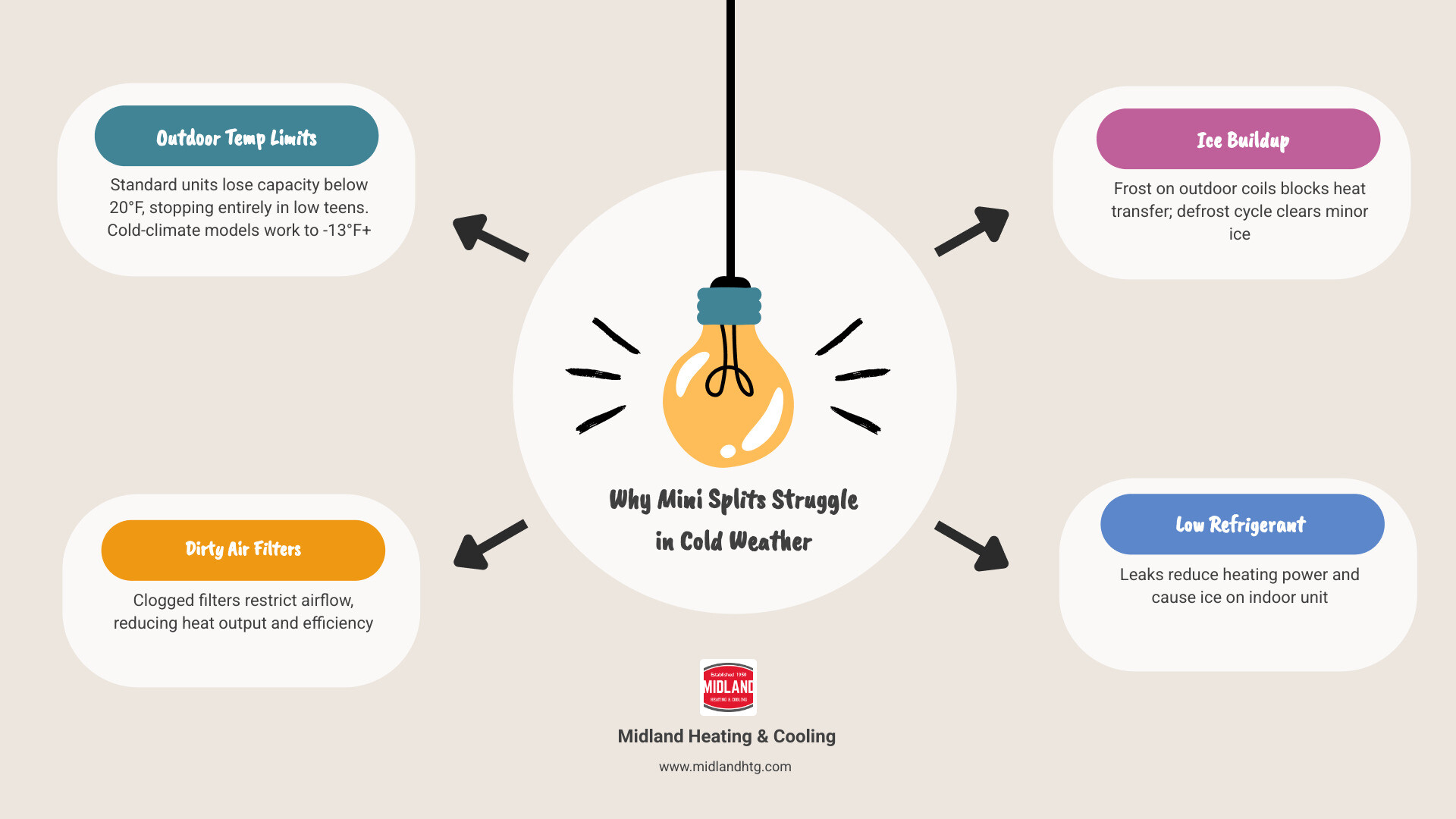
- Outdoor temperature limits – Standard mini splits lose heating capacity below 20°F and may stop working entirely in the low teens. Cold-climate models handle temps as low as -13°F or lower.
- Dirty air filters – Clogged filters block airflow and force the system to work harder with less output.
- Ice buildup on the outdoor unit – Frost on the coils restricts heat transfer. The defrost cycle handles minor frost, but heavy ice needs attention.
- Low refrigerant – A refrigerant leak causes reduced heating and can lead to ice forming on the indoor unit.
- Wrong thermostat settings – Running in “Auto” instead of “Heat” mode is a surprisingly common culprit.
- Sensor or component failure – Faulty sensors can cause the system to misread conditions and underperform.
About 75% of no-heat calls during winter come down to simple maintenance issues — not major equipment failure. That means there’s a good chance you can identify the problem before picking up the phone.
This guide walks you through everything: how mini splits work in cold weather, what’s normal behavior versus a real problem, and when it’s time to call in a professional.
Why Mini Splits Struggle in Extreme Cold
To understand why your mini split not heating well in cold weather is happening, we first have to look at how these systems actually work. Unlike a traditional furnace that burns gas to create fire and heat, a mini split is a heat pump. It doesn’t “make” heat; it moves it.
Even when it feels freezing outside in Minneapolis, there is still thermal energy in the air. Your outdoor unit uses refrigerant to absorb that heat and pump it indoors. However, as the temperature drops, two things happen:
- The Efficiency Curve: There is simply less heat available in the air to extract. As the mercury falls into the low 20s or teens, a standard unit has to work twice as hard to get half the result.
- Low-Ambient Limits: Every machine has a breaking point. Standard Heat Pumps are often rated to work efficiently down to about 5°F. Once you hit sub-zero temperatures, the physical properties of the refrigerant and the compressor’s ability to compress gas reach a limit.
In a Twin Cities January, a standard unit might “flatline,” meaning it’s running constantly but only producing lukewarm air. This is why understanding your unit’s outdoor temperature rating is vital. If you have an older system or a model not designed for northern climates, it may simply be physically incapable of keeping a room at 72°F when it’s -10°F outside.
Common Causes for a mini split not heating well in cold weather
When the performance drops, it’s easy to assume the whole system is “shot.” But before you panic, we need to look at the mechanical hurdles that winter throws at your equipment.
Many Common Heat Pump Operating Problems are exacerbated by the cold. For example, if your system has a tiny refrigerant leak, you might not notice it during a mild October. But when the system needs to run at 100% capacity in December, that low refrigerant level prevents the system from reaching the necessary pressures to create high-grade heat. You might see ice forming on the indoor unit or notice the air coming out of the vents feels more like a “cool breeze” than a “warm hug.”
Another major culprit is airflow. For a Ductless system to work, it needs to breathe. If the outdoor unit is choked by dead leaves, dog hair, or a wayward plastic bag, it can’t extract heat. Similarly, if your indoor sensors are blocked by furniture or dust, they might tell the system the room is warm when you’re actually freezing on the sofa.
Is your mini split not heating well in cold weather due to dirty filters?
We cannot stress this enough: your air filters are the lungs of your HVAC system. In the winter, your mini split is likely running almost constantly. This means it is pulling in dust, pet dander, and skin cells at an accelerated rate.
When a filter is clogged, the indoor blower fan has to fight against “airflow resistance.” This causes the indoor coil to overheat (since the heat isn’t being blown into the room), which can trigger the system to throttle down or shut off for safety. For the best performance in Ductless AC Minneapolis Minnesota applications, we recommend checking and cleaning your filters every 2 to 4 weeks during the peak heating season. It only takes five minutes to rinse them in the sink, but it can improve your heating output by 15% or more!
Troubleshooting a mini split not heating well in cold weather using thermostat settings
Sometimes the problem isn’t the machine; it’s the “brain” (the remote or wall controller). Here are three common settings that cause heating issues:
- The “Auto” Trap: Many homeowners set their system to “Auto” mode, thinking the system will figure it out. In Minnesota’s shoulder seasons, this can be a disaster. If sunlight hits the unit and warms it up, the system might switch to “Cool” mode in the middle of a 30-degree day! Always set your mode explicitly to the “Sun” icon (Heat mode).
- Fan Speed Optimization: While “Auto Fan” is great for efficiency, sometimes you need to manually set the fan to Medium or High to push that warm air down from the ceiling to where you are sitting.
- The Temperature Differential: Mini splits are designed to be “set it and forget it.” However, if the room feels cold, try setting the temperature 7-10°F higher than your desired temp for 20 minutes. This forces the inverter compressor to ramp up to its maximum speed, providing a quick burst of heat.
If you’ve checked the filters and the settings and you’re still cold, it might be time for Heater Repair Services Minneapolis to look for deeper electrical or sensor issues.
Understanding the Defrost Cycle and Normal Winter Operation
One of the most common “false alarms” we see is a homeowner calling because their mini split “stopped working and is blowing cold air” or “is smoking outside.”
In almost every case, this is just the Defrost Cycle.
When it is cold and humid outside, frost naturally forms on the outdoor coils. If that frost turns into ice, it blocks airflow and the system can’t heat. To fix this, the mini split temporarily reverses itself. It sends heat outside to melt the ice. During this 5-15 minute window:
- The indoor fan will stop or blow very slowly to avoid chilling you.
- You might see a blinking green light or an “H1” code on the display.
- You might hear a “whooshing” sound or a loud click (that’s the reversing valve shifting).
- You might see “smoke” coming off the outdoor unit. Don’t call the fire department! That’s just steam from the ice melting off the hot coils.
This is a normal part of Heat Pump Basics and Benefits Explained. If your unit does this once an hour during a snowstorm, it’s doing its job. However, if it stays in defrost for more than 30 minutes, or if the outdoor unit is a solid block of ice that won’t melt, you have a problem that requires a pro.
When to Upgrade to a Cold-Climate Mini Split System
If you are currently struggling with a mini split not heating well in cold weather, it might be because the unit wasn’t built for a Minnesota January. Older models (from 10-12 years ago) were often designed for mild climates like Japan or the southern US.
Modern “Cold-Climate” or “Hyper-Heat” models are a different breed. They use advanced inverter compressors and specialized refrigerants (like R-32) to maintain 100% of their heating capacity even when it’s 5°F outside. Some high-end models can continue extracting heat down to -13°F or even -25°F.
If you are looking for a Ductless Mini Split AC Minneapolis, here is how the performance generally breaks down:
| Feature | Standard Mini Split | Cold-Climate (Hyper-Heat) |
|---|---|---|
| Full Capacity Temp | 32°F to 40°F | 5°F to -5°F |
| Operating Limit | 5°F (Low efficiency) | -13°F to -25°F |
| Best Use Case | Garages / Shoulder Seasons | Primary Heat / Whole Home |
| Compressor Type | Single or Basic Inverter | High-Performance Inverter |
Upgrading to a cold-climate model means you won’t have to rely as heavily on expensive electric baseboard heat or wood stoves when the “Alberta Clipper” winds start blowing.
Preparing Your Ductless System for a Minnesota Winter
Prevention is the best cure. If you want to avoid your mini split not heating well in cold weather, you need to prep the “landing zone” for your outdoor unit.
In the Twin Cities, we get a lot of snow. If your outdoor unit is sitting on a plastic pad on the ground, it can quickly become buried. Once snow covers the intake, the system will suffocate and stop heating.
- Elevation is Key: We recommend mounting outdoor units on wall racks or elevated stands at least 18-24 inches off the ground.
- Clearance: Always maintain at least a 24-inch “no-fly zone” around the unit. Keep it clear of snow drifts, shrubs, and storage bins.
- The Drip Line: Never install a mini split directly under the “drip line” of your roof. Water from melting snow will drip onto the unit, freeze, and turn your expensive heater into a giant ice cube.
- Electrical Capacity: Mini splits are efficient, but they do pull a significant load when ramping up in the cold. While a single unit might run on a 100-amp service, if you are converting your whole home to Ductless AC Systems for Older Homes, we often recommend a 200-amp service upgrade to ensure your home’s electrical “backbone” can handle the winter demand.
Frequently Asked Questions about Mini Split Heating
Why is my mini split blowing cool air during the defrost cycle?
As we mentioned, the system has to move heat from the inside to the outside to melt ice. Most modern units will shut the indoor fan off entirely to prevent a “cold draft.” However, if the fan is still spinning, the air will feel cool (around 85°F), which is lower than your body temperature (98.6°F), making it feel like “cold” air even though it’s technically still warming the room slightly.
How much snow clearance does my outdoor unit need?
You should aim for at least two feet of clearance in every direction. If a blizzard dumps a drift against the unit, grab a broom (not a shovel, you don’t want to dent the fins!) and gently clear the area. Never use a tarp to cover the unit while it is in use; it needs to “breathe” to extract heat.
Can a mini split be the primary heat source in Minneapolis?
Yes, but only if it is a cold-climate rated model and sized correctly for the home’s “heat load.” In very old, drafty homes, we often recommend keeping your existing furnace as a backup for those rare nights when it hits -30°F. If your Furnace Not Heating is the reason you’re looking at mini splits, a dual-fuel setup is a fantastic way to stay comfortable year-round.
Conclusion
A mini split not heating well in cold weather can be frustrating, but it doesn’t always mean a costly repair is in your future. By keeping your filters clean, ensuring your outdoor unit is clear of snow, and understanding the “normal” quirks like defrost cycles, you can stay cozy all winter long.
At Midland Heating & Cooling, we’ve been the Twin Cities’ trusted HVAC experts for over 70 years. Whether you’re in St. Louis Park, Minneapolis, Edina, or Bloomington, our certified technicians are ready to help you optimize your ductless system for the harsh Minnesota climate.
Don’t let the next polar vortex catch you off guard. Schedule your Minneapolis mini split service today and experience the comfort of a system that’s truly ready for the cold!